

4 Understanding the similarity report
When you upload a draft to Turnitin, it produces a similarity report. This highlights parts of your work that are similar to other sources in its database.
Turnitin will show you where you’ve:
- missed a citation
- forgotten quotation marks
- copied wording accidentally and forgotten to identify it.
What to do: add the missing in-text citation or use quotation marks where needed. Make sure your reference list matches the sources you actually used.
You should be keeping an ongoing list of sources, or if you are using course materials you need to keep a note of the section, unit and week so that you can tell your reader where your source can be located.
Figure 5 shows part of a Turnitin report. In this example, 31% of this students word count has been matched to sources other than this assessment, such as webpages and course materials.
Number 1 is a match to another student's submission, number 2 is a 7% match to course materials and number 3 is a match to a webpage.
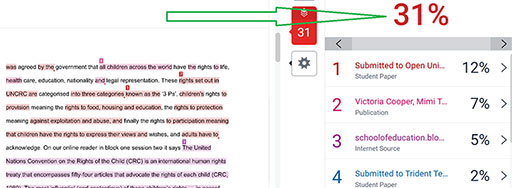
Remember, the similarity percentage is not a plagiarism score. The percentage score is a simple calculation between the assessment word count and the number of words that have been matched. For example, if the assessment word count is 1000 words and your match is 100 words, it will show on the Turnitin report as 10%. What matters is how you interpret the report. Here, we’ll break down how the report in Figure 5 could be interpreted and solutions you could take.
Number 1 has been highlighted in red and matches another student’s work that has previously been submitted to Turnitin. The student who is matched also studies with The Open University.
The problem: this section is poorly paraphrased.
The solution: try to use your own words and the three steps for easy paraphrasing (see Section 6 of course).
Number 2 is matched to the course materials, but it also contains the title of a document that is frequently cited in education, health and other courses at The Open University.
The problem: this section is not quoted and is not paraphrased and so it has been matched to content from the course materials.
The solution: this section should be identified as a direct quotation from the course materials even though the name of the policy document cannot be changed. There should be a citation for this section.
Number 3 is matched to an internet website which could be referenced and cited correctly. If the website has been acknowledged you won’t need to change anything in your work.
Now have a go at interpreting a Turnitin report yourself in Activity 1.
Activity 1 Interpreting a Turnitin report
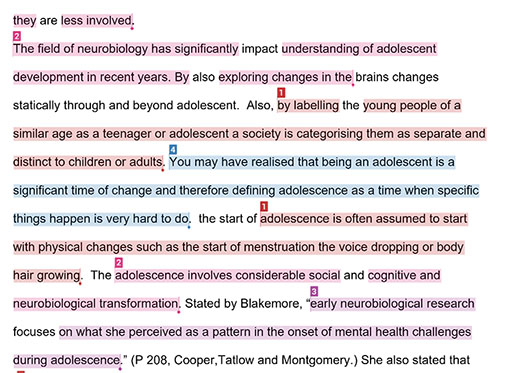
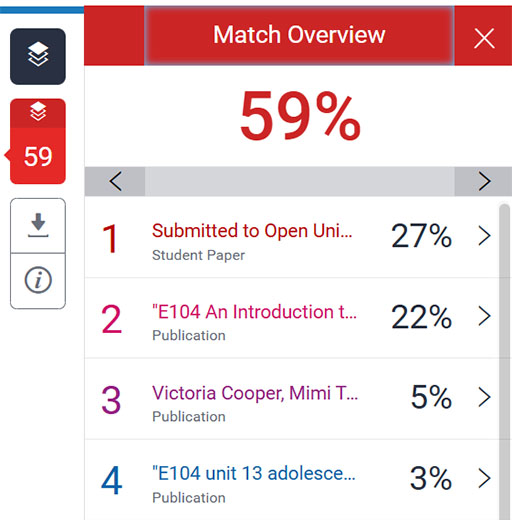
Look at Figures 6 and 7 which, combined, show a similarity report from Turnitin. Review each match and identify which you would need to correct and which are acceptable. What changes would you need to make?
Discussion
Number 1 has been highlighted in red and matches another student’s work that has previously been submitted to Turnitin. The student who is matched also studies with The Open University.
The problem: this section is poorly paraphrased course materials that multiple students have submitted.
The solution: try to use your own words and the three steps for easy paraphrasing (see Section 6 of course).
Number 2 (highlighted in pink) is matched directly to the course materials, but it also contains words and phrases that are not easily paraphrased. This happens with nouns and names.
The problem: this section is not quoted and is not paraphrased and so it has been matched to content from the course materials.
The solution: this section should be identified as a direct quotation from the course materials.
Number 3 (highlighted in purple) is matched to a chapter within the course materials and the textbook. It is cited and quoted correctly.
Number 4 (highlighted in blue) is a match to a chapter within the course.
The problem: this match is not quoted and there is not citation present despite it being copied word for word.
The solution: there must be acknowledgement that this is not unique text and therefore a citation is needed in text and a reference at the end of the assessment.