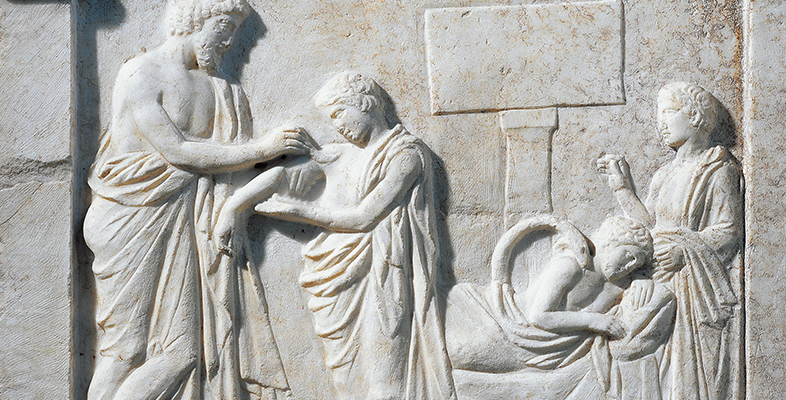
The ancient Greeks did not have a term equivalent to the English word ‘religion’. However, their world was populated by numerous figures they both recognised and worshipped as divinities. Among these figures was Amphiaraos, an ancient Greek hero who was later worshipped as a god and popularly associated with healing through the medium of dreams. But there was no sacred book (like those which exist in many religions today) which told the ancient Greeks what to believe about Amphiaraos or how to communicate with him. How, then, did people and communities know how to worship Amphiaraos?
In this course, you will explore this question by looking at textual and visual evidence relating to Amphiaraos’ sanctuary, which was located at a town called Oropos, in northeast Attica. You will engage with this material to learn about some of the different ways the ancient Greeks interacted with Amphiaraos, both individually and as part of their community.
This proved to be a very interesting course. Those coming to the course may assume greater coverage across the ancient Greek Gods, however the author elected to provide an in-depth case study on the 𝗰𝘂𝗹𝘁 𝗼𝗳 𝗔𝗺𝗽𝗵𝗶𝗮𝗿𝗮𝗼𝘀 𝗮𝘁 𝗢𝗿𝗼𝗽𝗼𝘀. It came as a surprise to note that the Greeks did not have formal sacred texts to define beliefs and religious practices. The distinction between ‘personal’ and ‘polis’ religion was also of special interest. The concept of incubation within the sanctuary to gain healing is presumably not a practice that would gain too many adherents these days!
It was greatly appreciated that there were no broken links and that all included figures were of the correct resolution; unfortunately, this is unusual for OpenLearn courses.
Just 2 miscellaneous points (such a small number is also very unusual) and a few potentially useful URLs:
1) “View description” and “View alternative description” for each figure are the same.
2) There seems to be a lack of consensus as to the interval between the 𝗚𝗿𝗲𝗮𝘁 𝗔𝗺𝗽𝗵𝗶𝗮𝗿𝗮𝗶𝗮 (4,5 or 4-6 years)?
4.4 Competing traditions: Athens and Oropos Activity 9
"The … quadrennial festival for Amphiaraos [i.e. the Great Amphiaraia, which occurred every four years]"
"it is likely that the festival is celebrated every 4 years"
https://www.open.edu/openlearn/history-the-arts/classical-studies-festivals
https://www.youtube.com/watch?v=CEKWLz9EqB0
"often this involved overhauling Amphiaraos’ penteteric festival known as the Great Amphiaraia"
https://brill.com/display/book/9789004472587/BP000001.xml
"At the Amphiareion, in addition to the presumed annual festival, Greater Amphiareia were celebrated in an agonistic festival of athletic games, every fifth year."
https://en.wikipedia.org/wiki/Amphiareion_of_Oropos
"…quadrennial festival (occuring every 4-6 years)"
https://warwick.ac.uk/fac/arts/classics/intranets/students/modules/greekreligion/database/clunbg/
I really enjoyed this course. It shows in an accessible way how different types of sources, such as inscriptions, objects, and ancient texts, are used to understand religious life in the past. The course is well structured and easy to follow, and it helps think more clearly about how objects and inscriptions can tell us about the past. I had already read about incubation practices in the abaton of Asklepios, but this course helped me learn much more about similar practices in a different cult.
It was greatly appreciated that there were no broken links and that all included figures were of the correct resolution; unfortunately, this is unusual for OpenLearn courses.
Just 2 miscellaneous points (such a small number is also very unusual) and a few potentially useful URLs:
1) “View description” and “View alternative description” for each figure are the same.
2) There seems to be a lack of consensus as to the interval between the 𝗚𝗿𝗲𝗮𝘁 𝗔𝗺𝗽𝗵𝗶𝗮𝗿𝗮𝗶𝗮 (4,5 or 4-6 years)?
4.4 Competing traditions: Athens and Oropos Activity 9
"The … quadrennial festival for Amphiaraos [i.e. the Great Amphiaraia, which occurred every four years]"
"it is likely that the festival is celebrated every 4 years"
https://www.open.edu/openlearn/history-the-arts/classical-studies-festivals
https://www.youtube.com/watch?v=CEKWLz9EqB0
"often this involved overhauling Amphiaraos’ penteteric festival known as the Great Amphiaraia"
https://brill.com/display/book/9789004472587/BP000001.xml
"At the Amphiareion, in addition to the presumed annual festival, Greater Amphiareia were celebrated in an agonistic festival of athletic games, every fifth year."
https://en.wikipedia.org/wiki/Amphiareion_of_Oropos
"…quadrennial festival (occuring every 4-6 years)"
https://warwick.ac.uk/fac/arts/classics/intranets/students/modules/greekreligion/database/clunbg/
3) The following links may be of interest:
https://brill.com/display/title/55344
https://warwick.ac.uk/fac/arts/classics/intranets/students/modules/greekreligion/database/clunbg/
https://en.wikipedia.org/wiki/Ancient_Greek_religion
https://nembutsu.cc/2020/01/26/whatever-happened-to-the-ancient-greek-religion/