
For many Open University students, that moment arrives after a busy day at work, caring responsibilities, family commitments or community activities. Unlike the stereotypical full-time campus student, OU learners often study alongside the realities of adult life. So when generative artificial intelligence (GenAI) tools such as ChatGPT, Copilot and Gemini appeared, an important question emerged: how are students actually using them when preparing assignments? What academic skills and knowledge are at play in their use of GenAI?
To find out, a small project team from The Open University invited students in the School of Education, Childhood, Youth and Sport to share their personal stories about GenAI and their use of it in assignments, known at The Open University as Tutor Marked Assignments (or TMAs). Ninety-two students responded, offering remarkably honest reflections about their learning practices, hopes, concerns and ethical dilemmas.
The results challenge many popular assumptions. Read on to find out!
Not a story of AI doing the work
Perhaps the biggest surprise is that most students were not using GenAI to write assignments for them. Instead, many described using it as a learning companion, study coach or proofreading assistant. Students reported using AI to:
- simplify complex concepts
- explain assignment questions in clearer language
- help create study plans and essay structures
- improve grammar, spelling and punctuation
- check referencing and citations
- identify gaps, repetition or unclear arguments
- manage word counts and organise ideas.
One student compared AI to ‘someone you can bounce ideas off,’ while another described it as a tool that helps turn confusion into understanding. Others used it to gain feedback on draft work without asking it to rewrite their assignments.
These accounts suggest that, for many learners, GenAI is less about replacing thinking and more about supporting their academic thinking skills.
The confidence factor
A recurring theme throughout the responses was confidence. Several students explained that AI helped them overcome uncertainty, particularly when returning to education after a long break. Others said it helped them understand academic language, create essay plans or express ideas more clearly.
For students with disabilities, learning differences or English as an additional language, AI appeared to provide valuable support. One student with ADHD and fibromyalgia described using speech-to-text and AI-assisted organisation tools to manage studying during challenging circumstances. Another student said GenAI helped them achieve a more polished academic writing style while ensuring the ideas remained their own.
In these examples, AI functioned less as a shortcut and more as an accessibility aid.
Not everyone is convinced
Yet the survey also revealed strong resistance. Many respondents stated that they never use GenAI and have no intention of doing so. Their reasons varied, but common concerns included trust, accuracy, environmental impact and the fear that AI undermines genuine learning.
Some students worried that AI-generated information can be inaccurate or fabricated. Others felt that relying on AI would prevent them from developing their own skills and understanding.
One respondent summed-up a widely shared concern: ‘If education is about learning, what happens when technology begins to do too much of the thinking?’ How’s that for insightful and reflective critical thinking, you might ask!
For these students, avoiding AI was not a technological issue but a values-based choice. They viewed independent study, critical thinking and personal effort as central to the university experience.
Walking the ethical tightrope
Perhaps the most fascinating finding was how many students occupied the middle ground. These learners were neither enthusiastic adopters nor outright opponents. Instead, they described carefully negotiated boundaries.
Many said they were comfortable using AI for proofreading but not content generation. Others used it to locate research papers more efficiently but insisted on reading and evaluating sources themselves. Several students openly admitted feeling uncertain about what constitutes acceptable use. Perhaps, therein lies a big challenge for universities worldwide as this uncertainty points to an important reality. The challenge is no longer simply whether students use AI. The real question is how they use it, and where they draw the line between support and substitution.
A new learning partner?
The survey responses paint a picture that is far more nuanced than the headlines often suggest. Among these Open University students, GenAI was rarely portrayed as an academic ghostwriter. Instead, it appeared as a tool used for clarification, organisation, feedback and confidence-building. At the same time, many students remained deeply cautious, questioning its reliability and its impact on learning, creativity and academic integrity.
What emerges is a portrait of thoughtful learners actively grappling with a rapidly changing educational landscape.
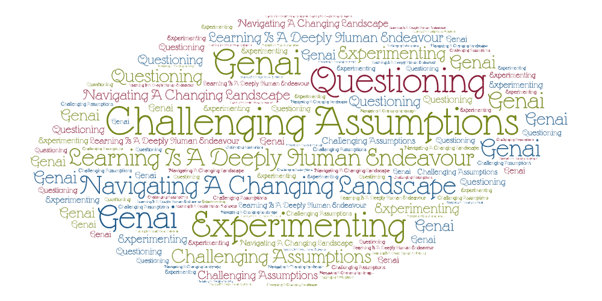
As AI becomes increasingly embedded in everyday life, students are not simply accepting or rejecting it. They are experimenting, questioning, adapting and defining their own ethical boundaries. The conversations captured in these 92 stories remind us that the future of education will not be shaped by technology alone. It will be shaped by the choices learners make about how they use it.
And perhaps that is the most important lesson of all. In a world of increasingly powerful AI, learning remains a deeply human endeavour.
Discover more content like this
-
AI Hub
Learn more to access more details of AI HubWelcome to the AI Hub from Microsoft and The Open University. Explore free, accessible courses designed to build your confidence and skills in artificial intelligence. Whether you’re just starting out or looking to deepen your knowledge, the AI Hub supports your learning journey with expert-led, trusted, easy to-use resources.

-
Artificial intelligence: implications for social work writing
Read now to access more details of Artificial intelligence: implications for social work writingFrom case notes and formal reports to basic emails, a crucial but time-consuming part of a social worker’s job is writing. Dr Gillian Ferguson and Dr Maria Leedham look at the opportunities and drawbacks of implementing artificial intelligence into the role.

-
Academic versus AI
Read now to access more details of Academic versus AIWe wondered how easy it was to tell the difference between the work of a real-life human, and a machine… so you tell us!

Study a free course
-
AI fluency
Learn more to access more details of AI fluencyAI fluency is a beginner-friendly learning path designed to build confidence and understanding in artificial intelligence. Through a series of practical sessions, learners explore AI fundamentals, generative AI, responsible AI principles, and the real world impact of AI across work, accessibility, and society. The course also introduces ...

-
An introduction to artificial intelligence
Learn more to access more details of An introduction to artificial intelligenceArtificial Intelligence represents great opportunity, but also significant disruption for modern societies and cultures. This course investigates the historical, ethical and social issues surrounding this technology. It is aimed at people interested in understanding where this technology has come from, the kinds of opportunities it brings to ...

-
Digital thinking tools for better decision making
Learn more to access more details of Digital thinking tools for better decision makingEver since the very beginning of humanity, tools have played a pivotal role in who we are and what we do. Tools for recording, processing and communicating information have a time-honoured history – from the clay tokens used in Mesopotamia to mechanical calculating machines. The invention of the digital computer has boosted the scale, speed and ...

Study our short courses
-
Generative AI in education
Learn more to access more details of Generative AI in educationGenerative AI is reshaping how we teach, learn and work, making it essential for educators to understand its impact, harness its benefits and manage its risks. This short course outlines current thinking on how to utilise this technology effectively in teaching and learning. You’ll explore key themes that help you make the most of what GenAI ...

-
Teaching languages and cultures with AI
Learn more to access more details of Teaching languages and cultures with AIDiscover how to use Generative AI (GenAI) in education through this hands-on short course, endorsed by Professor Mike Sharples, Emeritus Professor at The Open University's Institute of Educational Technology. Drawing on examples from language and culture teaching, you’ll investigate GenAI’s practical uses as well as the opportunities and ...

Rate and Review
Rate this article
Review this article
Log into OpenLearn to leave reviews and join in the conversation.
Article reviews
LLMs are reasonably good at analysing text and may be able to do so in a more sophisticated way than many learners can. An LLM can therefore be asked about a writer's emphases in order to surface those issues that are important in any given topic and perhaps which are more likely to be assessed but which the reader / student may have missed.