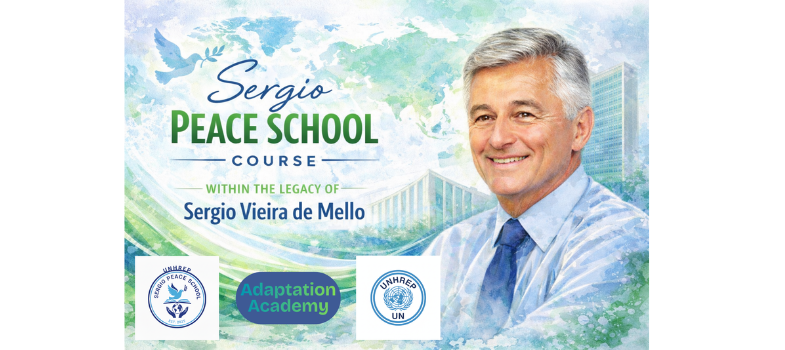
Course Conclusion: Integrating Peace, Human Rights, Climate Action, and Global Citizenship
Throughout this course at the Sergio Peace School, students have engaged with a comprehensive curriculum designed to integrate peacebuilding, human rights advocacy, climate resilience, ethical leadership, and innovative technology. The modules have built upon one another to provide both theoretical frameworks and practical applications for fostering sustainable peace and global cooperation.
Module 1 introduced foundational concepts of peace and human rights, highlighting the ethical responsibilities of global citizens. Students examined historical and contemporary case studies, such as East Timor, Syria, and Sub-Saharan Africa, to understand how human rights advocacy intersects with diplomacy and climate resilience (Bellamy, 2015; Nordås & Gleditsch, 2007; Kingsbury, 2009). Through reflection and critical analysis, participants explored their personal motivations for contributing to global peace, emphasizing the interconnectedness of human dignity, social justice, and environmental stewardship.
Module 2 expanded upon these foundations by focusing on climate resilience and ethical diplomacy. Students analyzed data demonstrating how drought, resource scarcity, and post-conflict reconstruction affect human security and governance outcomes (UNDP, 2020; Adams et al., 2018). The module emphasized the role of evidence-based interventions, such as early-warning systems, community engagement, and participatory governance, in reducing conflicts while promoting sustainable development. By linking climate adaptation to human rights and international cooperation, learners were encouraged to approach global challenges holistically.
Module 3 highlighted the relationship between human rights, climate policy, and global citizenship. Students examined quantitative and qualitative metrics to evaluate the effectiveness of climate adaptation strategies, community participation, and governance reforms (UNHRC, 2018; UNDP, 2020). Case studies illustrated that vulnerability to climate-related disasters disproportionately impacts marginalized populations, underscoring the ethical imperative of inclusive, participatory interventions. By analyzing these dynamics, students learned to design solutions that integrate ethical principles, policy instruments, and collaborative engagement.
Module 4 explored the transformative potential of technology and innovation in peacebuilding and climate resilience. Students examined the application of artificial intelligence, GIS mapping, mobile-based early-warning systems, and renewable energy technologies to support humanitarian and environmental objectives (Adams et al., 2018; UNDP, 2020). Data demonstrated that technology, when paired with strong governance and ethical oversight, enhances the efficiency, transparency, and sustainability of interventions. This module reinforced the importance of context-sensitive innovation in addressing complex global challenges.
Module 5 emphasized leadership, ethics, and collaborative governance. Students studied the impact of ethical leadership on conflict reduction, human rights compliance, and climate adaptation outcomes (Kingsbury, 2009; Nordås & Gleditsch, 2007). Data from East Timor, Sub-Saharan Africa, and Syria illustrated that capacity-building for leaders, participatory decision-making, and grievance-resolution mechanisms significantly improve social cohesion and community resilience. The module highlighted the interplay between ethical responsibility, decision-making, and the practical implementation of sustainable peace initiatives.
Finally, Module 6 integrated the knowledge from previous modules into holistic strategies for sustainable peace and climate action. Students synthesized insights from case studies, quantitative metrics, and governance models to design multi-dimensional interventions that simultaneously address conflict, human rights, climate vulnerability, and community empowerment (UNFCCC, 2022; UNHCR, 2023). This capstone module reinforced the course’s central premise: sustainable peace requires interconnected approaches that consider environmental, social, and political dimensions while prioritizing human dignity and ethical leadership.
In conclusion, the Sergio Peace School curriculum equips students with the analytical tools, practical knowledge, and ethical grounding necessary to navigate complex global challenges. By integrating lessons on human rights, climate adaptation, governance, technology, and leadership, the course fosters critical thinking, collaborative problem-solving, and a deep commitment to global citizenship. Students are now prepared to apply these principles in academic, professional, and community contexts, contributing to a world where peace, sustainability, and justice are mutually reinforced (Vieira de Mello, 2002).
References (selected for in-text citations)
-
Adams, R., et al. (2018). Community-Based Climate Adaptation in Africa. UNDP.
-
Bellamy, A. J. (2015). Syria: Humanitarian Response and Conflict Management. Global Policy.
-
Kingsbury, D. (2009). Post-Conflict Governance in East Timor. Routledge.
-
Nordås, R., & Gleditsch, N. (2007). Climate Change and Conflict in Africa. Journal of Peace Research, 44(1), 57–71.
-
UNDP. (2020). Climate and Conflict: Data and Metrics. United Nations Development Programme.
-
UNFCCC. (2022). National Adaptation Plans: Global Progress.
-
UNHRC. (2018). Human Rights Compliance and Governance Metrics.
-
UNHCR. (2023). Global Displacement Data Portal.
-
Vieira de Mello, S. (2002). Peacebuilding and Human Dignity: Lessons from Practice. United Nations Publications.