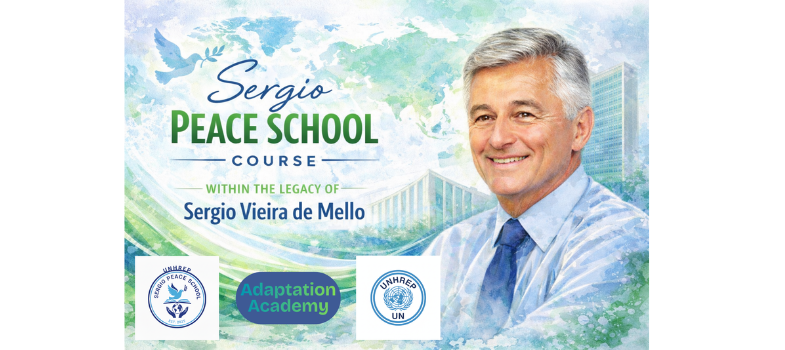
Module 0: Welcome to Global Peacecraft
Welcome to Global Peacecraft: Human Rights, Climate Resilience, and Ethical Diplomacy! This opening module introduces students to the mission, vision, and ethos of Sergio Peace School, drawing inspiration from the life and work of Sérgio Vieira de Mello. Students will explore the fundamental concepts of peacebuilding, human rights advocacy, and climate resilience, setting the stage for advanced studies in ethical diplomacy and global problem-solving.
Learning Objectives:
By the end of this module, students will be able to:
-
Articulate the core mission and values of Sergio Peace School.
-
Explain the legacy of Sérgio Vieira de Mello in promoting peace, human dignity, and global cooperation.
-
Identify key interconnections between human rights, climate adaptation, and international peacebuilding.
-
Reflect on personal motivations for contributing to global peace and sustainability.
-
Navigate the course platform and resources effectively for collaborative and independent learning.
1. Understanding the Mission and Values of Sergio Peace School
At its core, Sergio Peace School is dedicated to cultivating ethical, informed, and compassionate leaders who are equipped to address the complex challenges facing our world today. The school’s mission goes beyond traditional diplomacy or conflict resolution; it integrates peace education with human rights advocacy and climate resilience, recognizing that these domains are inseparably linked.
The values of Sergio Peace School include:
-
Human dignity: Recognizing the intrinsic value of every individual, regardless of nationality, ethnicity, religion, or social status.
-
Ethical leadership: Promoting integrity, empathy, and responsibility in global decision-making.
-
Sustainability and environmental stewardship: Understanding that protecting our planet is essential for lasting peace and human flourishing.
-
Global cooperation: Encouraging collaboration across borders, cultures, and disciplines to solve shared challenges.
As students in this program, you are invited to reflect on these values and consider how they align with your personal vision and goals. Understanding and internalizing these principles will provide a foundation for the practical skills and knowledge you will develop in subsequent modules.
2. The Legacy of Sérgio Vieira de Mello
Sérgio Vieira de Mello was a Brazilian diplomat whose work with the United Nations profoundly shaped contemporary approaches to peacebuilding and human rights advocacy. His career was defined by tireless dedication to protecting human dignity, facilitating dialogue in conflict zones, and promoting sustainable solutions for vulnerable communities.
Sérgio believed that peace was not simply the absence of conflict, but the active cultivation of justice, dignity, and opportunity for all. His work spanned multiple continents and crises, including missions in East Timor, Kosovo, and Iraq, demonstrating an unwavering commitment to global cooperation. By studying his life, students learn how ethical diplomacy and human-centered approaches can transform fragile situations into opportunities for lasting stability.
Reflect on Sérgio’s philosophy: peace requires courage, patience, and creativity. It also demands a recognition of our shared responsibility to each other and to the environment. His legacy serves as both inspiration and a guidepost for your own journey in this course.
3. Interconnections Between Human Rights, Climate Adaptation, and Peacebuilding
Modern peacebuilding cannot be understood in isolation from human rights and climate change. These elements are deeply interconnected: violations of human rights often exacerbate conflict, while environmental degradation and climate crises can intensify social and political tensions. Conversely, addressing these challenges holistically can create pathways toward sustainable peace.
For example:
-
Communities facing water scarcity due to climate change may experience increased conflict over resources. Addressing both environmental adaptation and human rights protections can prevent escalation.
-
Climate-related displacement often results in human rights vulnerabilities, requiring coordinated international interventions rooted in diplomacy and justice.
-
Advocacy for education, health, and gender equity strengthens societal resilience, which in turn reduces susceptibility to conflict.
Through this module, you will begin to explore case studies and real-world examples demonstrating how integrated approaches can promote both human rights and sustainable peace. By understanding these interconnections, you will be better equipped to analyze complex challenges and design innovative solutions.
4. Reflecting on Your Personal Role
An essential component of Module 0 is reflection. As future leaders, you must understand your motivations for engaging in peacebuilding and sustainability. Take time to consider:
-
What inspires you to contribute to global peace?
-
Which human rights or environmental issues resonate most deeply with you?
-
How can your skills, knowledge, and values create tangible impact in your community or internationally?
Reflection is not merely introspective—it is the foundation for informed, ethical action. Journaling, discussion forums, and peer conversations are encouraged throughout this module to help you articulate your motivations and align them with the school’s values.
5. Navigating the Course Platform and Resources
Effective learning in this program requires both independent and collaborative engagement. Module 0 familiarizes you with the course platform, including:
-
Lecture videos and multimedia content that provide foundational knowledge.
-
Reading materials and case studies that deepen understanding of human rights, climate adaptation, and peacebuilding strategies.
-
Discussion forums and collaborative spaces where you can engage with peers, exchange perspectives, and develop critical thinking.
-
Assessment tools and reflection journals for tracking progress and synthesizing learning.
Practical guidance on navigating these resources will ensure that you can participate fully and maximize your learning experience. Take time to explore the platform, ask questions, and experiment with collaborative tools—these habits will serve you throughout the course.
Conclusion
Module 0 sets the stage for your journey at Sergio Peace School. By understanding the mission and values of the school, reflecting on Sérgio Vieira de Mello’s enduring legacy, exploring the interconnections between human rights and climate resilience, and examining your personal role in promoting peace, you will be prepared to engage with the course meaningfully.
Remember the guiding principle: “Peace begins with dignity, care for others, and care for our Earth.” Carry this ethos forward as you engage with the course content, discussions, and collaborative projects. Your journey begins here—equipped with inspiration, clarity, and the tools to make a meaningful difference.
Sincerely,
Your Professors
Prof. Dr. Dr. (H.C.) Benedicta Neysa Nathania, FRS, FRGS
Dr. habil. Sergio Vieira de Mello (in memoriam)