What are charges?
▶ Transcript
In this chapter, we will start by talking about extremely powerful tools in particle physics, so-called scattering experiments, and how they are used to study the properties of particles.
What is a scattering experiment? Basically, it means smashing together particles to study what happens. There are different types of scattering experiments and different things one can learn from them. But for now, we will focus on the basic principles of so-called "fixed target" scattering experiments with the help of this 3D-printed setup.
This is actually one of my favourite physics experiments, probably because I designed and 3D-printed it myself. If you want to play with it as well, you can find the link to the files down in the video description.
We see a disk with small pockets at the outer ring. In the centre, an object is attached to the disk. This is our "fixed target", that means it is an object that cannot move, it is fixed, and it is an object we can shoot things at, a target. But we cannot see the object because a lid covers it and, of course, we are not allowed to remove the lid. Now, how can we figure out what kind of object is hidden in the centre? This problem is similar to the mystery boxes we have shown you already. We cannot see the object directly, but we can think about a way to make observations. In particular, we can observe how the hidden object interacts with other objects.
In many experiments, we already have a model to work with from previous research. We can use this model to make predictions about what will happen in our new experiment and compare our observation with our prediction. In this case, I know it can be one of two shapes: either a square shape or a circular shape. Let us use this ramp to direct small steel balls at the hidden object and see how they scatter. The ramp is designed in such a way that we can release steel balls one by one parallel to each other.
But before we start the experiment, let us think about what scattering pattern we expect for each of the two possible models. I will give you a few seconds to pause the video and think about your predictions for both a square shape and a circular shape. This is not that easy, so take your time, I will not go anywhere! :)
Now, if you are just here to enjoy the show, let me tell you my predictions. If the steel balls hit a square shape, the scattering pattern depends on the orientation of the shape. If we assume, for example, that one corner of the square points towards the ramp then it is quite unlikely that some of the steel balls are scattered back towards the ramp. This would only happen if they hit the shape exactly at the corner. If the steel balls hit the shape at one of the sides, they will be scattered off at a fixed angle. That means all the steel balls that hit the same side of the square shape should end up in, more or less, one pocket. If we assume that the shape is oriented differently, for example, one of the sides is parallel to the ramp, then the steel balls that hit the shape should be scattered back towards the ramp. So, if we observe one of these scattering patterns the hypothesis of a square shape would be supported.
If the hidden object has a circular shape, however, the scattering pattern would look completely different. The scattering angle and, consequently, the pocket a steel ball ends up in depends on the exact position it hits the shape. For example, a steel ball at the centre of the ramp should be scattered back 180 degrees towards the ramp. The further away from the centre of the ramp a steel ball is released the smaller the scattering angle should get. And the steel balls at the outer ends of the ramp should only be deflected slightly if they hit the shape. So, if we observe this scattering pattern, the hypothesis of a circular shape would be supported.
Ready? Let us release the steel balls. So, one of the steel balls was scattered back towards the ramp. About half of the steel balls ended up close together on one side of the disk, and the other half ended up close together on the other side. Therefore, our observation supports the hypothesis of a square shape. But can we be sure that it is a square? No. We cannot see what is underneath the lid. That means we can never be sure what is really there. We can only observe how the unknown object interacts with our projectiles, the steel balls. And it interacts as if it had a square shape.
One thing we can do is to improve our measurement. For example, we can change the position of the ramp to let the steel balls hit the hidden object from a different direction. So, let us repeat the experiment. Now the steel balls were all scattered back towards the ramp. This supports the hypothesis of a square shape that is oriented in such a way that one side is parallel to the ramp. We can still not be 100% sure that there is a square shape, but we have certainly increased our confidence in this model of a square shape.
Why is this one of my favourite experiments? Because it is a very simple yet powerful demonstration of the basic principles of scattering experiments. We shoot some type of projectile, in our case steel balls, at an unknown hidden object to find out more about this object. In particle physics scattering experiments, we use a certain type of particles we know very well as projectiles, for example, high-energetic electrons. We can direct these high-energetic electrons at a target we want to investigate. Even if we cannot see our target, we can observe how it interacts with the electrons. And, if we study these interactions closely, we can learn a lot about the particles that make up the target and their properties.
What particles are not
But what kind of properties do particles actually have? First of all, we need to accept that particles are very different from any object we know from our daily life. Remember what we have discussed in the first chapter of this course: we do not know what a particle is. What we know is what particles are not. They are in no way any kind of solid object with a specific shape. In fact, particles do not have the properties "size" or "shape". This is the first important message of this chapter. Particles have no size or shape. We describe them as point-like objects.
You might have encountered illustrations of particles as objects with a size and shape, sometimes even with a colour or a face. For example, electrons are sometimes depicted as small yellow dots. You can also find super cute plush toys or particle badges. However, these are just attempts to visualise something we cannot see. Our brains always want to have some kind of mental model to work with – especially when we talk about particles. The problem is that our imagination is limited because our brain is trained by our everyday life in a 3-dimensional world, with things we can see and touch.
Particles, however, are described in a very different world, by a very abstract theory called quantum field theory. In this theory, particles are defined as excitations of quantum fields in 4-dimensional spacetime. And this mathematical description works very well and helps us to make extremely precise predictions of particle interactions. The problem is that every mental model we try to construct of these quantum field excitations can only be wrong, in one way or another. That is why we will not even bother trying to illustrate particles in any kind of way. It is just not possible. Instead, we will represent particles by using their symbols. For instance, here is an electron and over here is an up quark.
Properties of elementary particles
Now that we talked a lot about properties elementary particles do not have, let us talk about properties they do have. Although elementary particles do not have a size or shape, they do have a set of characteristic properties. One example of a particle property is mass. Now, I am sure you are wondering how on Earth something without a size can have mass. You are not alone! Most people find it difficult to separate the property "mass" from the property "size". Again, our brains are trained in a world where all things with a mass also have a size. But in the world of particles, we think of the property "mass" as a specific number associated with a certain type of point-like particle.
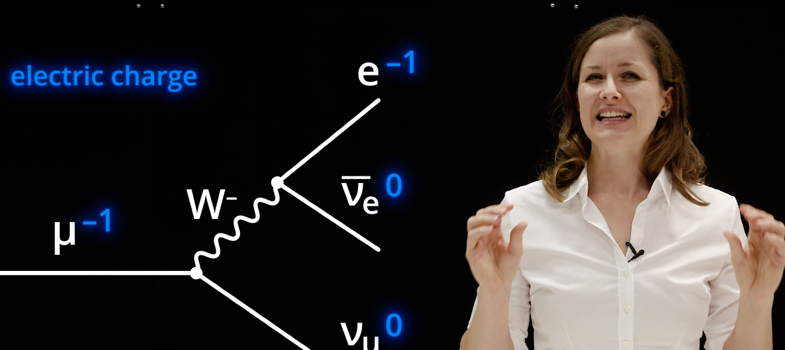
In addition, every elementary particle has "charges". Yes, you heard me correctly. I used the plural "charges" not just "charge" because there are three of them. You might already know one, the electric charge. But there are two more charges, namely the strong charge and the weak charge, which we will discuss later in the following chapters of this course. Elementary particles can have one, two, or even three charges. Together with the mass, the configuration of charges uniquely defines what type of particle it is. An important discovery of particle physics is that all charges can only have specific values. Therefore, we say that charges are "quantised".
Let us summarise this in the second important message of this chapter. Particles have properties that characterise them, for example, mass and charges.
Maybe you are wondering now what all this has to do with the scattering experiment I showed in the beginning. Well, to explain this, we need to discuss a second important concept: interactions. That is what we will do in the next chapter.
▶ Material & Links
DIY Experiment