What is a cloud chamber?
▶ Transcript
The last chapter was all about particle detectors, how they work and how they identify particles. But we did not explain yet, how you can build a particle detector at home to make your own discoveries. That is what we will do in this chapter. We will show you how to build a cloud chamber. You will not learn any new concepts. But we will come back to many concepts we already explained in previous chapters. So, just relax and enjoy.
How do we build a cloud chamber?
You can see everything you need to build your own cloud chamber on this table: safety goggles, two types of safety gloves, a box, a black metal plate, a fish tank with a felt attached to its bottom, and a torchlight. All these things are relatively easy to get. However, you will also need dry ice and very pure isopropanol, at least 90% pure. And these two ingredients are a bit more difficult to get, and you need to be very careful when handling them. Here, it is probably best if your teacher or your parents assist you.
To help you with your own cloud chamber projects, we compiled a detailed shopping list with all the material you need and even with ideas where to get the material. You can find the link to our cloud chamber manual in the video description below. In the following, I will show you step by step how to assemble this particle detector. Afterwards, we will discuss what we can observe in our cloud chamber. First, we put on safety goggles to protect our eyes and leather gloves to protect our hands. Next, we need our box and dry ice. Dry ice is solid carbon dioxide at -80° Celsius. It is really, really cold! Therefore, never touch it with your bare hands. I am wearing leather gloves. Therefore, I can touch it and use several blocks of dry ice to cover the bottom of our box.
Next, we need very pure isopropanol. To handle isopropanol, we use different protection gloves made of plastic, but we keep our safety goggles to protect our eyes from splashes. Then, we spray the isopropanol on a thick sheet of felt that is attached to the bottom of our fish tank. The felt needs to be completely soaked with isopropanol, so, this process will take a while. I always tilt the fish tank when filling in the isopropanol. In this way, we can see a little "lake of isopropanol" in one corner of the tank once the felt is completely wet.
Now, we place a black metal plate onto the dry ice. Do not freak out about the sound this makes. This is completely normal, and it simply means that some of the dry ice abruptly sublimates in contact with the relatively warm metal plate.
We use some more isopropanol to fill the groove of our metal plate. This will help to seal the chamber so that no air can go in or out. Then, we place the fish tank upside down onto the metal plate. It fits the grooves in the metal plate. Finally, we use a torchlight to illuminate the inside of the fish tank. Make sure that your torchlight is placed in the right way. It needs to illuminate the inside of the chamber right above the metal plate because that is where awesome physics is about to happen. And this was already the last step. After a few minutes, our cloud chamber is ready to detect particles.
How does a cloud chamber work?
If we dim the room lights, at first, we will only observe rain inside the cloud chamber. But it is a special type of rain. It is isopropanol rain with hundreds of tiny raindrops distributed all over the lower part of the chamber. But after a few minutes, we start seeing tracks of high-energetic particles moving through the cloud chamber. The tracks of these particles appear only for a short time as white lines, right above the metal plate. It is pretty amazing that we can really "see" the signals particles leave in this detector with our eyes.
But what is exactly happening? At the top of the fish tank, isopropanol evaporates from the felt. That means it now exists in its gaseous form. The gaseous isopropanol slowly sinks downwards because it is heavier than air. Now, the dry ice keeps the bottom of the chamber very cold. You might remember the temperature of the dry ice. It is -80° Celsius! Therefore, the isopropanol cools down rapidly when it sinks down. The result is a so-called super-saturated super-cooled environment. Yes, you heard me correctly, super-saturated and super-cooled. Well, the cloud chamber is a super nice detector, but what does super-saturated and super-cooled mean? Super-saturated is easy, it basically means a super wet gas, so, in our case, a gas with large amounts of evaporated isopropanol. Super-cooled means that the isopropanol is still in a gaseous state, but it is really, really, really cold and wants to transform into a liquid. Now, if anything disturbs the super-saturated super-cooled environment just slightly, this will immediately start the condensation process, and small droplets of liquid isopropanol will form.
And this is precisely what happens, once an electrically charged particle moves through the chamber. It can ionise the isopropanol molecules. That means the particle tears away electrons of some of these molecules, which leaves them positively charged. And this is already enough to disturb the super-saturated super-cooled environment and to start the condensation process. Many small droplets of isopropanol form along the path of the particle. And this is what we can observe as white lines. However, we need to keep in mind that we cannot see the particles themselves. We can only observe the signals they leave when they interact with a particle detector. In this case, particles leave these white tracks when they interact with the isopropanol molecules in our cloud chamber.
What can you observe in a cloud chamber?
We can observe different types of tracks in this particle detector, that are caused by different types of particles. We already discussed some of these tracks in previous chapters of this course but let me briefly summarise everything we know. Also, there is one more type of track that we have not mentioned before.
We already discussed the long straight tracks. These tracks are caused by muons. You might remember that muons have the same charges as electrons, but their mass is 200 times higher than the mass of electrons. Due to this high mass, muons just move straight through the cloud chamber. Indeed, it is very difficult to deflect them from this straight path.
In a previous chapter of this course, we also explained where muons come from. You might remember that the Earth is bombarded by high-energetic protons from space. We also call these protons from space cosmic particles. These high-energetic particles interact with the molecules of our atmosphere. In particular, they can transform into a shower of new particles. In this process, pions are created. We already introduced you to them as an example for a meson, so a composite particle system made of one quark and one anti-quark. And we know that pions have a short average lifetime, which means they quickly transform into other particles. For example, a pi- can transform into a muon and an anti-muon neutrino, whereas a pi+ can transform into an anti-muon and a muon neutrino. The muons and anti-muons, and the neutrinos and anti-neutrinos, that are created in these pion transformations then continue moving towards the Earth and move, for example, through our cloud chamber. However, in our cloud chamber, we can only detect the muons and the anti-muons. The neutrinos do not have an electric charge, so, they cannot leave a track in our cloud chamber. Furthermore, we cannot distinguish between muons and anti-muons because both types of particles leave exactly the same types of tracks in our cloud chamber. We would need a very strong magnetic field to figure out which is which because then the tracks of muons and anti-muons would be curved in opposite directions.
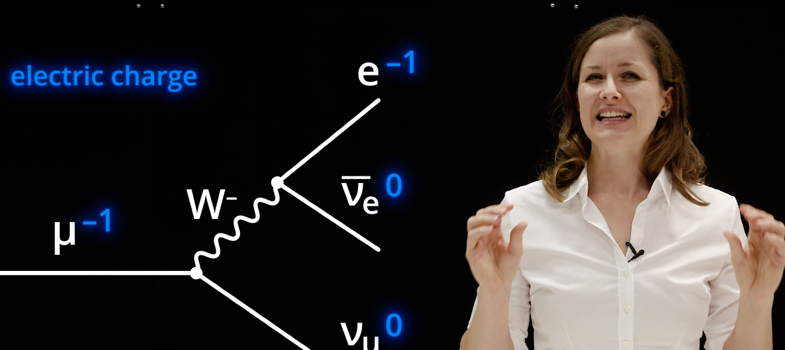
Now, you might remember that particle transformations are not only crucial in our atmosphere to create muons. We also discussed how muons themselves transform into other particles at the end of their lifetime. Indeed, this is the explanation of tracks in the form of kinks in our cloud chamber. A muon can transform into an electron, a neutrino, and an anti-neutrino. However, only the electron will cause a track in the cloud chamber. Since the mass of electrons is relatively small, it is quite easy to deflect them from a straight path. Therefore, electrons typically leave short and curly tracks in our cloud chamber.
There is one more type of track, we did not talk about yet. It is a short, straight, and very fat track. Sometimes, these tracks look a bit like caterpillars. They are caused by quite a complex particle system, a system of two protons and two neutrons. We call this particle system the alpha particle. Yes, I just called this pretty complex particle system a "particle". Indeed, it makes sense to adapt our particle model in this case because the alpha particle leaves a track just like the other particles.
You have probably heard of the alpha particle already in your physics lessons. Let me briefly summarise how alpha particles are created. We know that certain types of atoms are not stable – we call them radioactive. And radioactive atoms can transform into other types of atoms. During some of these processes, alpha particles are created.
One important property of the alpha particle is that it is extremely easy to stop. You just need to put a sheet of paper in its way. Hm, but that means the alpha particles that we detect inside our cloud chamber cannot come from the outside. The plastic walls of the fish tank would never let them through.
So, that means there have to be radioactive atoms inside our cloud chamber, that are responsible for the alpha particles. And indeed, radioactive Radon atoms form a tiny proportion of our air. The moment you place the fish tank onto the metal plate, you also trap air inside, which includes a few radioactive Radon atoms. Eventually, one of these Radon atoms will transform and emit an alpha particle. This alpha particle then leaves a short, fat track in our cloud chamber.
This now concludes our review of tracks you can observe in a cloud chamber. If you manage to observe anything else in your cloud chamber, this might be a sign of even more fascinating physics!
Why are cloud chambers no longer used in research?
Of course, cloud chambers are by no means modern particle detectors. They actually have a few limitations. For example, our cloud chamber is missing a magnetic field to determine the electric charge of particles. Therefore, we cannot distinguish between muons and anti-muons, or between electrons and positrons. Also, our cloud chamber cannot measure the energy of the particles. In fact, the cloud chamber is simply a tracker, a detector component that detects the tracks of electrically charged particles. Moreover, our cloud chamber can only detect tracks of particles moving, more or less, horizontally. If a muon moves vertically through our cloud chamber, it does not leave a track at all, or maybe just a tiny dot. Another disadvantage of cloud chambers is the type of signal they produce. It is a visual signal. To record the observations of a cloud chamber, we would need to take a lot of photographs and to go through them one by one to analyse the tracks. We already discussed that this is impractical, and this is the reason why modern particle detectors use electronic signals that can be analysed by computers.
Nevertheless, the basic principle of our cloud chamber is the same as for modern detectors. Different particles leave unique patterns, and these patterns help us to identify the particles. And cloud chambers have one huge advantage compared to modern particles detectors, such as the ATLAS or CMS detector. They are super easy to set up, and they are incredibly mesmerising to observe. With that, I will stop talking and give you some more time to enjoy the beauty of tracks in our cloud chamber.
▶ Material & Links
DIY Experiment