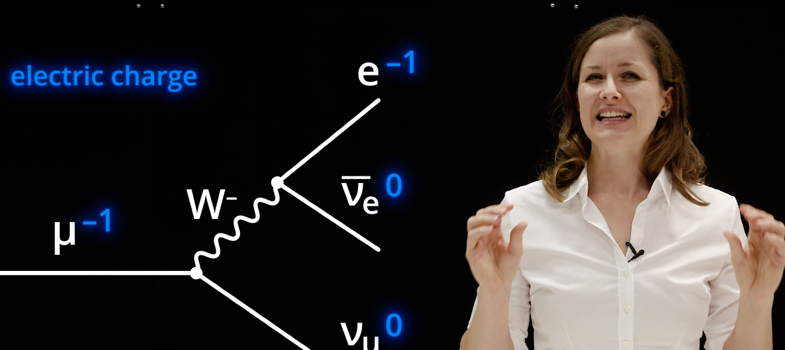
What are interactions?
▶ Transcript
In this chapter, we will discuss the concept of interactions and how they are linked to charges. We will also come back to the scattering experiment that we have shown you in the previous chapter.
With the scattering experiment, we have explained that even if we cannot see the target directly, we can observe how it interacts. But what does "interaction" actually mean? In short: something happens between some things. In particle physics, the term interaction includes all possible processes involving particles. For example, there can be forces between particles, that means particles can attract or repel each other. One type of particle can also transform into a different type of particle. Moreover, new particles can be produced, and particles can stop existing. All these processes are different aspects of interactions.
Now, I have used the plural: interactions. But how many interactions are there? In science lessons in high-school, we usually study different subjects such as physics, chemistry and biology. And, within these subjects, we study different, seemingly unrelated phenomena. What if I told you, that all phenomena in the Universe, including everything you will ever learn in any of your science lessons, can be traced back to only four fundamental interactions between elementary particles? For me, this completely changed the way I looked at the World and science around me because everything was suddenly connected. And, if you look at science this way, there is no fundamental difference between physics, chemistry, and biology. The only difference lies in the type and the energy range of the particles and composite particle systems involved, and the type of the fundamental interactions. This is the first important message of this chapter. All phenomena in the Universe can be traced back to four fundamental interactions between elementary particles.
I am sure you are curious about what these four fundamental interactions are. They are called the gravitational interaction, the electromagnetic interaction, the strong interaction, and the weak interaction. You might know the first two already. And you might expect that the strong interaction and the weak interaction have something to do with the strong charge and the weak charge that I mentioned in the previous chapter. And you are absolutely correct. Let me explain. The strong charge and the weak charge are both properties a particle can have. And these properties are linked to the interactions that have the same name. Specifically, if a particle has a strong charge it can interact via the strong interaction. Similarly, a weak charge allows particles to interact via the weak interaction.
In our daily life, we usually only encounter two of the four fundamental interactions, namely the gravitational interaction and the electromagnetic interaction. Therefore, we will look at these two a bit more in detail now. In the next chapters, we will discuss the other two, the weak interaction and the strong interaction.
The gravitational interaction
The gravitational interaction, which we also simply call gravity, is probably the weirdest of all four fundamental interactions. On the one hand, the only thing the gravitational interaction does is cause an attractive force. That means if two objects have a mass, they will always attract each other. And the gravitational interaction is very important for our daily life. How often did you almost drop your smartphone this week? Did you ever blame gravity?
On the other hand, at a particle level, the effect of the gravitational interaction is extremely small compared to the other fundamental interactions. That means that in most particle physics experiments, we can ignore its effects. Do not get me wrong. Gravity is extremely interesting for current research, for example, research about very massive objects such as black holes or dark matter clusters. But at a particle level, its effects are extremely weak. Moreover, the gravitational interaction is the only fundamental interaction that can not be described by the Standard Model of particle physics. Instead, it is described by a different theory, the general theory of relativity, also called general relativity. This is the second important message of this chapter. Apart from the gravitational interaction, all fundamental interactions are described by the Standard Model of particle physics.
Do you have an idea of how exactly the gravitational interaction works? In particular, at a particle level? In this case, please mention this course in your speech in Stockholm when you collect your Nobel Prize. In the following, we will do the same as many particle physicists, and we will appreciate that gravity plays an important role in our life but ignore it when thinking about particles. Instead, we will move on to the electromagnetic interaction.
The electromagnetic interaction
We notice the effects of the electromagnetic interaction every day. Every phenomenon that has anything to do with electricity or magnetism stems from the electromagnetic interaction between elementary particles. However, the electromagnetic interaction is quite different from the gravitational interaction. For example, it can cause an attractive force, but it can also cause a repulsive force. You might already know that two electrons will repel each other because of the electromagnetic interaction, whereas an electron and a proton will attract each other.
I said earlier that the gravitational interaction acts on all objects that have a mass. But what determines if and how particles interact via the electromagnetic interaction? Can all particles interact via the electromagnetic interaction? Think about our example with the proton and the electron. What if you replace the proton with a neutron instead? You probably know that the electron has a negative electric charge, the proton has a positive electric charge, but the neutron is electrically neutral. That is the reason for its name, and it also means that neutrons cannot interact via the electromagnetic interaction, because they have no electric charge. This is the third important message of this chapter. The electric charge determines if and how a particle can interact with other particles via the electromagnetic interaction. If two particles have an electric charge, they can interact via the electromagnetic interaction. The type of electric charge, positive or negative, will determine whether the particles attract or repel each other. Particles with the same type of electric charge repel each other, while particles with opposite electric charges attract each other.
Interaction particles
How do we describe the electromagnetic interaction between two electrically charged particles in the Standard Model of particle physics? How do two electrons "know" that they have to repel each other? We use a different type of particles, called interaction particles, and we think of these interaction particles as mediators of fundamental interactions. The interaction particle of the electromagnetic interaction is called the photon, and we have already talked about the photon when we introduced it as the "quantum of light". Two particles with an electric charge can exchange photons. This exchange of photons is then used to explain an attractive or repulsive force between the particles. This is the fourth important message of this chapter. The electromagnetic interaction is mediated by a characteristic interaction particle, the photon.
We will not discuss the other two interactions, the weak and the strong interaction, here in detail. However, I already want to mention that the rules of these interactions are surprisingly similar to the electromagnetic interaction. They have very similar basic principles. As I mentioned earlier, both the weak interaction and the strong interaction are associated with a characteristic charge that determines if and how particles can interact. And both are associated with characteristic interaction particles. This is the fifth important message of this chapter. The three fundamental interactions described by the Standard Model of particle physics are each associated with characteristic charges and characteristic interaction particles.
Scattering experiment
Let us come back to scattering experiments and why they are such powerful tools in particles physics. Through scattering experiments we can study interactions between one type of particle we know very well, which is used as projectile, and one type of particle we do not know well, which acts as the target. From the observation of the scattering patterns, we can determine some of the properties of the target. For example, we can determine whether or not a particle has an electric charge, or whether or not a particle is an elementary particle.
Let me give one famous example that led to the Physics Nobel Prize in 1990. In the 1960s, particle physicists in the USA directed high-energetic electrons as projectiles at a target of protons. Then, they studied the scattering pattern of the electrons caused by the electromagnetic interaction between the electrons and the protons. Their initial model of a proton was that of an elementary particle. However, they were quite surprised by their observations. The scattering pattern they observed was not consistent with their initial model. Instead, the pattern could be described much better if the proton consisted of several point-like particles, each with an electric charge. Later, these were interpreted as quarks. Consequently, our model of a proton has changed dramatically, and it is now interpreted as a composite particle system made of three quarks.