What are particle transformations?
▶ Transcript
In the last chapter, we introduced you to the weak interaction, which allows particles to transform into other particles. This chapter is all about particle transformations, how they work and how we can visualise them. We will start by looking into the cloud chamber again, to investigate the mysterious kink we observed in the previous chapter.
The kink and the cloud chamber
Now, we promised you to explain how to build a cloud chamber and how exactly it detects particles. No worries, we did not forget that. And we will certainly do that in a future chapter. However, for this chapter, you only need to know one important feature of this particle detector. A cloud chamber can only detect particles with an electric charge. Only particles with an electric charge can interact via the electromagnetic interaction with the molecules that form the vapour in the cloud chamber. In particular, electrically charged particles that move through the cloud chamber can ionise the molecules on their way, and this leads to the white cloud-like tracks we can observe.
You might remember that the different types of tracks in a cloud chamber indicate that they are caused by different types of particles. For example, do you see these long, thin tracks? These tracks are caused by a type of particle that you probably do not know yet but that we will need to explain the kink. Let me briefly introduce you to this new type of particle, the muon.
Muons
Muons are elementary particles. We often describe muons as the very massive brothers or sisters of electrons, because they have exactly the same charges as electrons, but their mass is 200 times higher than the mass of electrons. So, muons are basically massive versions of electrons.
When we talked about the structure of matter, we did not mention any muons. And it is true, muons are not really part of our everyday life. So, why do we observe muons in a cloud chamber? Where do they come from? Well, the Earth is bombarded by high-energetic protons from space all the time, from all directions. One source of these high-energetic protons are star explosions, so-called supernovae. When the high-energetic protons interact with our atmosphere, they can transform into a shower of new particles, which then have lower energies. In this process, muons can be created. These muons then continue moving towards the Earth and move, for example, through our cloud chamber. That means the muon tracks we can observe here in our cloud chamber are reminders that somewhere far away in the Universe and a long time ago, a star exploded.
Particle transformation
Now, these muons cause straight and thin tracks in our cloud chamber. Our mysterious kink also starts with a straight thin track. And, indeed, we interpret this track leading to the kink as a muon track. Just as a reminder: We cannot see muons themselves in our cloud chamber. We can only observe the signals they leave when they interact with a particle detector.
We interpret the curly track on the other side of the kink as an electron track. So, what happened to the muon? It seems that it stopped existing. Then, the energy associated with the muon mass was transformed into energy associated with the mass of a new particle. That means when the muon stopped existing, an electron came into existence. This is what we call a particle transformation. This is the first important message of this chapter. When a particle transforms, it stops existing and new particles are created.
In your physics textbook, you might find descriptions of particle transformations, for example, in the context of radioactivity. Your textbook will probably use the word "decay" instead of the word "transformation". However, we prefer the word "transformation" because it describes more accurately what happens. The word "decay" might make you think of a muon breaking up into different particles that were somehow inside the muon beforehand. But as far as we know, the muon is an elementary particle, so it cannot break up into different particles.
Or, you might associate the word "decay" with a slow continuous process like a banana decaying over weeks if you forgot to take it out of your school bag. But a muon does not transform slowly over time. Instead, this is a sudden process. Moreover, we can never say when exactly one muon will transform because it is also a random process. Therefore, in this course, we will always use the word "transformation" instead of "decay" to describe when particles transform into other particles.
Lifetime
Now, if the muon was created somewhere up in the atmosphere, why did it transform exactly while moving through the cloud chamber? In short, we were really, really lucky to observe our cloud chamber at the right time and the right place exactly when the muon stopped existing. We call the time span from the creation of a particle to the end of its existence the lifetime of a particle.
As I already mentioned, we cannot predict when exactly a muon transforms because this is a random process. Do not get me wrong. Random does not mean the transformation process does not follow any rules. On the contrary, we know very accurately that muons have an average lifetime of 2.2 microseconds, which is not a lot of time.
But this is just an average. You might measure a much shorter or a much longer lifetime if you only observe one muon. However, if you observe many of them, the average lifetime will always be 2.2 microseconds. Indeed, every type of particle has a characteristic average lifetime that is related to the other properties of the particle, such as its mass. As a rule of thumb, particles with higher masses usually have shorter average lifetimes. This is the second important message of this chapter. Particle transformations are random processes but, on average, particles transform at the end of their characteristic lifetime.
The weird kink revisited
Now, we know that, at the kink, a muon transformed into an electron. However, we did not talk about the reason for the kink, so for the sudden change in the direction of the track. We know that the total momentum of an isolated system is conserved, for any process happening in our Universe. Indeed, a particle transformation is only possible if it does not violate any conservation laws. This is the third important message of this chapter. During particle transformations, the total energy, the total momentum, and all charges are conserved.
But this kink does seem to violate momentum conservation. Something else must have happened during the muon transformation. Maybe another particle was created at the kink but then moved away from the kink in a way that the total momentum is conserved. But we do not observe another track. A particle that does not leave a track in a cloud chamber: is this possible? I will give you a moment to pause the video and to think this through. If you are only here to enjoy the show, I will explain how this can work.
At the beginning of this chapter, I mentioned that only electrically charged particles could leave a track in a cloud chamber. So, if an electrically neutral particle is created as a result of the muon transformation, then this particle can account for the missing momentum. Do you remember any particles without electric charge? We already introduced you to two of them, the photon, which is the interaction particle of the electromagnetic interaction, and the Z boson, one of the interaction particles of the weak interaction. Unfortunately, it is not that easy. It is neither the photon nor the Z boson. Instead, a different group of elementary particles is involved in this particle transformation, the so-called neutrinos.
Neutrinos
What are neutrinos? Neutrinos are probably the weirdest of all the elementary particles. They only have a very tiny mass, and the only charge they have is a weak charge. That means, neutrinos can only interact via the weak interaction or the gravitational interaction. Therefore, neutrinos only very, very, very, very, very rarely interact at all, and, thus, it is extremely difficult to detect neutrinos. The weird thing is that there are billions of neutrinos going through our bodies every second, and we do not notice them at all. They can even move through the whole Earth without any interaction with other particles. Now, if these neutrinos do not really interact with other particles, why do we need them? Well, it seems Nature needs neutrinos to keep the conservation laws happy, for example, during a muon transformation.
Feynman diagrams
If you were to ask any particle physicist to visualise a muon transformation, they would all draw a so-called Feynman diagram of the process. Feynman diagrams use different types of lines with arrows to represent different types of particles and arrange these lines to represent a process, for example, a particle transformation. Also, Feynman diagrams include symbols to represent particles, for example, an e for an electron, the Greek letter µ for a muon, a W- for a W- boson or the Greek letter ν for a neutrino. So, essentially what we have been doing throughout this course all along. Furthermore, the Standard Model of particle physics gives us very detailed rules on how to draw these Feynman diagrams. One of these rules is charge conservation. These rules allow us to make precise calculations with Feynman diagrams. This is the fourth important message of this chapter. Particle physicists use Feynman diagrams to visualise and calculate particle transformations.
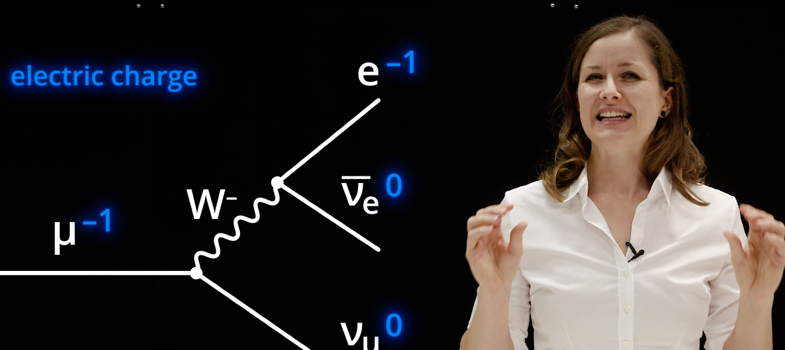
Let us have a look at the Feynman diagram of the muon transformation to see how that works, but also to figure out how neutrinos are involved in this process. Now, this diagram might look a bit confusing, maybe even frightening to you. But do not worry. For now, I will simply explain how we can read the diagram from left to right. On the left, we see a straight line for our muon with the symbol µ. When the muon stops existing, its line ends. Instead, we see two new lines appearing, a wavy line for a W- boson, and a straight line for a neutrino with the symbol νµ. The index µ at the neutrino symbol tells us which type of neutrino was produced. In this case, it was a so-called muon-neutrino. We can interpret this first part of the diagram as follows. A muon transforms into a muon neutrino by emitting a W- boson. The W- boson here tells us that the weak interaction was involved, which is no surprise because the weak interaction allows particle transformations.
Now let us follow the W- boson line from left to right. At some point, this line also ends, and two new lines appear. A straight line with the symbol e, which represents an electron, and a straight line which represents a second neutrino, the anti-electron neutrino. We can interpret this second part of the diagram as follows. The W- boson stops existing, and a pair of two particles is created, an electron and an anti-electron neutrino.
In summary, on the left, we only have one line representing a muon. But on the right, we see three lines representing an electron and two neutrinos. The wavy line for the W- boson was only there in the middle of the diagram, but then the W- boson stopped existing at some point. We would then say that a muon transforms into an electron and two neutrinos via the weak interaction.
And this concludes the mystery of the kink in the cloud chamber. It was not just one but two particles without an electric charge that account for the missing momentum because two neutrinos were created together with an electron when the muon stopped existing.
But how can we be sure that this transformation process is really possible in the way the Feynman diagram shows? Well, we can check whether it follows the most important rules of our Universe, the conservation laws. In particular, let us have a quick look at the charges to confirm charge conservation. The electric charge of the muon is -1. At the end of the transformation process, we have one electron with an electric charge of -1, and two neutrinos with no electric charge. Therefore, the total electric charge is conserved.
The weak charge of the muon is -1/2. At the end of the transformation process, we have one electron with a weak charge of -1/2 and two neutrinos. Now, the weak charge of neutrinos is +1/2. Something does not seem to add up here. The total weak charge of one electron and two neutrinos would be +1/2. This does not equal the weak charge of the muon, which is -1/2. What is the solution to this problem? Well, I already mentioned it earlier: one of the neutrinos was actually an anti-neutrino, which has a weak charge of -1/2. Therefore, the weak charges of the neutrino and the anti-neutrino cancel each other out and the total weak charge is conserved. But what does "anti" mean? This leads us to the next chapter, and the question "What is anti-matter?".
▶ Material & Links
ATLAS Cheat Sheet
Articles
Track inspection: how to spot subatomic particles
The march of the penguin diagrams