What are conservation laws?
▶ Transcript
In this chapter, we will talk about the most important rules of our Universe, conservation laws. And this will also bring us back to the fundamental interactions. You might have noticed that, by now, we have already discussed three of the four fundamental interactions: the gravitational interaction, the electromagnetic interaction, and the strong interaction. That means there is only one missing! And indeed, we will focus on the final puzzle piece, the weak interaction, in this chapter.
Before we start, we need to discuss a very important model that we are going to use in this chapter: the model of an isolated system. An isolated system is a hypothetical proportion of our Universe that does not exchange energy or particles with the outside – somehow like a hypothetical box with really thick walls that isolate whatever is inside the box. And when we use this model of an isolated system, we only care about what is inside the box. Isolated systems do not really exist in nature, but we use this model quite a lot in physics to simplify things.
Now we are ready to discuss the big question of this chapter: What are conservation laws? A conservation law states that a particular measurable property of an isolated system does not change over time no matter what happens in this system. We say that such a property remains constant or is conserved. Conservation laws are extremely powerful because they allow us to make predictions about whether a process is possible in our Universe – or not. Does a hypothetical process violate one of the conservation laws? Then this process is not possible. Does a hypothetical process conserve all properties that are associated with a conservation law? Then it is possible.
However, a conservation law does not tell us how likely a hypothetical process is, only if it is possible in principle. There are three conservation laws that are relevant in the framework of this particle physics course. And we will go through them one by one in the following.
Energy conservation
You might already know the first of them, the law of energy conservation, which states that the total energy of an isolated system is conserved. Energy can transform into different forms. For example, if you throw a ball in the air, its energy transforms from kinetic energy into potential energy, and back into kinetic energy when it falls back down. However, if you sum up all forms of energy at any moment, the total amount of energy will always be the same. So the total amount of energy is conserved.
What about mass? For a long time, scientists believed that mass is conserved – but then came Einstein and his famous and beautiful formula, E=mc2. Now you are probably wondering how on Earth someone can find a formula beautiful. Well, first of all, E=mc2 is a super short formula compared to many others, and there are no annoying fractions or brackets. But second, it provides such an important message! It states that energy and mass are equivalent. This means that energy always corresponds to an equivalent amount of mass, and mass always corresponds to an equivalent amount of energy. We only need c2, which is the square of the speed of light, as a conversion factor to express any mass in the form of energy. This conversion factor is quite large because the speed of light is 300 million metres per second. And then we have to square it. Wow! That means that we can actually think of mass as a form of energy, just like kinetic energy is a form of energy.
When we talk about the mass of a particle in this course, we always mean the rest mass of a particle. For example, the rest mass of an electron is 9.1 x 10⁻³¹ kg. Wow, that is not a lot of mass. If we want to use the formula E=mc2 to express this tiny mass as a form of energy, we only need to multiply the electron rest mass with the square of the speed of light, and we get the amount of energy associated with the rest mass of the electron in the energy unit Joule. But you probably remember that particle physicists do not use the energy unit Joule. Instead, they use the energy unit electronvolt. So, if we convert the energy associated with the rest mass of an electron in the unit electronvolt, we get a value of 511 keV, so 511 kilo-electronvolts. This value is much easier to remember than 9.1 x 10⁻³¹ kg, one more reason why particle physicists really like the energy unit electronvolt.
Now, before Einstein came up with the formula E=mc2, scientists thought that mass is conserved. But now we know that mass is not conserved. Instead, mass is just a form of energy that can transform into different forms of energy. That means, even in an isolated system, the amount of mass can change over time. For example, there are processes in which an electron stops existing and the energy associated with its mass is converted into the mass and kinetic energy of new particles. However, contrary to the total amount of mass, the total amount of energy does not change. This is the first important message of this chapter. The total energy of an isolated system, which is the sum of all forms of energy, such as the energy associated with the rest mass of a particle or its kinetic energy, is conserved.
Momentum conservation
The second of the three conservation laws that are relevant for this course is the conservation of momentum. This is another conservation law you might already know. Nevertheless, I will briefly summarise what this conservation law is about and how it is relevant for particle physics.
Let me first explain the concept of momentum. Just give me a moment-uhm. To be honest, momentum is a tricky concept because it is hard to imagine. To calculate the momentum of an object, we need the mass of the object and its velocity. Now mass is kind of easy to imagine, it is just a value. Velocity, on the other hand, is slightly more difficult. Usually, when talking about how fast or slow something moves, we use the concept of "speed". And speed is also just a value, for example, 1% of the speed of light, so 3 million metres per second. Wow, that is pretty fast.
However, things can move with the same speed but in different directions. For example, an electron can move with 1% of the speed of light to the left or with 1% of the speed of light the right. In both cases, it has the same speed: 3 million metres per second. But to describe this situation accurately, we need to include the information about the direction it is moving. Here, the concept of "velocity" helps us to distinguish situations like this because velocity specifies the speed of an object, so how fast or how slow it is moving, as well as its direction of movement.
OK, I think you can still imagine the concept of velocity somehow. In short, something is moving with a certain speed in a certain direction. But what do you see in your head when you try to imagine the product of the mass of an object and its velocity? That is what we call the momentum of an object. It is a value, the mass of the object, multiplied by another value, its speed, and its direction of movement. See! It is a bit trickier to imagine that. But just remember that momentum has to do with the mass of an object and its velocity. Specifically, momentum is the product of the mass and velocity of an object. It has a magnitude and a direction.
Now that you know what momentum is, let us discuss the conservation of momentum, for example, in the context of particle physics. Imagine an isolated system of two electrons in vacuum. Here, isolated means that we do not care about anything else than these two electrons. The two electrons have the same mass because mass is a fixed property of electrons. And the electrons move towards each other from opposite directions. One moves from left to right, the other one moves from right to left. Both electrons move at the same speed of 3 million metres per second, but they move in opposite directions, that means that they have opposite velocities.
What does this mean for the momentum of the electrons, so the product of their velocity and their mass? It means that the magnitude of the momentum is the same, but the directions are exactly the opposite. Therefore, the momenta of the two electrons cancel each other out, and the total momentum of the two electrons is exactly zero.
Ok, so far, so good. Now let us think about an interaction between these two electrons. Both electrons have an electric charge. Therefore, they can interact via the electromagnetic interaction. And, because they have the same electric charge, two electrons will repel each other. That is why they will scatter off each other and change direction. Let us say that, for example, one electron will move upwards after the interaction. Now, what has to be the direction of the other electron?
Before the interaction, the momenta of the two electrons cancelled each other out, and the total momentum was zero. The law of momentum conservation states that this total momentum is conserved. Therefore, the momenta of the two electrons after the interaction also need to cancel each other out because the total momentum needs to remain zero. That means that the only way the second electron in this system can move is downwards because the electrons need to move in exactly opposite directions. This is the second important message of this chapter. The total momentum of an isolated system is conserved.
Conservation of charges
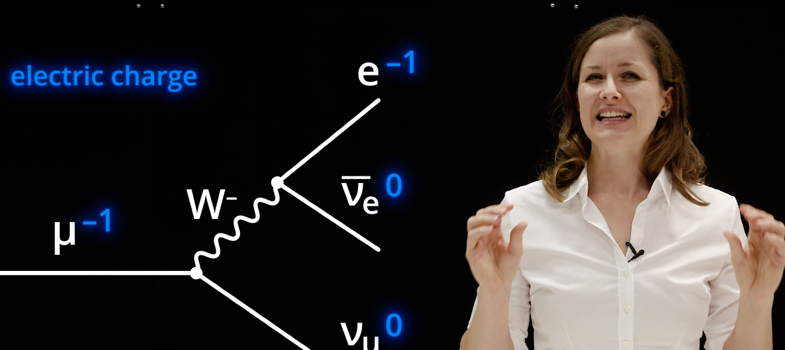
By now, we have already discussed two of the three conservation laws, the conservation of energy and the conservation of momentum. So, what about the third one? The third conservation law is the conservation of charges. Indeed, all three types of charges are conserved. If you think about the electric charge, this is quite intuitive. You might have already used the conservation of the total electric charge, for example, in chemistry when balancing chemical equations. And the same is true for the strong charge and the weak charge, they are all conserved. This is the third important message of this chapter. The total electric charge, the total strong charge, and the total weak charge of an isolated system are conserved.
The weak interaction and the weak charge
And this now concludes the overview of conservation laws that are relevant for this course. Now you know three of the most important rules of our Universe. Talking about the Universe: By now, we have mentioned the weak interaction and its associated charge a few times. Now it is time to shed some light on this last puzzle piece of the fundamental interactions. After this chapter, you will know the basic principles of all, I repeat, of all processes that are possible in our Universe. Are you ready for this?
The weak interaction is special and different from the other interactions. That is why we saved this one for last, and it is also the reason why this is my favourite interaction. Why is the weak interaction different? Let us first look back at the electromagnetic interaction and the strong interaction. The electromagnetic interaction is associated with the electric charge and mediated by the photon. It is responsible, for example, for particles attracting each other if they have opposite electric charges, or repelling each other if they have the same electric charge. The strong interaction is associated with the strong charge and it is mediated by gluons. It is responsible, for example, for holding quarks together to form composite particle systems, such as the proton or the neutron. That means both these interactions, the electromagnetic and the strong interaction, result in a force between particles. And this force is the most important aspect of the respective interaction. What if I told you that the weak interaction is not about a force?
Hm, an interaction without a force? Can this really be possible? If there is no force, what else can happen between particles? Well, with the help of the weak interaction, we can describe particle transformations. That means we can describe how one particle transforms into other particles. This is the fourth important message of this chapter. The weak interaction allows particles to transform into other particles.
Thanks to the weak interaction, elementary particles such as the up quark, the down quark, or the electron, do not have to stay as they are forever. This makes particle physics even more interesting, and that is the reason why this is by far my favourite interaction.
But how exactly does the weak interaction work? First of all, the weak interaction is associated with a charge, the so-called weak charge. This weak charge allows particles to interact via the weak interaction. Particles can have a negative or a positive weak charge, or no weak charge at all. In this sense, the concept of weak charge is similar to the concept of electric charge. However, the possible values for the weak charge are different compared to the electric charge. Indeed, elementary particles can have a weak charge of +½ or -½. For example, electrons have a weak charge of -½, and up quarks have a weak charge of +½. Nevertheless, the basic principles of the weak charge are the same as for the electromagnetic and also the strong interaction. In particular, all particles that have a weak charge can interact via the weak interaction. And, the weak interaction is also mediated by dedicated interaction particles.
Let me introduce you to these interaction particles. There are three of them: the W+ boson, the W- boson, and the Z boson. These are the interaction particles of the weak interaction. Yes, there are really three of them! So how do we remember the names of these interaction particles? You might notice that the names sound very technical compared to, for example, the gluon, whose name stems from the word "glue". Well, the particle physicists who first described the interaction particles of the weak interaction were not that creative. The W+ boson and the W- boson were simply named after the "w" in weak interaction. And you might have already guessed it: The W+ boson has a positive electric charge, that is why there is a plus in its name, and the W- boson has a negative electric charge, that is why there is a minus in its name.
But what about the Z boson? After describing already two interaction particles, the W+ boson and the W- boson, the particle physicists who first developed the model of the weak interaction noticed that their model needed one more interaction particle, but one without an electric charge. Therefore, they called the third interaction particle associated with the weak interaction the Z boson. Z for Zero, because it has zero electric charge. This is the fifth important message of this chapter. The weak interaction is associated with the weak charge, and it is mediated by the W+ boson, the W- boson, or the Z boson.
Cloud chamber revisited
We made it. Now, let us have another look at the experiment we showed you in the first chapter of this course, the cloud chamber. When you focus on the particle tracks, you can observe different shapes, for example, long thin tracks or short curly tracks. But from time to time, you can observe a very weird looking track – a kink. This does not happen too often, but if we are lucky, we might spot one. There it was! Wow, this looks strange, right? I mean, all the other tracks are quite straight, but this one looks like it took a sharp turn. How is this possible? Does this mean the law of momentum conservation is violated? No, this is not possible. The conservation laws are fundamental. There are no exceptions. Strange. I suggest that we stop here and jump directly to the next chapter to discuss this mysterious kink in detail.
▶ Material & Links
ATLAS Cheat Sheet