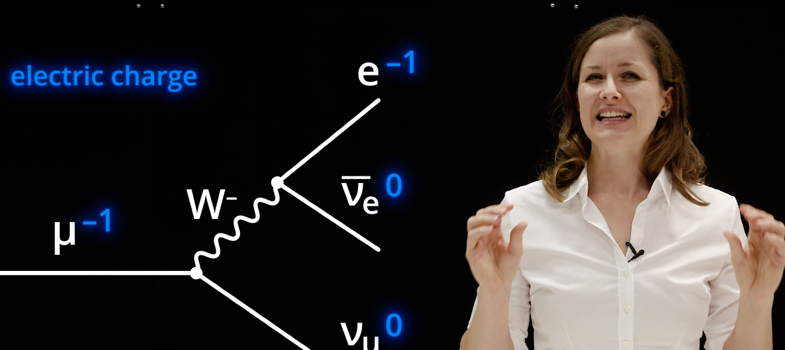
What is anti-matter?
▶ Transcript
In this chapter, we will go back to the beginning. No, not just to the beginning of this course. We will go all the way back to the beginning of our Universe. Yes, about 13.8 billion years back. But no worries, it will still only take us about 10 minutes. For this, we will first discuss the big bang theory. No, not the sitcom, the real big bang theory! :)
The big bang theory
The big bang theory is currently our best scientific model to describe how our Universe came into existence. According to this model, the origin of our Universe can be traced back to about 13.8 billion years, when spacetime was created and a huge amount of energy suddenly transformed into particles. Since then, our Universe has been continuously expanding. This is one of the empirical observations that support this scientific model. Indeed, wherever we look into space, we see that all objects, such as stars and even galaxies, seem to be drifting away from each other. This is best explained by the fact that the Universe itself expands, which in turn leads to growing distances between objects in space. And if we reverse this observation of the expansion of the Universe, we can assume that everything can be traced back to a single point. But of course, not a point that comprised stars and galaxies. I mean, it took millions of years until the first stars and galaxies were formed. At the very beginning of the Universe, the big bang theory describes that there were only particles. This is the first important message of this chapter. The evolution of the Universe is best described by the big bang theory.
You probably already guessed what is at the core of the big bang theory. It is by far the most famous formula in physics. We have introduced it in one of the previous chapters already: E=mc2. Such a beautiful formula! Einstein really was a genius. This formula alone would have made him a hero of physics, but he gave us so much more insight into modern physics. Wow! Anyway, E=mc2 is really a fantastic formula. It describes that energy and matter are equivalent. This means that matter is a form of energy that can transform into other forms of energy. So, energy can transform into matter, and matter can transform into energy. And this is exactly the basis for the big bang theory. A lot of energy suddenly transformed into matter in the form of particles. This is the second important message of this chapter. The big bang theory is based on Einstein's famous formula, E=mc2, that describes the equivalence of energy and matter.
However, there is one issue. This transformation of energy into particles is strictly restricted by the fundamental conservation laws that we also discussed in one of the previous chapters. Specifically, we can only transform energy into particles, as long as all charges of the particles are conserved. For example, if you want to transform energy into just one electron, you would create a single particle with a certain set of charges out of nowhere. Well, our Universe does not seem to like this. The only way to transform energy into an electron is to, at the same time, also transform energy into a second particle that is identical to the electron but whose charges are opposite. In this way, the charges of the two particles would cancel each other out and overall charge would be conserved. This is the third important message of this chapter. The transformation of energy into matter is restricted by charge conservation.
Anti-particles
In the case of the electron, this is quite straightforward. We already know that it has two of the three fundamental charges. A weak charge of -½ and an electric charge of -1. So, all we need is a particle identical to the electron, but with a weak charge of +½ and an electric charge of +1. In this way, we would be able to transform energy into matter in the form of two particles, and all charges would be conserved. And the good news is: such a particle exists within the Standard Model of particle physics! It is called the positron, and as far as we know, it is identical to the electron, except all its charges are opposite to the charges of the electron. That is why we consider the positron to be the anti-particle of the electron and we also call it the anti-electron.
Ok, but what if we want to transform energy into quarks, for example? How would this work? Well, this is also quite simple, because for every quark there is an identical anti-quark with opposite charges. As a matter of fact, within the Standard Model of particle physics, we have an anti-particle for every known particle. Well, for every known particle that has at least one charge. Otherwise, the concept of an anti-particle with anti-charges makes no sense. This is the fourth important message of this chapter. For every charged particle there is an identical anti-particle with opposite charges.
As far as we know, there is no difference between particles and their anti-particles except for their opposite charges. The fact that we call them "anti"-particles is just a convention. There is no deeper meaning behind the name. We just happened to discover the electron first and only later its anti-particle, the positron. And by the way, we still do not know what a particle – or an anti-particle for that matter – is. But what we do know is that particles and anti-particles are not necessarily best friends. What I mean by that is that they can interact with each other. If a particle meets its anti-particle, they cancel each other out and transform into energy, for example in the form of photons. Indeed, this is the awesome feature of equations, such as E=mc2. They work in both ways. This fantastic formula tells us that energy can transform into matter, but also that matter can transform into energy. And this is precisely what we observe whenever a particle meets its anti-particle. This process has a very fancy name. We call it annihilation. But in the end, this is just a transformation of matter into energy in the form of interaction particles. This is the fifth important message of this chapter. A particle and its anti-particle can cancel each other out and transform into interaction particles.
And this now brings us back to the very beginning – to the big bang. At first, I told you that our best description of the beginning of our Universe is that an enormous amount of energy transformed into matter in the form of particles. And this is true, but by now you probably spotted that I was not super precise here. Because energy can only transform into matter in the form of particles and the same number of anti-particles. Otherwise, the conservation of charges would not work out and this transformation would not be allowed.
Hm, but do you now spot the next problem? It is a big one. Most likely, one of the biggest problems in physics. If a lot of energy transformed into particles and the same number of anti-particles, how can we then still be here 13.8 billion years later? I mean, if a particle and its anti-particle annihilate, the big bang should have been a super boring event. A lot of energy transforms into particles and anti-particles, which then cancel each other out and transform into energy in the form of interaction particles. Boom, done.
Obviously, this did not happen because we would not exist today. So, apparently, our Universe evolved after the big bang instead of transforming into interaction particles. But we do not really have an idea or a good description of what happened in the first moments after the big bang. This is one of the many open questions we are currently facing in physics. And this is one of the reasons why we are so happy that you are still following along in this course. Because we need you! We need young researchers with new ideas of how to tackle the mysteries of our Universe! So, if you are interested, please finish high-school first and then study any subject that is related to particle physics. We look forward to hearing from you soon! :)
Anti-matter
Now we are ready to tackle the big question of this chapter: What is anti-matter? Well, this should be relatively simple, right? We already know what matter is. Matter is everything we can touch, theoretically or practically. And matter is made of particles, which form atoms. So, technically, anti-matter should be made of anti-particles, which form anti-atoms. And this is exactly how we describe anti-matter. This is the sixth important message of this chapter. Anti-matter is made of anti-particles that combine to form anti-atoms.
However, anti-matter does not exist in our daily life. Do not get me wrong. Anti-particles are part of our world. The positron, for example, is a by-product of radioactivity. But nowhere in the entire Universe do we see that anti-particles group together to form anti-atoms. Well, nowhere in the Universe with one exception. There exists one place in our Universe, where we can observe stable anti-atoms. Do you have any idea where this place could be? Well, I do not want to brag, but this place is right here at CERN! Yes, we have a unique research facility on site that is called the Antimatter Factory. I am not kidding, this is exactly what it is. A factory for anti-matter. This is just one of the examples that make CERN such a special place. If you want to study the properties of anti-matter anywhere in the Universe, CERN is the place to be.
But I have to be honest with you. This factory is not designed to produce complicated forms of anti-matter. We do not produce anti-phones or anti-cars. No, we focus on the simplest form of anti-matter. Mostly, we study anti-hydrogen. You probably already know that hydrogen is the simplest atom in our Universe. It is just one proton and somewhere around in the orbital space is one electron. That is it. So, if we want to produce anti-hydrogen, all we need is an anti-proton and an anti-electron, the positron. By bringing them close together, we can create a stable anti-atom, which we can study. After all, we want to figure out why our world is made of matter and why we do not see any quantities of anti-matter anywhere else. So, there has to be a fundamental difference between matter and anti-matter, which we have not figured out yet. This is another big open question in physics, for which we need any help we can get from young researchers! :)
Alright, by now, you might be wondering why we are so confident that there is no anti-matter in our Universe. I mean, the Universe is incredibly large. How can we be sure that far, far away there is not a lot of anti-matter nicely hidden in a corner of our Universe? Well, you are right. We cannot be sure. After all, we are always describing experimental observations with scientific models. And our current model of the Universe might need to be changed at some point if we discover the existence of stable anti-matter. However, this is quite unlikely, because if there were large quantities of anti-matter anywhere in the observable Universe, it could not hide from us. Remember what we discussed earlier: if a particle meets its anti-particle, they annihilate each other and transform into energy in the form of photons. So, if there were even small quantities of anti-matter somewhere, they would at some point interact with all the matter that is out there, and the particles would annihilate with their anti-particles. If this were the case, we would be able to detect flashes of photons from these annihilations. But so far, we have never made such an experimental observation. That is why we have to create anti-atoms on our own and study their properties.
Quadrupole ion trap
So, how do we study anti-atoms? Well, the short answer is: carefully. We have to study anti-atoms very carefully. This means, once we create an anti-atom, we try our best to make sure that it does not interact with anything that could lead to its annihilation. First, we place our experimental equipment in ultrahigh vacuum. This already reduces the risk of interactions with gas molecules. And then we trap the anti-atom in a clever configuration of magnetic fields. In doing so, we suspend the anti-atom to investigate its properties, for example, how it interacts with photons from a laser.
But here at CERN's Antimatter Factory, we are not only studying the properties of anti-atoms. We are also investigating anti-particles and composite anti-particle systems on their own. For example, we perform precision measurements of the mass of the anti-proton to see if it is identical to the mass of the proton. To do this, we trap the anti-proton in a particle trap. There are different kinds of particle traps. One of them is the so-called quadrupole ion trap. This kind of trap uses electric fields that oscillate in such a way that the anti-proton is being suspended in the centre of the trap.
And the cool thing is, it is possible to build such a quadrupole ion trap at home. I have this one right here. We designed and 3D-printed this one ourselves. Of course, we are not able to trap anti-protons or protons with this device, but we can demonstrate how it works with small spores or some cinnamon powder. So, if I switch on this LED to illuminate the centre of the trap, we can see the electrodes. These are important, as the electric fields are oscillating between them. You see, this trap is connected to a transformer because we need high voltage to generate these electric fields. So, if we switch everything on, we can now carefully take some of the spores with this stick and place them in the centre of the trap, like this. Et voilà, they are trapped. And this is precisely how we trap anti-protons here at CERN as well. But I admit, this experimental set-up is slightly less sophisticated. If you want to build this trap at home, the link is down in the video description. It is probably best to involve your teacher because they can help you with the electronics and hook you up with one of these nice transformers. And who knows, maybe at some point you end up here at CERN's Antimatter Factory working with one of our real particle traps.
▶ Material & Links
DIY Experiment