What is the Higgs boson?
▶ Transcript
In this chapter, we will continue where we left off in the previous chapter. We discussed the Standard Model of particle physics and how all elementary particles and anti-particles can be grouped into three generations based on their charges and masses. We already saw that the first generation of elementary particles plays a crucial role in our everyday life. Specifically, with just three elementary particles, namely the up quark, the down quark and the electron, we can construct every atom in the Universe. We just need a lot of them.
Baryons and mesons
So, let us now have a look at the second- and third-generation particles. Specifically, we will focus on the quarks and anti-quarks that we have not yet discussed. Just a reminder, in addition to the up quark and the down quark, we also have the charm quark, the strange quark, the top quark, the bottom quark, and of course all of their respective anti-particles. This is where particle physics gets a little bit fuzzy because none of them can exist on their own. Indeed, we already mentioned that quarks are always confined together to form composite particle systems. We highlighted this fact by showcasing the proton and the neutron as examples. Each one of them is made of three quarks. Either up, up, down for the proton, or down, down, up for the neutron. These three quarks are bound together by the strong interaction, which is mediated by gluons, to form composite particle systems. And this is the case for all quarks.
For example, there is a particle system made of an up quark, a down quark, and a strange quark. This composite particle system is called Sigma Zero. Have you heard of this particle system before? Probably not. It has a spectacular short average lifetime of about 10-20 seconds and, therefore, does not play a role in our daily lives. But this is not the only composite particle system made of three quarks. There are dozens of them, as there are various combinations of the different quarks. However, not all of them are possible because at some point the average lifetime of a specific combination is just too small to consider this particle system to be real. I mean, it is already difficult to imagine that something like the Sigma Zero system is considered real, right?
For now, we will conclude that there are various combinations of three different quarks that form different composite particle systems. We call this group of particle systems "baryons". But there is a second possibility of how quarks group together to form composite particle systems. Indeed, there is a category of composite particle systems that are made of only two quarks. Well, one quark and one anti-quark, to be precise. This group of particle systems is called "mesons". This is the first important message of this chapter. Composite particle systems made of three quarks are called baryons, and composite particle systems made of one quark and one anti-quark are called mesons.
Do not worry – the names are not super important. I just thought I would mention them at this point for completeness. What is more important is how we describe baryons and mesons within the Standard Model of particle physics. So, what is our current understanding of composite particle systems? Well, we already discussed all relevant details during different chapters of this course. Now, let us bring it all together to answer this question.
For a composite particle system to exist, we have to consider the strong interaction. After all, this fundamental interaction is responsible for confining quarks to form composite particle systems. This is only possible because each quark has not only an electric charge and a weak charge, but also a strong charge. So, they can interact via the strong interaction, which is mediated by gluons. It has been a while, but I hope you remember that instead of calling it strong charge we sometimes use the term colour charge. So, a quark can have a red, blue, or green colour charge. But again, this is just the model that we use to describe strong charge. We really do not know how a particle looks like! As long as three quarks have three different colour charges, they can combine to form a composite particle system. Even if this system then only has a super short lifetime. But it can exist.
Now, how does this work for mesons? I mean, how can a particle system made of two quarks even be allowed? Is there a way for two colour charges to add up to neutral? Red and blue? Green and blue? Green and red? Nope, this does not work. However, if you combine a quark with a certain colour charge and an anti-quark with the same anti-colour charge, then it works again. For example, we can take a down quark with a blue colour charge and an anti-up quark with an anti-blue colour charge. In this case, the colour charge of the down quark and the anti-colour charge of the anti-up quark would add up to neutral. Our model of colour charge would allow the existence of this composite particle system. You might have heard of it before. It is called pion, pi- to be precise, and we can mostly find it a couple of kilometres above our heads when high-energetic cosmic particles hit the Earth's atmosphere and transform into showers of pions. However, the pi-, as all mesons, is extremely short-lived. Its average lifetime is about 26 nanoseconds before it transforms into a muon and an anti-muon neutrino. Wow, particle transformations are really fascinating!
The Higgs boson
But now it is finally time to tackle the big question of this chapter. What is the Higgs boson? I am sure you have heard of the Higgs boson already. It is definitely one of the most famous particles. It is also one of the youngest particles of the Standard Model of particle physics. We only managed to gather enough evidence to prove its existence a couple of years ago in 2012. However, it was theoretically predicted already in 1964. Yes, it took particle physicists almost 50 years to be sure that the Higgs boson exists.
So, what is the story of the Higgs boson? Well, I want to be honest with you, the Higgs boson is not really important! Of course, finding the Higgs boson was a massive success for us at CERN, but the Higgs boson itself is definitely not relevant in our daily lives. Let me explain what I mean. In quantum field theory, which is the theoretical framework we use to describe the Standard Model of particle physics, we consider particles to be the excitations of fields. This is where the name quantum field theory comes from. We describe every elementary particle as the excitation of its associated field. For example, the electron is the excitation of the electron field, the up quark is the excitation of the up quark field, and so on. The same is true for all interaction particles as well. The photon, the gluon, the W- boson, the W+ boson, and the Z boson – all of them are excitations of their respective fields. For example, the photon is the excitation of the electromagnetic field. This is the second important message of this chapter. In quantum field theory, elementary particles and interaction particles are considered to be excitations of their associated fields.
And we describe the Higgs boson in precisely the same way. It is the excitation of the Higgs field. Well, to be correct, the name of the field is Brout-Englert-Higgs field. It is named after the three physicists, who came up with this theory independently from each other in 1964. Mr Brout and Mr Englert worked together, and Mr Higgs worked on his own. There was a third group of physicists working on a similar theory as well, but in the end, Brout, Englert, and Higgs were slightly quicker and got all the fame. It would be absolutely correct to call the Higgs boson the Brout-Englert-Higgs boson. But we somehow got used to the terms Higgs boson and Higgs field – they are just so much easier to say.
And this field – the Brout-Englert-Higgs field – is the star of this story. According to the Standard Model of particle physics, this field is everywhere in our Universe. We use it to describe how particles get their mass. Indeed, this was one of the big open questions in particle physics. How do elementary particles acquire mass? This is where the so-called Brout-Englert-Higgs mechanism comes in. It describes how elementary particles can interact with the Brout-Englert-Higgs field, through which they get mass. This mechanism does not tell us why a particle has a certain mass or why some particles are more massive than others. But it explains how elementary particles and some of the interaction particles get their mass. I say some of the interaction particles because the photon and the gluon are massless. They do not interact with the Brout-Englert-Higgs field. This is the third important message of this chapter. The Brout-Englert-Higgs mechanism describes how elementary particles and interaction particles can interact with the Brout-Englert-Higgs field, which causes them to acquire mass.
And now you see why I was quite harsh to the Higgs boson at the beginning. It just does not play an important role in the Brout-Englert-Higgs mechanism. However, it was absolutely crucial to confirm the existence of the Brout-Englert-Higgs field. By experimentally observing the Higgs boson, we indirectly proved that its associated field, the Brout-Englert-Higgs field, exists. Thus, the theory of Brout, Englert, and Higgs, which predicted the Higgs boson as the excitation of the Brout-Englert-Higgs field was confirmed. This led to the Nobel Prize in Physics for Mr Englert and Mr Higgs in 2013. Mr Brout, unfortunately, had died already in 2011. Otherwise, he would have also received the Nobel Prize together with Englert and Higgs for sure.
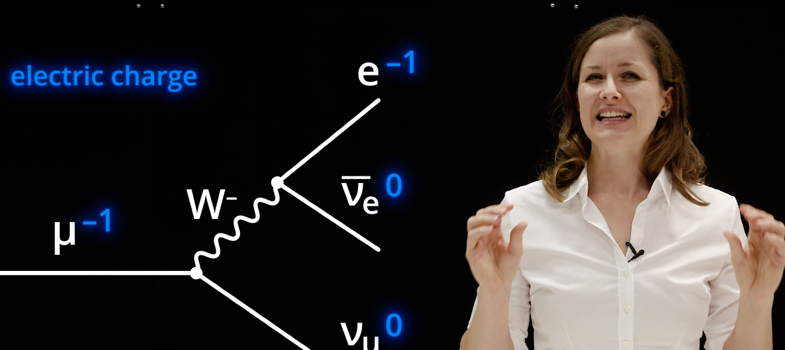
Now, when we say we "observed" the Higgs boson, this is probably a little bit of an overstatement. The Higgs boson is quite massive and, therefore, super short-lived. Its average lifetime is only about 10-22 seconds! This is way too short to observe anything. So, how can we be sure that we did find it? Well, because Nature gave us the awesome gift of conservation laws. Oh yes, I would not want to live in this Universe without conservation laws! They are one of my most favourite things ever. Close after pancakes! Because of conservation laws, we can experimentally observe even super short-lived particles, such as the Higgs boson. Ok, we cannot observe them directly, but we can at least observe them indirectly. For instance, once a Higgs boson is created, it immediately transforms into other particles. There are different transformation options possible, but all of them have to follow the fundamental conservation laws. So, the energy of the Higgs boson, its momentum, and its charges are conserved. This means, when it transforms into other particles, the sum of their energies, momenta, and charges has to add up to the original values for the Higgs boson. And this is how we can experimentally observe the existence of the Higgs boson: by detecting the particles it transformed into and by measuring their properties to add them up. I will leave it at that for now, but in the following chapters, we will take a closer look of how we create new particles and how we detect them and measure their properties in detail.
Last but not least, I want to address one common misunderstanding with the Brout-Englert-Higgs mechanism. You see, when we say that it is responsible for the mass of elementary particles and some of the interaction particles, we mean just that. This does not mean that all the mass that we encounter in our daily lives stems from the Brout-Englert-Higgs mechanism. This sounds a little bit technical, but you will see that this is an essential distinction. Let us have another look at the proton. By now, we know perfectly well that it is a composite particle system made of two up quarks and one down quark, that are held together by gluons. Now, if we measure the mass of the proton, we get a specific value. We would assume that if we measure the masses of the quarks and add them up, this should give us the same mass. But this is not the case. They are quite far off. The masses of the quarks only add up to about 1% of the mass of the proton. So, where do the remaining 99% come from? Well, this sounds like a case for good old Albert Einstein. Do you still remember from one of the earlier chapters of this course what we discussed about his famous formula? E=mc2 tells us that mass can be described as a form of energy. And this is the solution to the puzzle of the proton's mass. The majority of the mass of a proton stems from the energy of the strong interaction between the quarks, that is mediated by gluons. Together with the masses of the quarks, this adds up to the mass of the proton. This is the fourth important message of this chapter. The mass of a composite particle system stems from the masses of its quarks and the energy of the strong interaction between them.
Wow, that was quite a long chapter. So, let us finish with a fun activity. I promised you at the beginning of this chapter to show you how to figure out which particle fits your personality best. I, for example, am a charm quark. How do I know this? Well, we developed the so-called particle identities online quiz. You only have to answer a couple of easy questions, based on which an algorithm will tell you which particle you would be in the Standard Model of particle physics. Indeed, this quiz features all particles that are described in the Standard Model of particle physics. So, all elementary particles and anti-particles, as well as all interaction particles, and the Higgs boson. But there are even some hypothetical particles in there as well! You can find the link to the quiz down in the video description. And if you are curious about physics that goes beyond the Standard Model of particle physics, I have brilliant news for you: we will discuss this in the next chapter of this course!
▶ Material & Links
Quiz