
Find out more about The Open University's Arts and Humanities courses and qualifications.
1. What first got you interested in history?
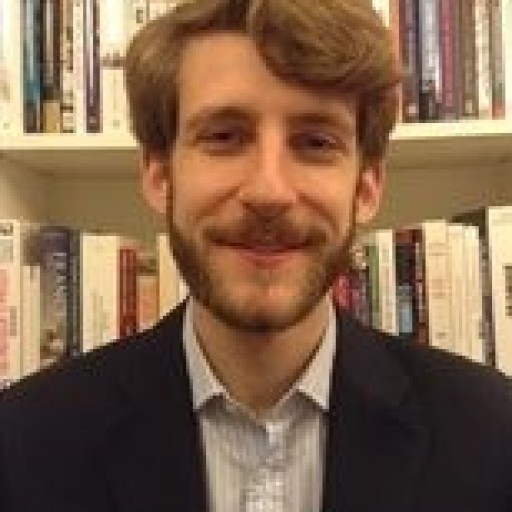 As an undergraduate student, I did an interdisciplinary liberal arts degree in Canada, which included a fair bit of history. I spent one year abroad in Paris, where most of my modules were on French history, which I loved. When the time came to specialise for my postgraduate degrees, history was the obvious choice.
2. What is your specialist area and how did you end up focusing on this?
My PhD dealt with the history of European integration, and I spent some time working at the EU institutions in Brussels. From there, I expanded to look more at transatlantic relations and particularly NATO. During my PhD and for years afterwards, I also worked closely with the Cold War Studies Programme at the London School of Economics (LSE), where I became interested in nuclear history.
3. What is it about your specialist area that fascinates you?
I’m especially interested in the dynamics between civil society and policymaking. In my research on anti-nuclear and peace activism, it’s striking how far the actions and campaigns of individuals and groups of citizens are noticed by policymakers, who need to respond.
In some cases, this means addressing their concerns; in others it means trying to mollify them; sometimes it’s much more antagonistic. But overall, it is encouraging to see the impact we can have as citizens, and that our voices are indeed heard by policymakers, even if the eventual policy responses aren’t necessarily the ones we might hope for.
4. What is your research project about?
I recently directed an Arts and Humanities Research Council (AHRC)-funded project on global histories of anti-nuclear activism, working with partners around the world. Most of the existing scholarship on anti-nuclear activism in the late Cold War focuses on Western Europe and the US. With this project, we explored the different forms of anti-nuclear activism beyond the North Atlantic, leading to an edited volume (which can be read open access here). Related to this, I’m just finishing writing a monograph on anti-nuclear activism in Canada in the 1980s, showing how this fits into the broader transatlantic and global contexts.
5. Why did you decide to pursue this project?
This project came about because of my students. Before joining the OU, I was teaching the history of the Cold War at LSE, and I had a couple of very bright Canadian MA students who kept asking me to add Canadian content to the seminars. This led me to read up on different aspects of it, and I found there was a considerable gap in the historiography, which I hope to address with my forthcoming book. From there, I developed a project adopting a wider, global scope.
6. What is the project’s argument?
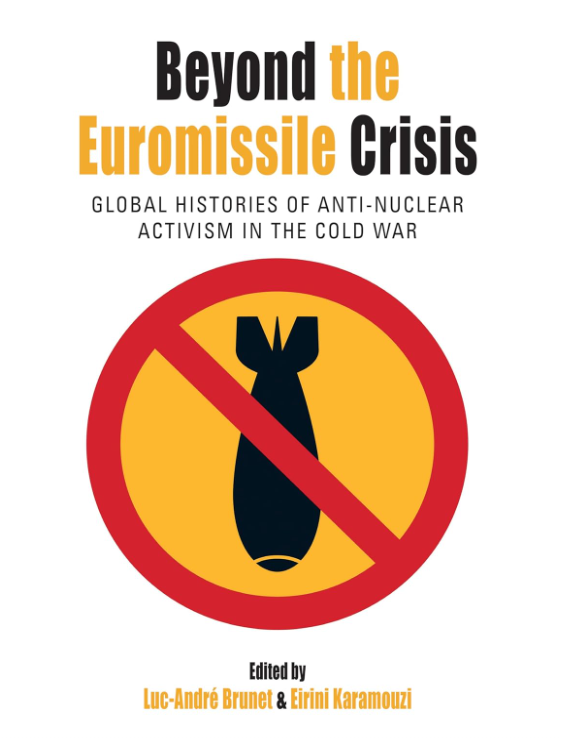 I would highlight two central arguments. One is that opposition to nuclear weapons was very much a global phenomenon in the 1980s. Historians have tended to focus on anti-nuclear activism in the US under President Reagan and in Western Europe during the so-called ‘Euromissile Crisis’ (when new nuclear weapons were deployed in Western Europe, including the UK). This project shows how anti-nuclear activism was significantly broader than this and thrived in places like Cape Town, Toronto, and Papeete.
The second key argument is that policymakers were significantly influenced by anti-nuclear protest in the 1980s. In some cases, world leaders took up the anti-nuclear cause themselves and engaged in high-level anti-nuclear activism. Even when governments disagreed with activists, they were forced to respond and to publicly justify nuclear policies, which was unprecedented. In short, protest mattered and could not be ignored by policymakers.
7. What is its significance to your specialist area, the broader field of history, and our understanding of human experience?
In so many cases, opposition to nuclear weapons was the manifestation of other, more local issues. In South Africa, anti-nuclear activism was bound up with opposition to apartheid, as the government in Pretoria secretly developed its own nuclear weapons. In French Polynesia, nuclear weapons testing was related to the broader issue of colonialism, as the French government in Paris authorised tests in this overseas territory. In Canada, the testing of American nuclear missiles in Canadian territory seemed to undermine Canadian sovereignty, prompting nation-wide protests.
In all these cases, opposition to nuclear weapons and the prospect of nuclear war – very much a global issue – was inseparable from these more specific, local concerns. This highlights the interplay between global and local dimensions of anti-nuclear activism.
8. What were the most enjoyable, and difficult, parts of the project?
For me, the most enjoyable part of the project has been working with different partners around the world. We organised a series of workshops in the UK, Sweden, South Africa, Brazil, Japan, and the US, and each brought together academics in different disciplines with policymakers and activists. I learned so much from my colleagues, and it was exciting drawing connections between different cases of anti-nuclear activism from around the world.
I also enjoyed collaborating with ICAN, the Nobel Peace Prize-winning NGO, with which I co-created an OpenLearn course on the history of anti-nuclear activism: Banning the bomb: a global history of activism against nuclear weapons.
9. Tell us about the sources that you used, and the challenges that came about using them.
I used a range of sources, from government records to the collections of NGOs and activists, and I also conducted quite a few interviews, using oral history. I relied on an international source base, using archival documents from over a dozen different countries to piece together this international story.
One of the challenges in writing about a fairly recent historical period – the 1980s – has been gaining access to the relevant files. While British records are largely open from the 1980s, in many other countries much of the archival record remains very restricted. This is where a multi-archival approach can be especially helpful. While the record of a meeting between Canadian and German leaders was unavailable in the Canadian archives, for example, I was able to find the German record of the meeting in the German archives to uncover what was discussed.
10. Can you choose one or two ‘favourite’ sources and tell us about them?
One source that stands out is the record of a meeting between Margaret Thatcher and Canadian Prime Minister Pierre Trudeau, who met at 10 Downing Street on 11 November 1983 to discuss nuclear issues. The UK had recently witnessed its largest-ever anti-nuclear demonstration, with 300,000 people gathering in Hyde Park. Trudeau was trying to get NATO leaders to reduce tensions with the Soviet Union, and he feared the possibility of a nuclear war. Thatcher was utterly dismissive, even suggesting that a nuclear war wouldn’t be catastrophic. Chillingly, she told her Canadian counterpart ‘one must remember things were growing again one year after Hiroshima was attacked’. This document gives a sense of the divergent views on nuclear weapons within NATO, and reveals Thatcher’s views on nuclear weapons more starkly than any of her public comments from the time.
11. What advice would you give to those who want to study history, whether as part of a degree at university, or beyond a university context?
History is such a wonderfully broad discipline: it includes anything that has ever happened, anywhere in the world. There’s always so much to explore and even for familiar topics, there will be new sources and new ways of thinking about issues and events.
If you’re thinking about registering for an OU history module, you could also complete one of our free OpenLearn courses, which will give you an idea of how we teach history at the OU and some of the topics you would get to discover.
12. What are you planning to work on next?
My first book was on Vichy France, and I’m interested in using some of the global history methodologies of my most recent project to work on a global history of France under the Vichy regime (1940–1944). But first thing’s first, I need to finish up the manuscript of my current book!
Read more from our Opening up history series
-
Opening up history: art in the Reformation
Read now to access more details of Opening up history: art in the ReformationIn this Opening up history conversation we speak to Dr Roisin Watson about her research on how Protestants used images and objects to express their faith in the Reformation.
-
Opening up history: eighteenth century ideas of national independence
Read now to access more details of Opening up history: eighteenth century ideas of national independenceAs part of our Opening up history series, we speak to Dr Anna Plassart, senior lecturer in History about her current research.
-
Opening up history: political culture in eighteenth-century Ireland
Read now to access more details of Opening up history: political culture in eighteenth-century IrelandDr Suzanne Forbes is a senior lecturer whose current research focuses on ‘controverted’ elections in eighteenth-century Ireland. OpenLearn speaks to her as part of our Opening up history series, where we delve into the thoughts and work of OU historians.
-
Opening up history: religion and politics in the Elizabethan era
Read now to access more details of Opening up history: religion and politics in the Elizabethan eraHistorian Dr Neil Younger recounts his fascination with the Elizabethan era and the political dynamics of this period, which has led him to his current research project.
-
Opening up history: teaching transatlantic slavery in British schools
Read now to access more details of Opening up history: teaching transatlantic slavery in British schoolsIn this Opening up history conversation we speak to Dr Katie Donington, senior lecturer in Black, African and Caribbean History at The Open University, about her most recent project focusing on the teaching of slavery in British schools.

-
Opening up history: the intersections of tobacco consumption and modern war
Read now to access more details of Opening up history: the intersections of tobacco consumption and modern warDr Michael Reeve is a lecturer in Modern British History at The Open University. We speak to him here about his current research on smoking in wartime Britain, as part of our Opening up history series.
Like this? Try a FREE course
-
Banning the bomb: a global history of activism against nuclear weapons
Learn more to access more details of Banning the bomb: a global history of activism against nuclear weaponsIn this free course you will learn about the global anti-nuclear movement that has worked for decades to prevent the use of nuclear weapons, with the ultimate aim of abolishing them altogether. You will see how opposition to nuclear weapons has been an important cause on every continent. Beginning in 1945, this course will equip you with ...

-
What do historians do?
Learn more to access more details of What do historians do?What do historians do? In this free course you will explore some of the ways that historians work to develop our understanding of the past. You will learn about three aspects of the historian’s craft through three topic areas: landscapes, infant health and criminal justice. Through the activities in the course, you will experience a wide range ...

-
Empires: power, resistance, legacies
Learn more to access more details of Empires: power, resistance, legaciesEmpires have existed throughout most of human history. They have spanned the globe. They have influenced the way we are governed, our systems of trade, how we use technology, our relationships with the natural world. They have shaped how we have seen, mapped and divided the world. They have profoundly affected how we have understood and ...

Rate and Review
Rate this article
Review this article
Log into OpenLearn to leave reviews and join in the conversation.
Article reviews