
Find out more about The Open University's Arts and Humanities courses and qualifications.
1. What first got you interested in history?
 I never intended to become a historian; my first degree was in economics. But I discovered that I was less interested in contemporary economic theory than in the history of economic thought. Eighteenth-century writers were effectively inventing what we now call economics as they tried to make sense of a rapidly changing world, and what struck me was how familiar their concerns felt. They were debating issues we still face: who benefits from global trade, whether commerce promotes peace or rivalry, and how governments should respond to economic upheaval.
2. What is your specialist area and how did you end up focusing on this?
I gravitated toward the Scottish Enlightenment because eighteenth-century Scotland was both intellectually vibrant and politically unusual. After the Union of 1707, Scotland became part of a commercial empire with England. That change intensified debates about sovereignty, national identity, and the balance between autonomy and prosperity. I was drawn to the way those political realities shaped the ideas people developed in response.
3. What is it about your specialist area that fascinates you?
At heart, I am a historian of ideas because I want to understand how people in the past made sense of their own world: what they feared, what they hoped for, what seemed obvious to them and now feels strange to us. Intellectual history reminds us that ideas are not abstract theories floating above events. They shape how people interpret upheaval, justify action, and ultimately they influence the course of politics itself.
4. What is your research project about?
I recently finished writing a book examining movements for independence in Corsica, Poland, America, France, Ireland, and Haiti. Rather than treating each revolution separately, I focus on how contemporaries thought about the legitimacy of independence: what made a claim to self-rule valid, and how they justified separation from foreign domination. By placing these movements side by side, the book shows that people across Europe and the Atlantic world were engaged in a shared debate about sovereignty, empire, and liberty.
5. Why did you decide to pursue this project?
My first book, The Scottish Enlightenment and the French Revolution (Cambridge University Press, 2015), explored how Scottish thinkers responded to events in France. While writing it, I kept encountering references to other national movements – Corsica, Poland, America, Ireland, and later Haiti – which contemporaries treated as part of a wider conversation about the fate of nations. I wanted to understand why these examples mattered so much in eighteenth-century political thought, and this new book grew from that question.
A Leverhulme Research Fellowship in 2021 gave me a year to immerse myself in the primary sources. I carried out most of the research then and spent the following years shaping it into the book.
6. What is the project’s argument?
We often associate the Enlightenment with the rise of democracy, particularly through the American and French Revolutions, where liberty is closely linked to representation and political rights. My book argues that there was another equally important understanding of liberty at work in the Enlightenment. In an age of expanding empires and commercial globalisation, I show that many writers were preoccupied with national independence – the right of a people to live free from foreign domination.
7. What is its significance to your specialist area, the broader field of history, and our understanding of human experience?
The debates I explore in the book are not confined to the eighteenth century. Writers at the time were already grappling with issues that remain politically charged today: how to define a nation, who has the authority to speak in its name, and where the line lies between intervention and domination.
What struck me most was how clearly eighteenth-century commentators distinguished between liberty as democratic participation and liberty as national independence. That distinction still shapes many political arguments today, but it is often blurred in contemporary discussion. Recovering it makes some of our own assumptions easier to recognise.
8. What were the most enjoyable, and difficult, parts of the project?
The most enjoyable part was learning about the different case studies. When I began the project, I knew relatively little about Corsica, Poland, or Haiti. Immersing myself in their histories was truly intellectually exciting.
The most difficult part was, unsurprisingly, the same thing. Each case required serious engagement with unfamiliar historiographies and sources. It meant moving beyond one national context and thinking comparatively across Europe and the Atlantic world.
9. Tell us about the sources that you used, and the challenges that came about using them.
The book draws on a wide range of sources: newspapers, pamphlets, political treatises, parliamentary debates, private correspondence, and declarations of independence.
The challenge was abundance. The late eighteenth century was a print-saturated world, and the political crises I examine generated torrents of argument, so the most difficult task was deciding what to leave out. But there was also the practical challenge of working across multiple languages and national archives.
10. Can you choose one or two ‘favourite’ sources and tell us about them?
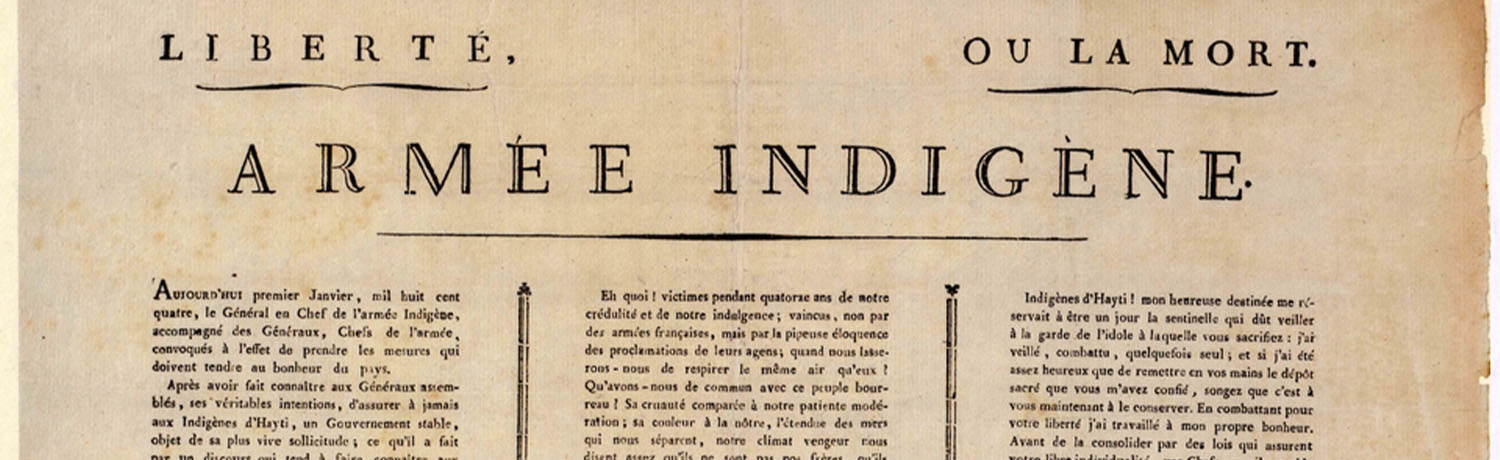
One of my favourite sources is the Haitian Declaration of Independence of 1804; I think it is a really extraordinary document. It is rhetorically powerful, but it is also conceptually very innovative. Haitian leaders took the universal language of liberty that had emerged from the French Revolution, and then turned it against the French Republic itself to assert independence. They exposed the tension between proclaiming universal rights and maintaining colonial domination.
11. What advice would you give to those who want to study history, whether as part of a degree at university, or beyond a university context?
Immerse yourself in primary sources. Reading history books is wonderful, and historians work very hard to synthesise complex material. But there is something really different about encountering the voices of the past directly. When you read a pamphlet written in the heat of political crisis, or a private letter expressing fear or hope, the past stops being distant and abstract. Working with primary sources restores contingency to the past; it reminds you that outcomes were not inevitable, even if they can appear that way in retrospect.
12. What are you planning to work on next?
Having just finished a book, I am still recovering. However, I am increasingly interested in how politics was taught in eighteenth-century universities, particularly in Scotland. Professors were discussing subjects such as sovereignty, empire, race, and revolution in lecture halls filled with future lawyers, clergy, and politicians. Teaching such material required careful judgement, especially when classroom discussions touched on live political controversies. It is another way of exploring the relationship between political theory and political reality, and how the two shape one another.
Read more from our Opening up history series
-
Opening up history: anti-nuclear activism during the Cold War
Read now to access more details of Opening up history: anti-nuclear activism during the Cold WarDr Luc-André Brunet is a senior lecturer in Contemporary International History at The Open University. As part of our Opening up history series, we speak to him about his current project on anti-nuclear activism.
-
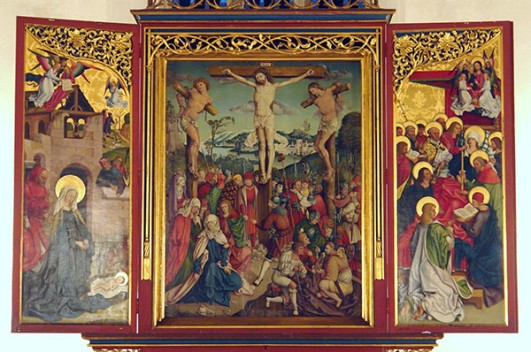
Opening up history: art in the Reformation
Read now to access more details of Opening up history: art in the ReformationIn this Opening up history conversation we speak to Dr Roisin Watson about her research on how Protestants used images and objects to express their faith in the Reformation.
-
Opening up history: political culture in eighteenth-century Ireland
Read now to access more details of Opening up history: political culture in eighteenth-century IrelandDr Suzanne Forbes is a senior lecturer whose current research focuses on ‘controverted’ elections in eighteenth-century Ireland. OpenLearn speaks to her as part of our Opening up history series, where we delve into the thoughts and work of OU historians.
-
Opening up history: religion and politics in the Elizabethan era
Read now to access more details of Opening up history: religion and politics in the Elizabethan eraHistorian Dr Neil Younger recounts his fascination with the Elizabethan era and the political dynamics of this period, which has led him to his current research project.
-
Opening up history: teaching transatlantic slavery in British schools
Read now to access more details of Opening up history: teaching transatlantic slavery in British schoolsIn this Opening up history conversation we speak to Dr Katie Donington, senior lecturer in Black, African and Caribbean History at The Open University, about her most recent project focusing on the teaching of slavery in British schools.

-
Opening up history: the intersections of tobacco consumption and modern war
Read now to access more details of Opening up history: the intersections of tobacco consumption and modern warDr Michael Reeve is a lecturer in Modern British History at The Open University. We speak to him here about his current research on smoking in wartime Britain, as part of our Opening up history series.
Like this? Try a FREE course
-
Early modern Europe: an introduction
Learn more to access more details of Early modern Europe: an introductionThe early modern period from 1500 to 1780 is one of the most engaging periods for historical study. Beginning with the upheavals of the Reformation, and ending with the Enlightenment, this was a time of fundamental intellectual, social, religious and cultural change. At the same time, early modern Europe was rooted in and retained many of the ...

-
The many guises of the emperor Augustus
Learn more to access more details of The many guises of the emperor AugustusThis free course focuses on Rome’s first emperor, Augustus, who lived from 63 BCE to 14 CE. The rule of Augustus marked a significant political change in Rome, and Augustus’ position as emperor was initially fragile and controversial. Key to his success in holding onto power was his masterful use of visual propaganda to cement his position and ...

-
The ethics of cultural heritage
Learn more to access more details of The ethics of cultural heritageThis free course, The ethics of cultural heritage, provides the basic theory behind the protection of cultural property in war zones and is presented in three parts: the protection of cultural property; the legal basis for that protection; and accounts of proportionality (that is, on deciding whether or not there is a feasible alternative to ...

Rate and Review
Rate this article
Review this article
Log into OpenLearn to leave reviews and join in the conversation.
Article reviews