1.2 Sequencing the genetic material
Following extraction and purification, sequencing is the next step in the metagenomic workflow. Sequencing means reading the genetic instructions stored in the DNA. DNA is like a long string made of four letters (A, T, G, C, the nucleotides). Sequencing tells us the exact order of those letters in a piece of DNA.
a.
A method used to copy DNA during cell division.
b.
A technique that determines the exact order of letters (nucleotides) in a piece of DNA
c.
A process in which RNA is translated into protein.
d.
A technique for separating pieces of DNA using an electric current.
The correct answer is b.
Metagenomics uses an approach called shotgun sequencing: the DNA is broken into many small pieces, which are sequenced all at once.
-
Why do you think the sequencing used in metagenomics is called a shotgun approach?
-
Because the DNA is broken into many random pieces, similar to how pellets from a shotgun spread out randomly when fired.
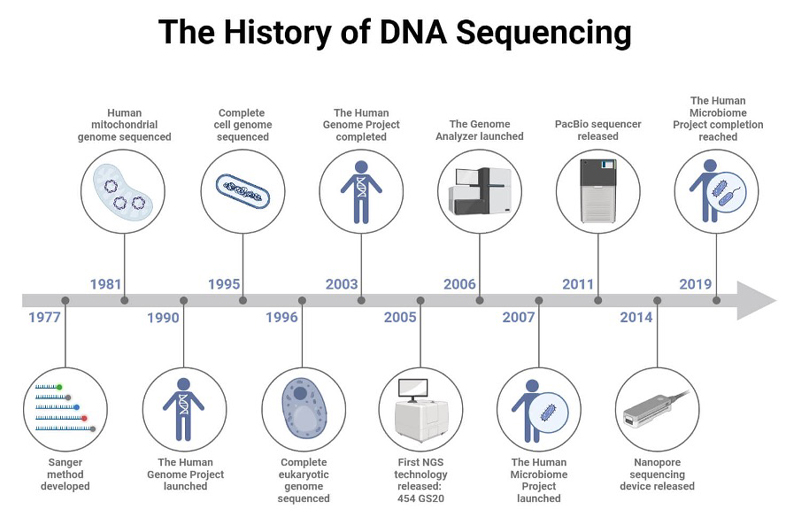
Scientists can use different approaches and instruments to sequence DNA, but they are beyond the scope of this course. It is worth pointing out that metagenomics became a reality and then reached its full potential thanks to the evolution of DNA sequencing methods.
It is important to note that early sequencing methods were slow and expensive. However, the advent of high‑throughput next‑generation sequencing in the early 2000s drastically increased speed while reducing cost, making it possible to sequence millions of DNA fragments simultaneously from a sample. More recently, new sequencing technologies that are higher in accuracy and can read longer stretches of DNA have further improved genome reconstruction and functional analysis.