
2.5 DNA is in the air
Environmental DNA can also be captured from the air by drawing air through filters or liquid collectors that trap tiny biological particles such as skin cells, hair fragments, pollen, fungal spores, and microscopic droplets carrying free DNA.
Active air samplers typically use fans or pumps to pull air through fine filters, while passive samplers rely on natural air movement to deposit particles over time. After sampling, DNA is extracted from the filters or liquid and analysed using metabarcoding or metagenomic sequencing to identify the organisms present.
Air eDNA can also sample terrestrial biodiversity across a wide area and multiple organisms simultaneously, reducing field effort and cost.
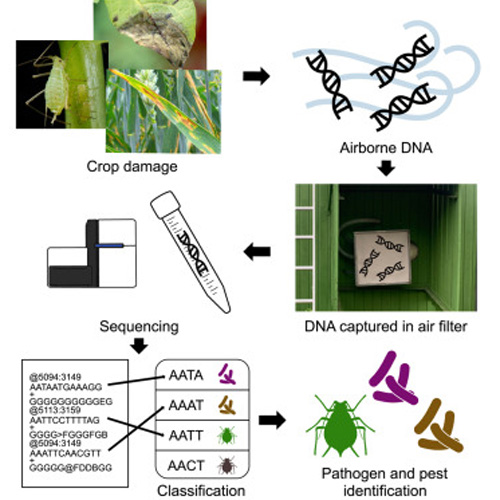
One area of particular interest is crop protection. By capturing and sequencing air DNA, farmers and researchers can detect crop pathogens (such as fungal blights or rusts) and insect pests before symptoms are visible. Early warning allows targeted interventions, reducing yield losses and avoiding unnecessary pesticide use.
Activity 3
Below you will find quotes from the abstract of a peer-reviewed research paper on airborne eDNA metagenomics (Nousias et al 2025). Read it through and then answer the questions.
‘Here we report the rapid application of shotgun long-read environmental DNA (eDNA) analysis for non-invasive biodiversity, genetic diversity and pathogen assessments from air. We also compared air eDNA with water and soil eDNA. Coupling long-read sequencing with established cloud-based biodiversity pipelines enabled a 2-day turnaround from airborne sample collection to completed analysis by a single investigator.’
‘From outdoor air eDNA alone, comprehensive genetic analysis was performed, including population genetics (phylogenetic placement) of a charismatic mammal (bobcat, Lynx rufus) and a venomous spider (golden silk orb weaver, Trichonephila clavipes), and haplotyping humans (Homo sapiens) from natural complex community settings, such as subtropical forests and temperate locations. The rich datasets also enabled deeper analysis of specific species and genomic regions of interest, including viral variant calling, human variant analysis and antimicrobial resistance gene surveillance from airborne DNA.’
‘Together these approaches can enable rapid simultaneous detection of all life and its genetic diversity from air, water and sediment samples for unbiased non-targeted information-rich genomics-empowered (1) biodiversity monitoring, (2) population genetics, (3) pathogen and disease-vector genomic surveillance, (4) allergen and narcotic surveillance, (5) antimicrobial resistance surveillance and (6) bioprospecting.’
Question 1
What is airborne environmental DNA (eDNA), and how was it used in this study?
Answer
Airborne eDNA consists of genetic material released into the air from organisms, such as cells, spores, pollen, or fragments of tissue. In this study, air samples were collected non‑invasively and analysed using sequencing to identify DNA from many different organisms at once, without targeting specific species.
Question 2
What types of biological information were obtained from air eDNA in this study?
Answer
The researchers obtained broad biodiversity data as well as detailed genetic information. From air alone, they carried out population genetics, identifying species such as bobcats and spiders, analysed human genetic variation, detected viral variants, and screened for antimicrobial resistance genes.
Question 3
What do you think could be an ethical implication of using airborne DNA sequencing, particularly in public spaces?
Answer
Privacy would be a key issue. Air eDNA can contain human DNA, and as shown in studies like the one above, it may be possible to detect human genetic variants unintentionally. This raises concerns about collecting genetic information from people without their knowledge or consent in public spaces.
Question 4
Among potential uses of airborne DNA sequencing, the authors also mention allergen surveillance. What do you think this implies, and how can it be used?
Answer
Allergen surveillance means monitoring airborne biological sources that can trigger allergic reactions. Pollen from plants, fungal spores (e.g. moulds), dust mites, or animal dander contain DNA or are associated with organisms whose DNA is present in the air. Sequencing air eDNA could improve allergy forecasts, help link symptoms of allergy to specific biological sources, and support public health responses to asthma and hay fever.