
1 What is metagenomics and how does it work?
All living organisms contain genetic material in the form of deoxyribonucleic acid (DNA) and ribonucleic acid (RNA), which store the information needed to build and maintain life. DNA and RNA molecules are not only found inside living cells, but are also released into the surrounding environment when the cells die or can be isolated from shedded hair, faeces, or other biological secretions.
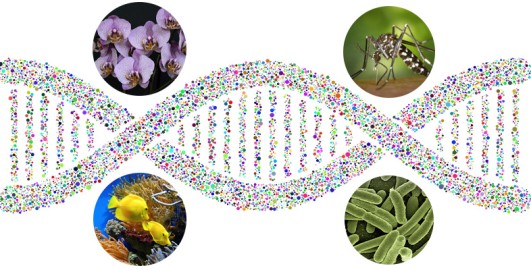
Click on the three environments in Figure 1 to discover which organisms live there.
The genetic material found in the environment can act like a molecular fingerprint, allowing scientists to study and identify entire biological communities without directly observing the organisms themselves.
If a genome is the complete set of genetic material found in a single organism or cell, then the collective genetic material from all organisms in a particular sample is called metagenome. Thus, metagenomics is the study of the collection of all individual genomes in the sample.
Besides allowing scientists to identify any living organism in the sample, metagenomics can also determine the genes that individuals have within their genome. Because genes contain instructions for making proteins, identifying the genes in a metagenome allows scientists to predict what functions the organisms can carry out in that environment, such as breaking down nutrients, producing energy, resisting antibiotics, or causing disease.
-
What is meant by the statement that metagenomics reveals ‘who is there and what they do’?
-
Metagenomics is the study of all genetic material found in an environmental sample. It tells us ‘who is there’ by identifying the organisms present based on their DNA or RNA, and ‘what they do’ by analysing the genes they carry. This predicts their biological functions and activities in that environment.
The origin of metagenomics can be traced to the late 20th century, when microbiologists sought ways to study microorganisms that could not be easily grown in the laboratory. More specifically, metagenomics as a term was first introduced by Jo Handelsman and colleagues in 1998 to describe the study of the combined genomes of microorganisms directly from environmental samples (Handelsman et al, 1998).
Now that you know what metagenomics is, it is time to get a bit more into how it works in practice.