
1.1 Stereotyping and prejudice
Activity 1
Watch the following short video about ageism and older people.
What are your initial thoughts having watched this video?
Comment
We hope you found that short video thought provoking - and that it helped you to think about how prevalent ideas about older age are and how easily assumptions can be made.
Let’s look at stereotypes and prejudice – how we think and how we feel.
Stereotypes (how we think)
Stereotypes are generalised, oversimplified ideas or beliefs about a group of people.
They dehumanise individuals by grouping people together under a label: a label that is often unrelated/unrecognisable to the individuals being labelled.
They do not consider individual differences, perspectives, preferences, aspirations and needs.
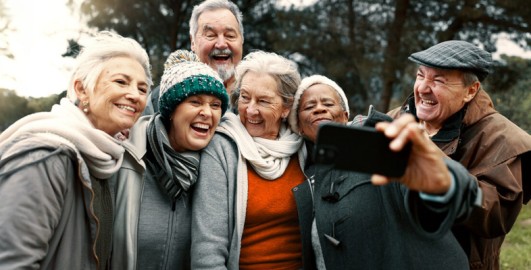
They can influence how we communicate (the language, terminology and images we use). One common example is that all older people are frail and vulnerable. This is a common depiction seen in the media, an image or video of an older person with wrinkled hands on a walking stick, for example.
Stereotypes can become harmful when:
- the stereotype is so strongly held that it overrides evidence that an individual who belongs to the group does not conform to
- they start informing how we feel and influencing how we act.
Prejudice (how we feel)
Prejudice can be defined as attitudes, feelings or judgements about members of other groups. They may be positive or negative, though are frequently negative.
Examples of negative prejudice include:
- all older people are ‘stuck in their ways’
- all older people enjoy financial security at the expense of younger people
- older people can’t use IT
- older people are a ‘drain’ on public services
- older people shouldn’t be working.
Hostile or benevolent
Stereotyping and prejudice against different groups in society does not take the same form. It can be hostile or benevolent.
A hostile example would be ‘older people are a drain on public services’.
Examples of benevolence include ‘all older women are like a kindly grandmother’. This is still ageist and has consequences in how we think, feel or act towards older people and ageing, it does not take account of the individual.