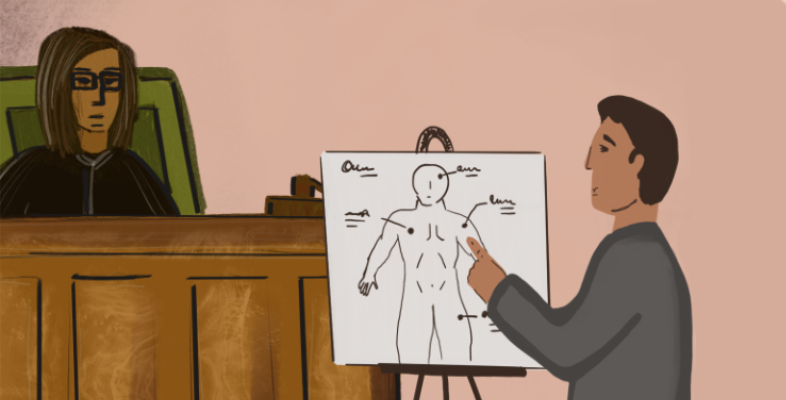
This free course gives an overview of the law of expert evidence, including practice and procedure, the duties and liabilities of experts, the question of how non-experts can adjudicate between the views of experts, and the increasing mathematisation of scientific evidence. The various issues are finally brought together in a case study of one of the most notorious miscarriages of justice in recent years.
A fascinating if concerning course! The safeguards for evidence given by 'expert' witnesses under the English legal system are clearly in a parlous state. The validity of 'hearsay evidence', the Prosecutor’s Fallacy, and the outright wrongdoing by experts confirms foundations made of sand. There is little prospect of 12 lay persons achieving a valid consensus if the expert witnesses are experts in name alone. Most laypersons would note 'Professor' and assume expertise, when the miscarriages of justice detailed clearly confirm that this cannot be assumed.
A wrongful conviction and subsequent, potentially very long-term, sentence is just too high a risk for the current status quo to be maintained. Indeed, juries are regularly dominated by strong personalities that may steer the interpretation of expert evidence, with no knowledge of the judge or appeal's process. [Added to the usage of the court officers to 'encourage' jurors to agree to a very prompt decision, so that they can be allocated to the next case!]
Some possible issues with the course notes:
4.1 Activity 4 Which expert opinions are true and valid?
Case 1:
Is should surely be Truth=True Validity=UNKNOWN, since 10% left-handed and 4% red-headed does not, necessarily, then imply that 10% of 4% is the probability.
Examples:
1) Evidence of INDEPENDENCE must be proven/known first in making the claim: if the trait occurs independently then the probability is indeed 0.4%; if red-headed people are more likely to be left-handed then the probability could be > 0.4%; if red-headed people are less likely to be left-handed then the probability could be < 0.4%.
2) Indeed, the possibility of MUTUAL EXCLUSION might also be a remote possibility, leading to a probability of 0%.
5 Box 4:
Whilst the survival rate from plane crashes has indeed been reported as 95% in the US NTSB reports, the definition of a crash includes many incidents that most would not classify as a 'crash'. If one were to consider only those that had any fatalities at all, then the figure drops considerably to below 20% (even then, this is very heavily skewed by Asiana Airlines 214's 99% survival rate.)
5.2 Activity 6 Cadaver detector dogs
Reverting back to the source document:
https://rss.org.uk/RSS/media/File-library/Publications/rss-case-assessment-interpretation-expert-evidence.pdf
Table 4.1 Cadaver dog signals in the presence or absence of cadaver scent
Dog’s response Scent present [body] Scent absent [no body]
1. Positive signal 224 4
2. No signal 11 115
Total 235 119
Proportion of signal/scent = 224/235 = 0.953
Proportion of no signal/scent = 11/235 = 0.047
Proportion of no signal/no scent = 115/119 = 0.966
Proportion of signal/no scent = 4/119 = 0.034
Within Activity 6:
"the probability of a body if the dog signals is 0.95 (224/224 + 11) or 95%" surely the dog has NOT signalled for the '11'.
"the probability of a body if the dog does NOT signal is 0.03 (4/ 4 + 115) or 3%" -> surely the dog HAS signalled for the '4'.
Within activities 6 and 7 denominator parentheses are missing.
A wrongful conviction and subsequent, potentially very long-term, sentence is just too high a risk for the current status quo to be maintained. Indeed, juries are regularly dominated by strong personalities that may steer the interpretation of expert evidence, with no knowledge of the judge or appeal's process. [Added to the usage of the court officers to 'encourage' jurors to agree to a very prompt decision, so that they can be allocated to the next case!]
Some possible issues with the course notes:
4.1 Activity 4 Which expert opinions are true and valid?
Case 1:
Is should surely be Truth=True Validity=UNKNOWN, since 10% left-handed and 4% red-headed does not, necessarily, then imply that 10% of 4% is the probability.
Examples:
1) Evidence of INDEPENDENCE must be proven/known first in making the claim: if the trait occurs independently then the probability is indeed 0.4%; if red-headed people are more likely to be left-handed then the probability could be > 0.4%; if red-headed people are less likely to be left-handed then the probability could be < 0.4%.
2) Indeed, the possibility of MUTUAL EXCLUSION might also be a remote possibility, leading to a probability of 0%.
5 Box 4:
Whilst the survival rate from plane crashes has indeed been reported as 95% in the US NTSB reports, the definition of a crash includes many incidents that most would not classify as a 'crash'. If one were to consider only those that had any fatalities at all, then the figure drops considerably to below 20% (even then, this is very heavily skewed by Asiana Airlines 214's 99% survival rate.)
5.2 Activity 6 Cadaver detector dogs
Reverting back to the source document:
https://rss.org.uk/RSS/media/File-library/Publications/rss-case-assessment-interpretation-expert-evidence.pdf
Table 4.1 Cadaver dog signals in the presence or absence of cadaver scent
Dog’s response Scent present [body] Scent absent [no body]
1. Positive signal 224 4
2. No signal 11 115
Total 235 119
Proportion of signal/scent = 224/235 = 0.953
Proportion of no signal/scent = 11/235 = 0.047
Proportion of no signal/no scent = 115/119 = 0.966
Proportion of signal/no scent = 4/119 = 0.034
Within Activity 6:
"the probability of a body if the dog signals is 0.95 (224/224 + 11) or 95%" surely the dog has NOT signalled for the '11'.
"the probability of a body if the dog does NOT signal is 0.03 (4/ 4 + 115) or 3%" -> surely the dog HAS signalled for the '4'.
Within activities 6 and 7 denominator parentheses are missing.