How Best to Use This Online Spanish Course for Kids
About This Spanish Course for Kids
This course includes eleven complete bilingual (English-Spanish) stories with a total listening time of approximately two hours.
Each story is available as an audiobook and in written form, so children can listen, read, or do both.
Every story also includes supporting materials designed to reinforce Spanish vocabulary in a natural way.
You will find Spanish word lists, fun game ideas using the story vocabulary, a printable word search puzzle, and a printable coloring sheet connected to the characters and themes.
The stories are the foundation of this Spanish for kids course. The activities are optional extensions. Use what supports your child’s interest and personality.
The goal is to make Spanish feel enjoyable, familiar, and approachable.
Why These Bilingual Stories Are Different and Especially Effective for Teaching Kids Spanish
Many bilingual picture books for babies and toddlers use a paired sentence format simply because there are only one or two sentences per page.
The sentences might be paired together on the same page or spread out across two pages. Here is an example bilingual baby picture book:
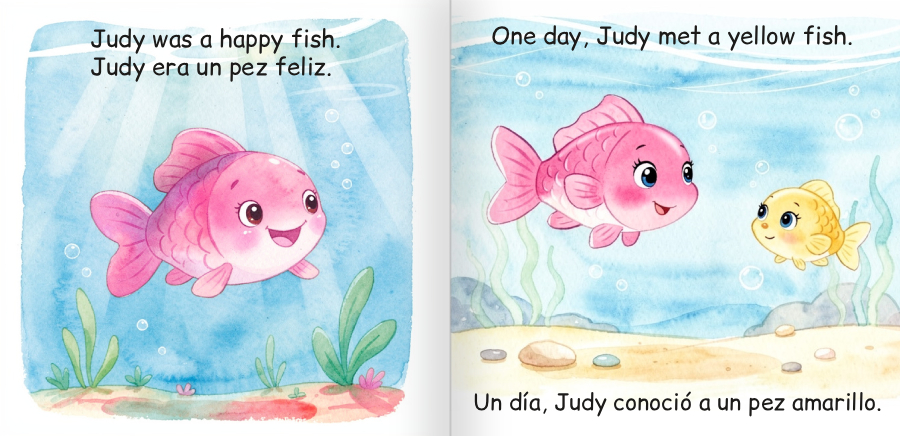
While that paired sentence format is ideal for language learning at all ages, publishers typically only use it for picture books for ages 0-3. And due to the extremely simple, short stories and basic plots, older kids quickly get bored and outgrow these baby books.
When it comes to longer stories for ages 6 to 12 and above, traditional publishers do not use a sentence-by-sentence translation approach. Instead, they usually publish one full book in Spanish and a separate version in English. That forces language learners to switch between two copies, which breaks attention and interrupts immersion.
Other publishers create so called parallel-text bilingual books, where one full page is in English and the facing page is in Spanish.
Example parallel-text book:
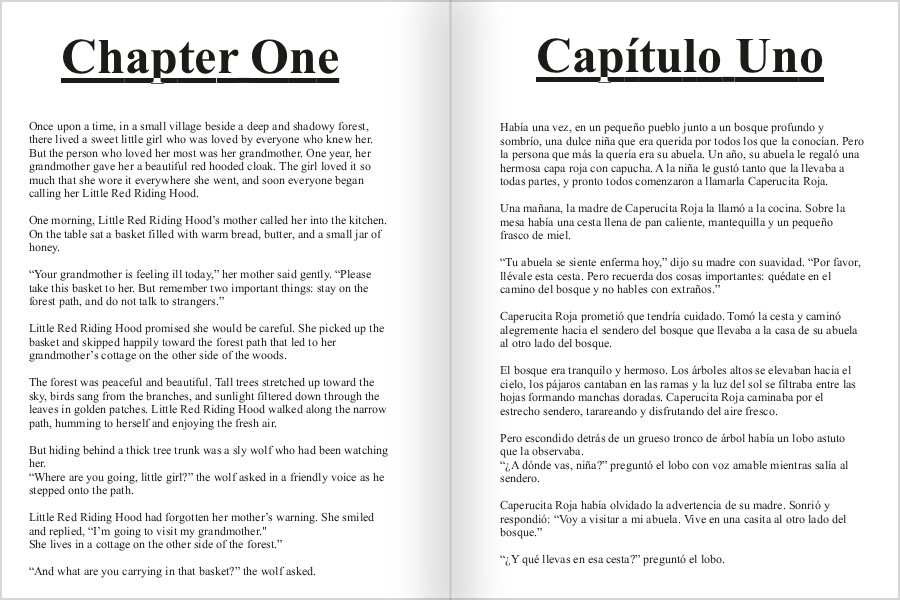
On paper, that format sounds helpful. In practice, it often creates separation and confusion.
The child reads the English page first and understands everything. Then they look at the Spanish page but may skip it because they already know what happens and feel little motivation to read it again.
If they do try to read the Spanish page, a new problem appears. To understand it, they have to remember a long and detailed scene they just read in English. That requires holding a lot of information in their memory at once.
Many children lose track, get confused, and start flipping back to the English page to find the matching sentence. They search for the right spot, compare lines, and try to piece the meaning together, or are forced to constantly refer to a dictionary to decipher the Spanish page's content.
This constant switching breaks attention. It interrupts the flow of the story. The sense of immersion disappears. What was once enjoyable becomes effortful. Frustration builds, and motivation drops.
If they attempt to read the Spanish page first, comprehension often falls quickly. When too much feels unclear, they jump back to the English page for safety. Over time, this can lead to avoiding the Spanish entirely.
In both cases, the story’s rhythm is broken, and the desire to engage with Spanish weakens.
It can be especially challenging for younger kids with shorter attention spans.
The stories in this course are different.
This course includes original bilingual stories by LingoLina™ that use LingoLina's NeuroFluent Immersion Method with sentences consistently paired throughout the entire book.
Example:
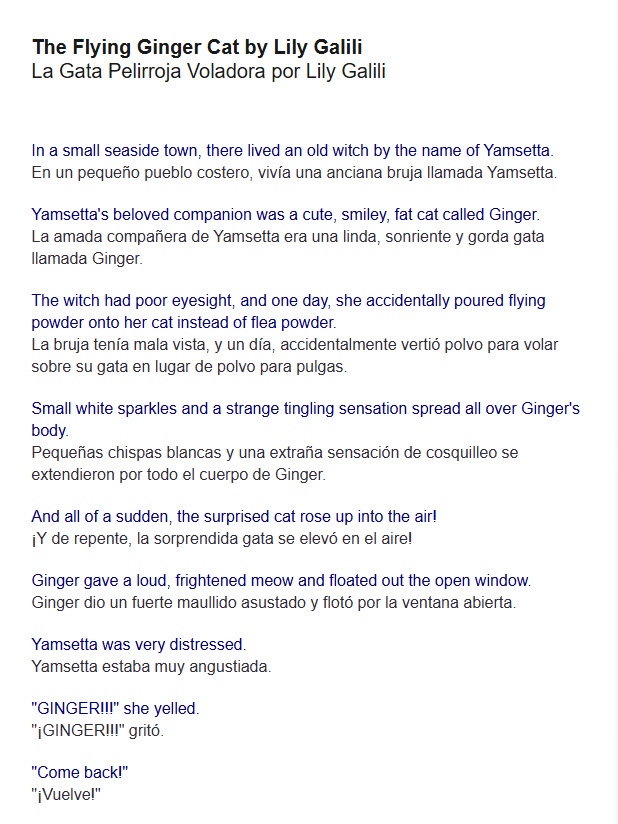
No matter the child’s age or the length of the story, they’ll be able to follow along easily and understand what they hear in Spanish because each sentence appears first in English and then immediately in Spanish.
The child never has to flip pages, hold two books, or memorize an entire long, detailed page before understanding the translation.
This sentence-by-sentence bilingual pairing creates continuous comprehension. The story moves forward smoothly. The child understands what is happening at every step.
Spanish words are introduced in real time while the scene is still vivid in the child’s imagination.
As a result, the brain links new Spanish words to words and concepts the child already knows in English. The brain easily builds connections between the two.
Vocabulary connects naturally. Grammar patterns become familiar. Word order starts to make sense without formal explanation.
Over time, the Spanish begins to stand on its own.
The bilingual story remains enjoyable while Spanish becomes increasingly natural.
Learning Spanish happens without effort because comprehension is never lost.
How to Use This Story-based Spanish for Kids Course Effectively
The most powerful way to use bilingual stories is simple: make them part of your child’s daily rhythm.
Consistency matters more than intensity. Ten to twenty minutes a day is far more effective than one long session once a week. The brain learns through repetition.
Repetition is also very helpful. Hearing the same story multiple times strengthens neural pathways and builds deeper familiarity with sentence structures and vocabulary. Children often enjoy repetition because familiar stories feel safe and satisfying.
Bedtime is one of the most effective times for language learning. When children listen to a story before sleep, the brain continues processing what it heard. During sleep, memory consolidation takes place. New Spanish words begin settling into long-term memory. A calm bilingual story before bed is both relaxing and powerful for learning.
Encourage your child to listen and read the bilingual stories whenever possible. Listening strengthens Spanish pronunciation, accent, listening comprehension, and rhythm. Reading builds visual recognition of Spanish words, Spanish reading comprehension, writing skills, and reinforces spelling patterns. Together, they naturally increase comprehension and develop Spanish fluency.
After reading the stories, reinforce the new Spanish words through play and games using ten Spanish words from the story. Act out scenes. Draw characters. Use puppets to roleplay parts of the story. Invent a sequel. Play simple vocabulary games, activity games, and movement-based games.
When language is connected to movement and creativity, it becomes part of the child’s lived experience. For more structured ideas, you can explore our Spanish language learning Games and Play Course.
Word puzzle games are helpful reinforcement tools. They strengthen vocabulary recognition without turning the experience into a test. Printable coloring sheets connected to the characters create positive emotional associations with Spanish.
Avoid turning story time into a formal lesson. Do not pause constantly to explain grammar. Do not quiz your child on translations. If your child asks about a word, explain it briefly and continue the story. The strength of this method lies in relaxed, meaningful exposure.
Do not pressure your child to speak early or perfectly. Speaking grows out of comprehension. With regular reading or listening, many children show clear understanding within three to four months. Speaking often begins between four and six months. With steady exposure, conversational comfort and fluency typically develop within twelve to eighteen months. Every child progresses at a slightly different pace, but consistent input leads to steady growth.
Focus on enjoyment first. The goal is not perfect pronunciation or memorization. The goal is familiarity and comfort with Spanish. From that foundation, everything else grows naturally.
Spanish for kids does not have to be stressful. It does not need drills, pressure, or forced memorization.
When children enjoy the story, and can follow along easily, the Spanish language develops naturally in the background.
Let’s begin!
Related Courses
Interested in the science behind the bilingual story method and how it teaches kids Spanish naturally?
If you would like a deeper explanation of The Story Method, including a closer look at the research, science, and learning principles behind it, you can study the full Story Method theory course here.
If you want to explore how to use games and playful activities to reinforce the Spanish words learned in the stories, and gently check your child’s progress in a fun way, enroll next in the complete Games and Play Method course here.
For a deeper understanding of why reading bilingual stories before bedtime helps your child retain new Spanish words longer in their memory, enroll in our course on the method of teaching kids Spanish with Bedtime Stories.
To learn more about the lifelong benefits of bilingualism and practical techniques for raising bilingual children, you can also enroll in our Bilingualism course here.