

8 Independent t-tests
In previous activities, you learned how to enter data into Jamovi, explore datasets using descriptive statistics, and investigate relationships between variables using correlations. In this activity, you will learn how to carry out an independent samples t-test in Jamovi.
Like correlations, t-tests are used to test research hypotheses. A hypothesis is a prediction about what researchers expect to happen in a study. In experimental research, hypotheses often predict that there will be a difference between groups or conditions.
While correlations investigate relationships between variables, t-tests investigate differences between groups or conditions. For example, researchers may wish to compare whether one group scores higher or lower than another, or whether participants perform differently before and after an intervention.
An independent samples t-test is used when researchers want to compare the average scores of two separate groups or conditions. This type of test is commonly used in experiments and other studies where different participants take part in each condition.
Activity 7: Independent samples t-tests
The video uses a fictional research example based on a study investigating how people respond when witnessing a conflict between two individuals. Participants are shown one of two versions of a video depicting an argument and are then asked to rate how willing they would be to intervene. The study explores whether participants respond differently depending on whether they believe the individuals are strangers or in a relationship.
As you work through the activity, you will learn how to:
- identify the independent and dependent variables in an independent groups design
- run an independent samples t-test in Jamovi
- check assumptions such as homogeneity of variance
- interpret descriptive and inferential statistics from the output
- report and interpret the results of an independent samples t-test appropriately.
The video will guide you through selecting variables for analysis, choosing the correct t-test options, and interpreting the output produced by Jamovi, including means, standard deviations, t-values, p-values, and effect sizes.
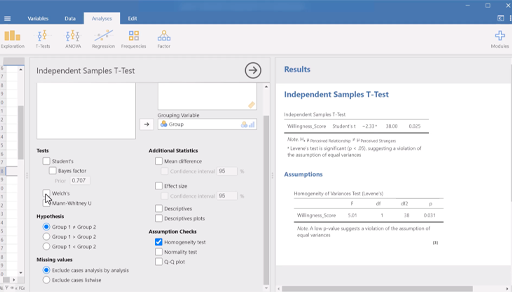
Transcript: Video 6: Independent t-test
File: Independent t-test [Tip: hold Ctrl and click a link to open it in a new tab. (Hide tip)]
Now you have seen how to carry out an independent samples t-test in Jamovi, you can practise these skills yourself using the example dataset provided alongside this activity. Try reproducing the same analysis and explore how changing different options within the t-test menu affects the output. You can download a PDF version of this tutorial, and the dataset used in it below: