
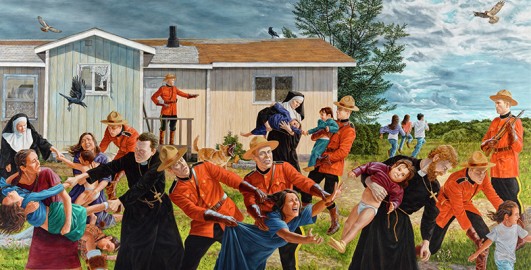
Who gets to be a human? Religion in colonial histories and Indigenous resistance
Introduction
The global challenge of growing inequalities is intricately linked to the distinction made between those historically regarded as human and those not. You may wonder why the question ‘Who gets to be a human?’ matters. Historically, not all people were considered fully human. Some were considered rational, civilised, and intelligent, thus human, while others were labelled as barbarian, animal-like, or primitive, and therefore not fully human.
This division between ‘civilised’ and ‘non-civilised’ played a vital role in justifying the colonisation and enslavement of those who were deemed ‘lesser human’, ‘other human’, or ‘non-human’, along with the perception of their lands as empty and waiting to be exploited.
The ‘Age of Discovery’, a wave of European colonisation which took place between the fifteenth and seventeenth centuries, marked the beginning of a new era in which European empires established control over so-called ‘discovered’ lands, framing them as terra nullius exploiting both the people and resources of these regions.
In this course, you will explore how some religions and religious categories were conceptualised and employed in ways that contributed to dehumanising colonised individuals and communities, many of whom organise and identify as Indigenous today. The capital ‘I’ in Indigenous indicates experiences of enduring shared colonial histories, as well as political initiatives for the recognition of collective rights.
This OpenLearn course is an adapted extract from the Open University course DA332 Religion and global challenges in the past and present [Tip: hold Ctrl and click a link to open it in a new tab. (Hide tip)] .