
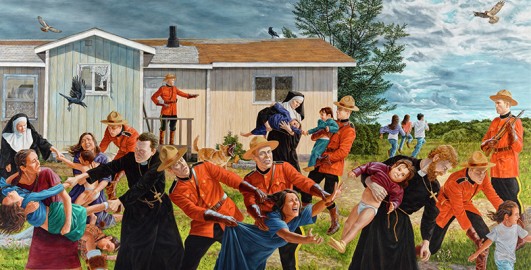
2.2 Colonising hair
Cutting hair was a key part of assimilation processes and was often one of the first experiences children encountered when entering school. Cutting hair signified more than a mere physical change. For many communities, hair carries deep meaning, embodying and reflecting their values, experiences and relationships.
Watch the following video, where a survivor of a residential school, Fred, shares the impact that cutting hair had on him:
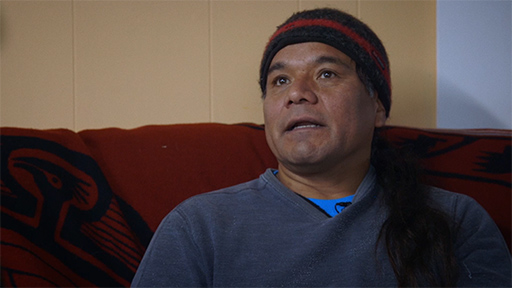
Transcript: Video 1: Fred recalls hair cutting in residential school as an attack on identity
Activity 4 Religion and colonialism
In this part of the course, you learned about Tuhiwai Smith’s understanding of colonialism and residential schools for Indigenous children in North America. Complete the questions below based on what you have learned about the role of religious institutions in colonialism:
1) Who ran the residential schools for Indigenous children in Canada?
Using the following two lists, match each numbered item with the correct letter.
-
Catholic Church
-
Anglican Church
-
other Christian denominations
Match each of the previous list items with an item from the following list:
a.and the remaining 10 per cent were run by
b.30 per cent by the
c.60 per cent of residential schools were run by
- 1 = c,
- 2 = b,
- 3 = a
a.
1891 in US and 1917 in Canada
b.
1987 in US and 1990 in Canada
c.
1941 in US and 1945 in Canada
d.
1978 in US and 1997 in Canada
The correct answer is d.
a.
Christianity was taught as the only true religion.
b.
Children were introduced to Christianity but could continue to follow their Indigenous practices and knowledges.
c.
Children’s names were changed to Christian names.
d.
Children could choose an additional Christian name while keeping their birthname in their mother tongue.
The correct answers are a and c.