
2 Religion and colonialism
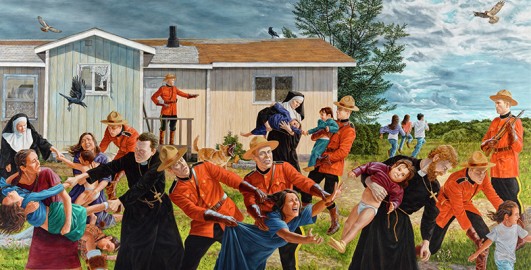
When European powers colonised North America, known as Turtle Island to many Native American peoples, Christian churches played a major role by operating government-funded residential schools in what today is known as Canada and the United States of America. In Canada, 60 per cent of residential schools were run by the Catholic Church, 30 per cent by the Anglican Church and the remaining 10 per cent were run by other Christian denominations (Feir, 2016).
Residential schools were a core part of colonialism, a system of domination that, in words of Tuhiwai Smith (1999, p. 31), ‘brought complete disorder to colonised peoples, disconnecting them from their histories, their landscapes, their languages, their social relations and their own ways of thinking, feeling and interacting with the world.’
Regardless of the disruptive and dehumanising nature of colonialism, it was presented as something beneficial for the colonised peoples. The means by which this narrative was implemented was through the promises of salvation, modernisation and civilisation. For this to hold any kind of credibility, the colonised peoples had to be imagined as uncivilised and in need of such salvation, a perception effectively reinforced by the term ‘primitive’.
Thousands of children passed through the schools, many of whom were forcibly removed from their families. Children in residential schools experienced widespread physical, mental, and sexual abuse. Many died, and those who survived continue to carry generational traumas. Residential schools actively operated until the 1970s, with the last ones closing in the United States in 1978 and in Canada as late as 1997.