
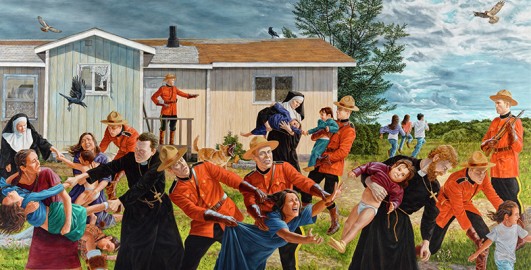
1 Colonisation and race: The making of ‘us’ and ‘them’
People have long categorised themselves into ‘us’ and ‘them’. It is common to make such distinctions as we navigate our lives. However, some ‘us’ and ‘them’ separations create far more powerful divisions, especially when supported by political, educational, and religious institutions.
Activity 1 Am I one of ‘us’ or one of ‘them’?
Take a moment to reflect on who you include when you think of ‘us’ and who you imagine as ‘them.’ Consider your participation in these groups.
- Did you choose to be part of them, or were you included by default?
- Have you ever moved from one group to another?
- What factors define belonging in these groups?
Discussion
You might have come up with a wide range of different examples of groups here. This might have included groups of ‘us’ that you identify with and that you potentially can choose to join or leave, like groups of friends, team-mates or neighbours. However, membership of some groups can be more fixed, such as family or fellow citizens of the same nation-state, which are often determined by birth or external institutions. Inclusion in or exclusion from these groups can therefore often be harder, though not always impossible, to change, for example through marriage, or gaining an additional citizenship.
Many scholars argue that most inequalities are rooted in ‘us’ and ‘them’ divisions. The French philosopher Bruno Latour (1993, p. 97) calls this creation of polarities the Great Divide and traces it back to a conceptual division between humans and non-humans.
In the late seventeenth and eighteenth centuries, the Enlightenment emerged as a major intellectual movement centred on human reason and scientific knowledge. Humans became not only the subjects and objects of knowledge but a classificatory category, giving rise to one of history’s most divisive and destructive constructs – race.
According to a widely influential and celebrated Enlightenment philosopher Immanuel Kant (1724–1804), Native Americans were seen as the lowest of the four races (‘incapable of being educated and too weak for work in the fields’); the ‘Negroes’ were placed above (‘capable of being trained to be slaves but not in any other form of education’); the ‘Hindus’ as superior to ‘Negroes’ (‘capable of being educated in the arts, but not in the sciences’); and the ‘whites’ as ‘superior and the only non-defiant race’ (Kleingeld, 2007, p. 576–577).
As a result, colonised peoples were judged and classified by their suitability for enslavement and exploitation and deliberately placed at the bottom of racial hierarchies to justify colonial domination.