
Conclusion
In this course, you have explored how religion, religious institutions and religious categorisations have played a role in colonising projects. You were introduced to three important concepts – colonisation, colonialism and coloniality. You learnt that although related, each of them describes a different set of processes.
In reflecting on colonial histories, you have been introduced to the formative role of binaries like ‘civilised’ versus ‘primitive’ and ‘us’ versus ’them’ in justifying colonising and civilising missions imposed on colonised peoples. You learnt about the processes and consequences of classifying ‘humans’ and ‘religions’ into hierarchies. You learned the impact of defining Christianity as a religion of ‘civilised people’ and shamanism as a religion of ‘primitive people’. Thus, you now have the skills to critically approach other concepts and binaries that you may have been taking for granted.
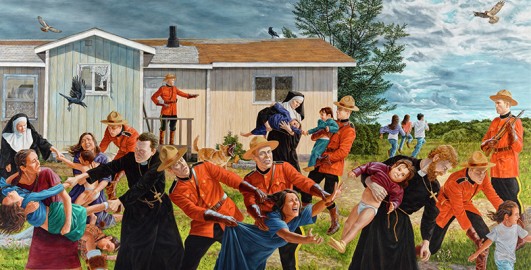
You were introduced to various examples of colonising projects and initiatives, from the conquest of lands deemed empty or wild to economic exploitation and the control of colonised communities and their knowledges. At the same time, you explored how Indigenous peoples resisted these processes. Practices such as mapping, residential schools, and joik illustrate both the imposition of colonial power and the forms of anti-colonial resistance that emerged in response. These topics are explored in greater depth and detail in the Open University course DA332, Religion and global challenges in the past and present [Tip: hold Ctrl and click a link to open it in a new tab. (Hide tip)] .
Activity 7 Key terms
Match the following terms with their definitions based on what you learned in the course.
Using the following two lists, match each numbered item with the correct letter.
-
Coloniality
-
Colonialism
-
Colonisation
Match each of the previous list items with an item from the following list:
a.Process of imperial conquest, ‘discovery’ and physical establishment of colonies in ‘new’ lands.
b.Process of establishment of entire systems of control and exploitation of colonised communities.
c.Process of controlling and management of knowledge by universals of Western modernity and Eurocentrism.
- 1 = c,
- 2 = b,
- 3 = a