
1.1 Under the colonial gaze: dehumanising and demonising shamans
The Indigenous Māori scholar Linda Tuhiwai Smith (1999, p. 28) argues that the categorisation of ‘primitive peoples’, based on colonial hierarchies of race, excluded Indigenous peoples not only from the realm of civilisation but from humanity itself. You will now learn how an example of a ‘shaman’ illustrates Tuhiwai Smith’s observation.
The drawing shown in Figure 1 is one of the first recorded accounts of shamans, depicted by the Dutch statesman Nicolaes Witsen (1641–1717). The word ‘shaman’ comes from the Evenki word šaman or xaman, which can loosely be translated into ‘agitated’, ‘excited’ or ‘raised’ (Znamenski, 2007, p. viii). Evenki are a Tungusic-speaking people of North Asia, whose lands currently stretch across the nation states of Russia, China and Mongolia.
Activity 2 Shaman and the colonial gaze
Take some time to examine Figure 1.
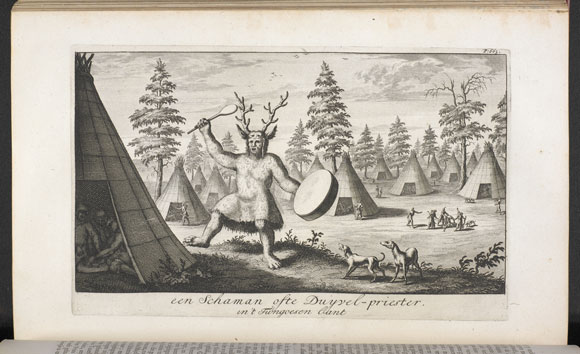
- Who or what do you think is depicted in this picture?
- Would you think that shamans were humans or some mythical creatures based on this image?
Discussion
The presence of animal claws, furry skin and reindeer horns all suggest that shamans were not really humans. This depiction of an Evenki shaman was not produced with the Evenki audience in mind. It was made by Nikolaes Witsen for a European public, whom he likely hoped to impress with his travels in ‘mysterious’ lands previously not known to his audience. Coupled with the caption ‘the priest of the Devil’, this image represents an example of visual dehumanisation and the beginning of centuries-long demonisation of Indigenous religious practitioners categorised as shamans.
Witsen never personally encountered Evenki šaman and never visited Evenki lands during his brief travel to Russia between 1664 and 1665. His reports were largely based on stories he had heard from people he met during his travels.
Despite the questionable (indeed non-existent) evidence supporting Witsen’s account, his depiction of an Evenki šaman marked the start of the West’s ongoing fascination with shamans, who were believed to have abilities like being able to turn their bodies into animals, perform magic tricks and, most characteristically, leave their human bodies for spirit journeys, often with the use of drums. Stories about dark spirits tormenting shamans during their initiations, often defined as ‘shaman illness’, were of great interest to Europeans, who were keen to find a scientific explanation to such bodily experiences.
Most of the ethnographers studying Siberia came from Christian backgrounds and used Christian vocabularies to describe local practitioners and knowledge-holders, some of whom they described as shamans. Shamans were depicted as half-human, half-animal beings and as servants of the Devil, playing a significant role in feeding the colonial fantasies of European explorers eager to discover curiosities and wonders in the ‘newly explored worlds.’
In his study of shamans, Swedish historian of religion Olle Sundström (2012, p. 356) argues that ‘depicting foreign people’s spiritual and political leaders as frauds, maniacs or devil-worshippers could be the only reason needed to motivate colonisation and the subjugation of the land and the peoples’. The Russian conquest of Siberia, began in the sixteenth century and was strongly driven by economic motives. In particular, there was a significant interest in Siberian fur, often referred to us ‘soft gold,’ which at that time functioned as an important global currency.
Over time, the term ‘shaman’ was applied not only to Evenki šaman but also to various Indigenous practitioners in Siberia and then across colonised regions worldwide. Their knowledges, practices and worldviews were collectively categorised as ‘shamanism.’ What these people shared was not necessarily similar practices or skills, but a common experience of being defined through a colonial gaze – one that, at best, objectified and exoticised them, and at worst, demonised, criminalised, and dehumanised them.