
 article icon
Science, Maths & Technology
Centrifugal casting
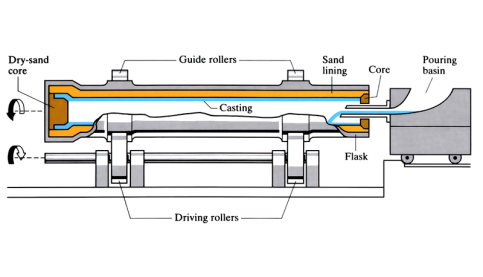
Typically used to cast hollow cylinders or pipes. The casting process is not by gravity or applied pressure, but by centrifugal forces. Molten metal is poured directly into a mould, which is rotated at high speed. Centrifugal force projects the metal outwards from the rotational axis and onto the walls of the mould.
 article icon
Society, Politics & Law
Explainer: how do you read an election poll?
Kevin McConway helps to demystify election polls.
 free course icon
level 2: intermediate icon
free course icon
level 2: intermediate icon
Science, Maths & Technology
Obesity: balanced diets and treatment
The incidence of obesity is on the increase in affluent societies, and the phenomenon commands increasing attention from health professionals, legislators and the media. This free course, Obesity: balanced diets and treatment, looks at the science behind obesity, examining the dietary, physiological and genetic aspects of the topic.
 article icon
Science, Maths & Technology
Full mould casting (evaporative pattern)
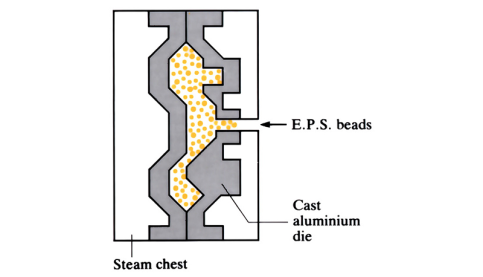
A pattern is made from fused polystyrene beads heated in an aluminium die. Once cooled, the pattern is coated with a refractory compound, before being placed in a flask and surrounded by sand. A vacuum is applied to the flask and molten metal is poured into the pattern. Molten metal vaporises the polystyrene material as it flows into ...
 article icon
Science, Maths & Technology
Melt casting
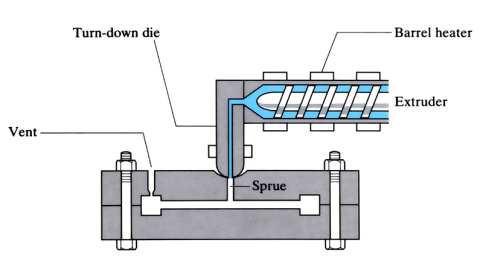
Molten polymer is extruded, via a sprue, into the closed mould cavity formed from two parts bolted together. The mould is vented, and once polymer leaks from the vent, extrusion stops and the material is left in the mould to solidify. Bolts are removed and the component is extracted.
 article icon
Science, Maths & Technology
Monomer casting
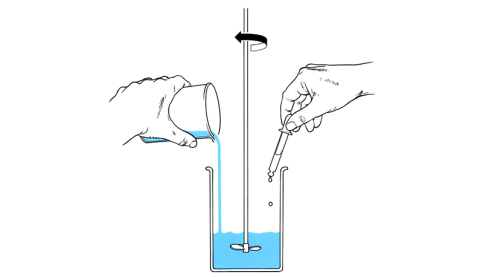
A non-pressurised casting process using a controlled chemical reaction of polymer materials. The monomer is mixed with an initiator (catalyst), before pouring into the mould. Whilst the mixture is curing inside the mould, polymerisation takes place. Once cooled, the component is removed from the mould.
 audio icon
Society, Politics & Law
Syria, Spitsbergen and Seeds
How are the civil war in Syria, the remote Norwegian island of Spitsbergen, and the future of the world’s food supplies connected?
 article icon
Science, Maths & Technology
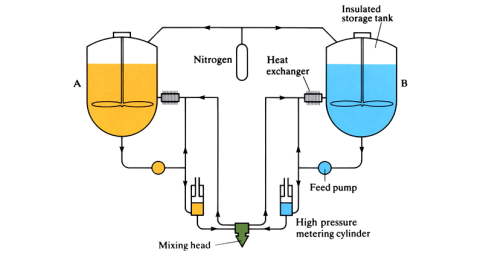
Reaction injection moulding (RIM) and Reinforced reaction injection moulding (RRIM)
In reaction injection moulding, two types of monomers are mixed together before being injected into a mould, where they polymerise to form the plastic component. In reinforced reaction injection molding, reinforcing agents are added to the monomer mixture.
 article icon
Science, Maths & Technology
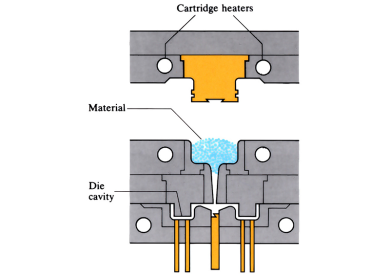
Transfer moulding
Similar to compression moulding, however, the polymer material is not placed directly into the die, but is often pre-heated before being loaded into a separate heated pot chamber situated above the die. A hydraulic plunger (ram) forces the polymer into the die cavity via a sprue. When cured, the moulded component is released using ejector pins.
 article icon
Science, Maths & Technology
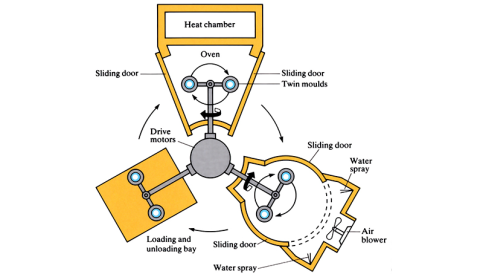
Rotational moulding (Rotational or rotary casting)
A low pressure and high-temperature process for moulding hollow plastic components. Three separately rotating ‘arms’, with moulds connected to each, revolve bi-directionally around their axes. One arm is for loading and unloading of moulds, another arm is rotating within an oven, and the third arm holds a cooling chamber. The mould is opened to ...
 article icon
Science, Maths & Technology
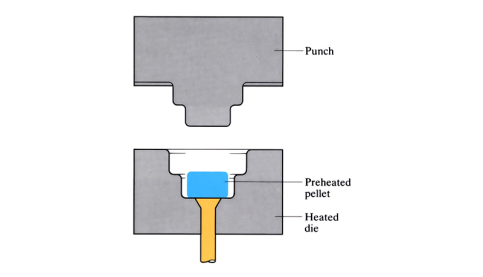
Compression moulding
A preheated pellet of thermoset plastic is placed into the bottom half of a heated die. The top half of the die (punch) compresses the molten plastic into the shape of the die. After curing under heat and pressure, the moulded component is ejected.
 article icon
Science, Maths & Technology
Squeeze casting and squeeze forming
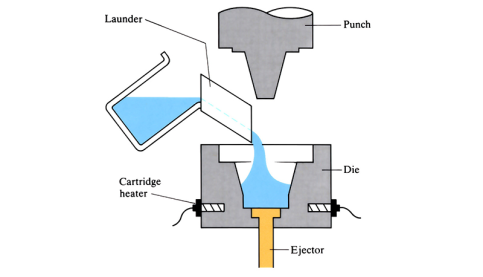
Molten metal is poured into the bottom half of a pre-heated die cavity. As the metal starts to solidify, the top half of the die (punch) is pressed into the bottom half and held in position until the casting has solidified. The cast component is then ejected.