Gothic art
Gothic art is a multifaceted term closely linked to Gothic architecture, which began to emerge in France around 1137 with the restoration of the Abbey Church of St-Denis. This architectural style integrated sculpture prominently, featuring larger portals and figures adorning church facades, evolving until the late Gothic period when carved altarpieces and reredos became focal points in ecclesiastical structures. Gothic painting, which diverged from Romanesque art, emerged around 1200 and reflected similar geographic spread, beginning in France around 1144 and extending throughout Europe by the 13th century, establishing itself as the international style despite a less distinct transition in sculpture and painting compared to architecture.
The majority of Romanesque churches were superseded by Gothic structures, especially in economically flourishing regions, while Romanesque buildings remain in areas that experienced economic struggle. The Gothic style facilitated the creation of larger windows, leading to iconic stained glass artistry, which is widely recognized as emblematic of the Gothic era, though original glass pieces, like those at the Sainte-Chapelle in Paris, are now rare. Additionally, most Gothic wall paintings have been lost, although they were commonly found in parish churches. Secular buildings also featured such adornments; however, royalty favored the more costly tapestries, which they transported across their various residences and during military campaigns. An exemplary collection of late-medieval textile art was acquired during the Battle of Nancy, where the Swiss defeated Charles the Bold, Duke of Burgundy, seizing his baggage train.

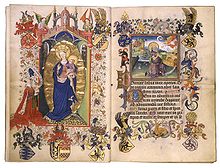
During the Gothic period, there was a notable focus on the Virgin Mary, with the Virgin and Child becoming central to Catholic art. This period also saw an increase in the portrayal of saints, introducing visual attributes that helped identify them for an illiterate public. Panel painting gained prominence, especially for altarpieces and polyptychs, transitioning from earlier Byzantine influences, primarily in Italy. Artists like Cimabue, Duccio, and Giotto were pivotal in establishing a distinct Western style that paved the way for Renaissance painting. International Gothic, spanning from about 1360 to 1430, served as a courtly expression before Gothic art evolved into Renaissance styles, marked by a revival of classical composition and realism.
Key figures like Nicola Pisano and Giotto were influential during this transition. A significant work of this era is the Très Riches Heures du Duc de Berry. The transition to Renaissance styles varied regionally, with Early Netherlandish painting representing a blend of Gothic and emerging Renaissance aesthetics. The Protestant Reformation contributed to the decline of Gothic art in Protestant regions, due to its links with Catholicism. Although the early 15th-century Italian Renaissance introduced linear perspective, Gothic painting had already made strides in naturalistic representations, albeit without prioritizing perspective as a crucial element. Late Gothic sculpture exhibited increased naturalism, and while artists attempted to depict spatial relationships, their methods frequently lacked systematic adherence to scaled representations.
The end of the period includes new media such as prints; along with small panel paintings, these were frequently used for the emotive andachtsbilder ("devotional images") influenced by new religious trends of the period. These were images of moments detached from the narrative of the Passion of Christ designed for meditation on his sufferings, or those of the Virgin: the Man of Sorrows, Pietà, Veil of Veronica or Arma Christi.
The trauma of the Black Death in the mid-14th century was at least partly responsible for the popularity of themes such as the Dance of Death and Memento mori. In the cheap block books with text (often in the vernacular) and images cut in a single woodcut, works such as that illustrated (left), the Ars Moriendi (Art of Dying) and typological verse summaries of the bible like the Speculum Humanae Salvation is (Mirror of Human Salvation) were the most popular.
Renaissance Humanism and the rise of a wealthy urban middle class, led by merchants, began to transform the old social context of art, with the revival of realistic portraiture and the appearance of printmaking and the self-portrait, together with the decline of forms like stained glass and the illuminated manuscript. Donor portraits, in the Early Medieval period largely the preserve of popes, kings, and abbots, now showed businessmen and their families, and churches were becoming crowded with the tomb monuments of the well-off.