Painting
PAINTING
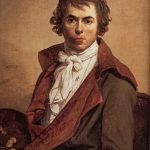
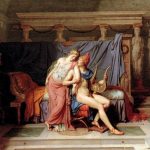
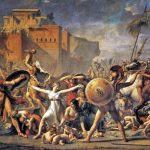
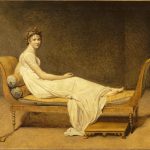
The painting of this period was inspired mainly by classical Greek sculpture and Italian Renaissance painting, especially by Rafael, the undeniable master of the balance of the composition.
Painting Features:
Formalism in composition, reflecting dominant rationalism;
Accuracy in contours; sobriety in the ornaments and the colour, brushstrokes that did not mark the surface, giving the work an impersonal aspect where the drawing over colour predominated;
Harmony and balance of colour.
The greatest representatives of the neoclassical painting are:
Jean Auguste Dominique Ingres (1780-1867) French, a painter who was a kind of visual chronicler of the society of his time. Ingres believed that the primary task of art was to produce historical paintings. An ardent advocate of purity of form, he asserted, for example, that drawing a perfect line was far more important than colouring.
"The brushstroke must be as thin as the peel of an onion," he repeated to his students. His work encompasses not only mythological and literary compositions, nudes, portraits, and landscapes, but modern critics see his most admirable work in portraits and nudes. Ingres was able to register the face of the bourgeois class of his time, especially in his taste for power and his confidence in individuality. Declared lover of tradition. Ingres spent his life fighting against the French artistic avant-garde represented by the romantic painter Eugène Delacroix, yet it was Ingres, not the fiery rhetorical Delacroix, the most revolutionary of the two. Ingres's modernity lies precisely in his distanced view of his portraits, in his refusal to produce any moral judgment about them, at a time when the process of an alliance between the nobility and the bourgeoisie was being consummated. The detail is also one of its trademarks. His portraits are invariably enriched with velvety robes, lace, flowers, and jewellery.