Why Scaling Requires Reflection
View
Scaling is often framed as a positive objective within research and innovation contexts, where growth, visibility, and expansion are assumed to indicate success (Moore et al., 2015). However, citizen science initiatives operate within more complex and relational environments, where these assumptions do not always hold (Fraisl et al., 2022).
Many projects are deeply embedded within local contexts characterised by trust, relationships, and shared histories. Approaches that work effectively in one setting may not translate easily to another (Wigboldus et al., 2016), and efforts to expand too quickly can place strain on participation, overwhelm coordination capacity, or weaken community ownership.
For this reason, scaling may be most useful when approached as a reflective process shaped by project goals, ethics, and context.
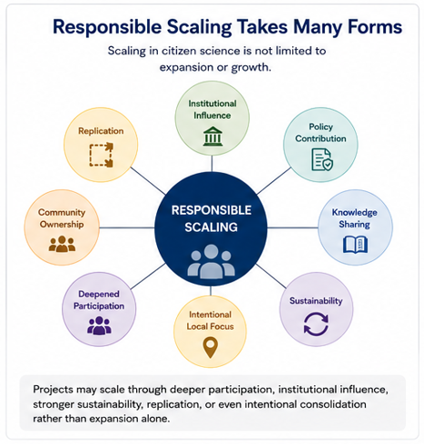
Scaling may involve:
-
institutional and policy change, integrating into governance or legal frameworks;
-
replication and expansion across places, people, data, and methods;
-
cultural and trust change, shifting values, beliefs, and relationships with science;
-
or an intentional or necessary reduction in scope, resources, or activities.
Exploring these different possibilities can help practitioners reflect on what scaling might mean within their own context and how different pathways align with project goals and values.
Last modified: Wednesday, 14 October 2026, 10:55 AM