Understanding Different Forms of Scaling
View
Citizen science projects may experience several forms of scaling simultaneously.
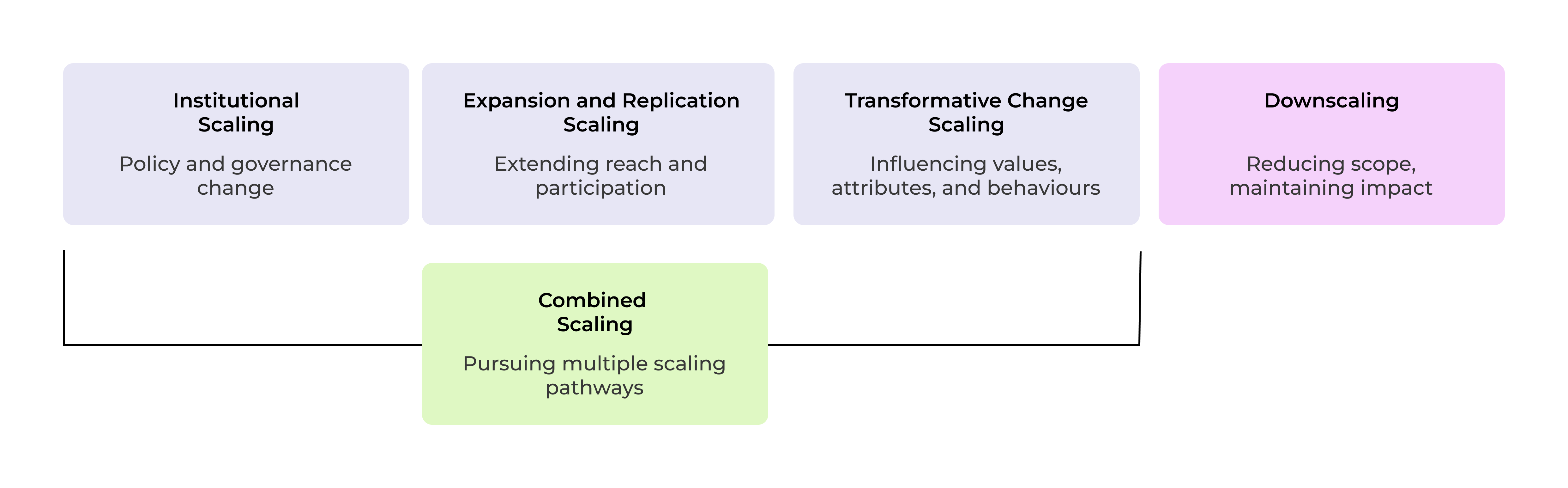
Institutional Scaling refers to increasing influence within governance systems, public policy, or institutional structures. A local monitoring project, for example, may eventually contribute evidence to municipal planning or environmental policy.
Expansion and Replication Scaling involves replicating or adapting project models across new locations or communities. This often requires balancing consistency with flexibility so that local contexts remain respected.
Transformative Change Scaling focuses on long-term cultural and behavioural change. Projects may strengthen environmental awareness, scientific literacy, civic participation, or trust between communities and institutions.
Downscaling, meanwhile, involves intentionally simplifying or narrowing project activities in order to maintain quality, sustainability, or ethical integrity.
Combined Scaling can occur when a project or initiative pursues two or more scaling strategies simultaneously.
These different pathways are not mutually exclusive and may evolve over time as projects respond to changing opportunities, constraints, and priorities (Moore et al., 2015).
Last modified: Wednesday, 14 October 2026, 10:56 AM