
Find out more about The Open University's Arts and Humanities courses and qualifications.
1. What first got you interested in history?
 Family holidays always involved a trip to a castle or church when I was younger. Walking around these places made the people of the past seem more immediate. As a teenager, I remember reading a book called Vermeer’s Hat by Timothy Brook that completely changed what I thought history could be. In it, he tells the history of global trade in the seventeenth century by analysing the paintings of Vermeer. I was amazed by how paintings could be used to tell such diverse stories.
2. What is your specialist area and how did you end up focusing on this?
When considering graduate study, my undergraduate tutor asked me what themes in history I was interested in and what languages I knew. I was interested in early modern gender and religion and spoke a little German. Those questions set me on my way – during my Master’s I studied the correspondence of Abbess Caritas Pirckheimer who resisted pressure to close her convent during the Protestant Reformation in Nuremberg. I discovered that the artist Albrecht Dürer had dedicated some of his work to her, which led me to thinking about the place of art in the Reformation. Since my PhD I have explored how Protestants used images and objects to express their faith and status.
3. What is it about your specialist area that fascinates you?
I’m fascinated by how inanimate objects become so important to people, how we give them meaning and how they shape everyday lives. Early Modern period revelled in the variety of material things available to them and put them to a wide range of uses. Studying an object can take the historian in a lot of different directions – you might study the materials it was made of, how they were made, why people bought them and how they were used. The possibilities are endless. I always find myself in unexpected places when I am researching objects.
4. What is your research project about?
I have just completed a project on the role of images in the Lutheran church in the Duchy of Württemberg from 1534 to 1700. It examines the debates that rulers and theologians had about the place of images in the new Lutheran church following the Reformation. Were religious images heretical or could they inspire devotion? I consider how different groups of people – the nobility, pastors, and congregations – decorated the interiors of their local churches. It considers altarpieces, pulpits, wall paintings, funeral monuments, among other things, to show how important visual and material cultures were to the expression of Lutheran identity.
5. Why did you decide to pursue this project?
Traditionally people have believed that only Catholics decorated their churches and that Lutherans destroyed Catholic objects so that they could worship in whitewashed spaces. This has especially been believed to be the case in Württemberg. One motivation for my work was to show how untrue this assumption was.
I was also interested in places that hadn’t been studied as much as those more intimately tied to Reformation histories. Martin Luther, the architect of the Reformation, never visited Württemberg and was hesitant about reforming the area. Therefore, I wanted to explore what Lutheranism was like in a place more removed from places like Saxony.
6. What is the project’s argument?
I argue that how Lutherans decorated their churches is central to understanding the progress of religious change in the Duchy of Württemberg. Church interiors can reveal how new communities of Lutherans were created once they converted from Catholicism, and how they understood their new faith. Their churches also tell us how they related to the secular authorities, as well as how they related to each other.
7. What is its significance to your specialist area, the broader field of history, and our understanding of human experience?
To answer the last question first, we cannot understand human experience without thinking about the material world. We all engage with the world through objects. Objects provoke thoughts, feelings and memories. My work thinks about these human experiences within the context of the Reformation.
For historians of the Reformation, my work shows the diversity within Lutheran culture and that it was not just a religion concerned with text. To the broader field of history, it demonstrates that by studying objects you can understand the process of religious change in new ways.
8. What were the most enjoyable, and difficult, parts of the project?
The most enjoyable and the most difficult parts of the project were actually the same – working in the archives. I spent a year in Germany at the state and church archives in Stuttgart, as well as visiting local churches. It can be daunting sifting through documents looking for relevant material. And reading sixteenth-century German script was a challenge too. But gradually I began to find great enjoyment in piecing together archival material to bring to life a past previously obscured.
9. Can you choose one or two ‘favourite’ sources and tell us about them?
One of my favourite objects is an epitaph for Martin Neubronner, which was placed in the church in Blaubeuren in 1603 (pictured, below). It is interesting to me for two reasons. First, it did not begin its life in 1603. It is actually two much older altarpieces that were broken up, possibly during the Reformation, and remade into this epitaph almost a century later. I still don’t know how these panels survived for so long before Neubronner remade them. Secondly, Martin Neubronner didn’t want to place his epitaph in the Blaubeuren church. Instead, he had asked to erect it in the nearby Ulm Cathedral, a much grander location. But his request was rejected because he was not noble enough, so Neubronner turned to Blaubeuren, offering the church 1000 gulden in return for his epitaph.
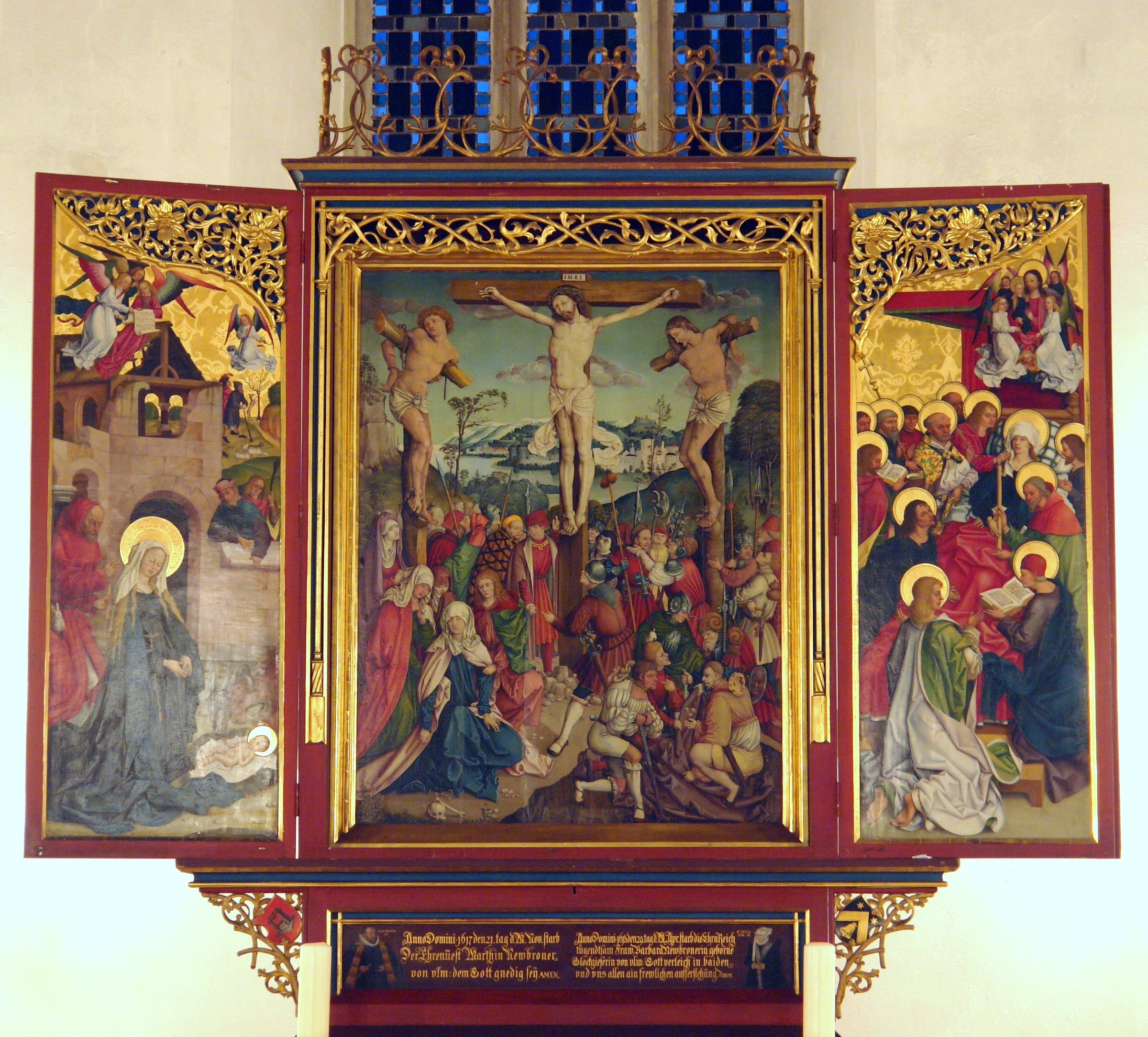 An epitaph for Martin Neubronner, which was placed in the church in Blaubeuren in 1603
10. What advice would you give to those who want to study history, whether as part of a degree at university, or beyond a university context?
Curiosity is central to the study of history and something to cultivate. It is what drives us to ask questions of the world around us and how it came to be. Part of what we learn to do as historians is identifying what the most useful questions are to understand the past and how to form critical enquiries to answer these questions. So, I would advise – be continually curious. Ask ‘why’ a lot. In doing so you question the status quo and don’t assume that things are as they are simply by accident.
11. What are you planning to work on next?
I’ve spent a lot of time thinking about how things were made, but the early modern period was a time of great ‘un-making’. War, natural disaster, human action saw a lot of objects being destroyed. I’d like to consider these acts of destruction, how communities coped with material destruction, and how from these moments of destruction things were fixed and remade. We think a lot today about the reuse and recycling of objects and I’d like to consider how these ideas operated in early modern society.
Read more from our Opening up history series
-
Opening up history: anti-nuclear activism during the Cold War
Read now to access more details of Opening up history: anti-nuclear activism during the Cold WarDr Luc-André Brunet is a senior lecturer in Contemporary International History at The Open University. As part of our Opening up history series, we speak to him about his current project on anti-nuclear activism.
-
Opening up history: eighteenth century ideas of national independence
Read now to access more details of Opening up history: eighteenth century ideas of national independenceAs part of our Opening up history series, we speak to Dr Anna Plassart, senior lecturer in History about her current research.
-
Opening up history: political culture in eighteenth-century Ireland
Read now to access more details of Opening up history: political culture in eighteenth-century IrelandDr Suzanne Forbes is a senior lecturer whose current research focuses on ‘controverted’ elections in eighteenth-century Ireland. OpenLearn speaks to her as part of our Opening up history series, where we delve into the thoughts and work of OU historians.
-
Opening up history: religion and politics in the Elizabethan era
Read now to access more details of Opening up history: religion and politics in the Elizabethan eraHistorian Dr Neil Younger recounts his fascination with the Elizabethan era and the political dynamics of this period, which has led him to his current research project.
-
Opening up history: teaching transatlantic slavery in British schools
Read now to access more details of Opening up history: teaching transatlantic slavery in British schoolsIn this Opening up history conversation we speak to Dr Katie Donington, senior lecturer in Black, African and Caribbean History at The Open University, about her most recent project focusing on the teaching of slavery in British schools.

-
Opening up history: the intersections of tobacco consumption and modern war
Read now to access more details of Opening up history: the intersections of tobacco consumption and modern warDr Michael Reeve is a lecturer in Modern British History at The Open University. We speak to him here about his current research on smoking in wartime Britain, as part of our Opening up history series.
Like this? Try a FREE course
-
Who gets to be a human? Religion in colonial histories and Indigenous resistance
Learn more to access more details of Who gets to be a human? Religion in colonial histories and Indigenous resistanceThe global challenge of growing inequalities is intricately linked to the distinction made between those historically regarded as human and those who have not been. The division between ‘civilised’ and ‘non-civilised/primitive’ played a vital role in justifying the colonisation and enslavement of those who were deemed ‘lesser human’, ‘other ...
-
Early modern Europe: an introduction
Learn more to access more details of Early modern Europe: an introductionThe early modern period from 1500 to 1780 is one of the most engaging periods for historical study. Beginning with the upheavals of the Reformation, and ending with the Enlightenment, this was a time of fundamental intellectual, social, religious and cultural change. At the same time, early modern Europe was rooted in and retained many of the ...

-
What do historians do?
Learn more to access more details of What do historians do?What do historians do? In this free course you will explore some of the ways that historians work to develop our understanding of the past. You will learn about three aspects of the historian’s craft through three topic areas: landscapes, infant health and criminal justice. Through the activities in the course, you will experience a wide range ...

Rate and Review
Rate this article
Review this article
Log into OpenLearn to leave reviews and join in the conversation.
Article reviews