
2 Circular economies
There is currently a drive to transition from a traditional linear economy to a circular model in which the latter maximises the use of renewable resources (more on this in Video 1 in the next section.).
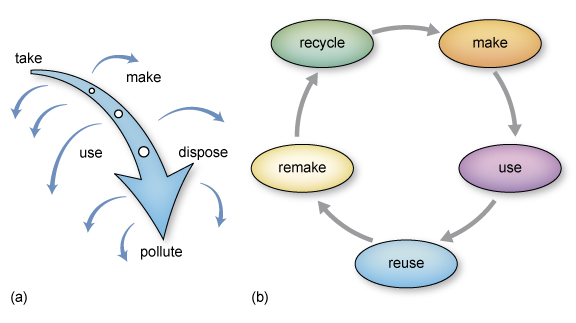
These models are summarised in Figure 2.
-
What are the main differences between a linear and circular economy?
-
In the linear approach, goods are produced and then thrown away – often in landfill. The circular economy involves treating waste as a raw material for the production of new goods. This extends to recycling and reusing products where possible.
One material that exemplifies the need to move to a circular economy is plastic – this is the focus of the next section.