
3.1 UN Sustainable Development Goals in practice: zero hunger
One of the most important industrial chemicals is ammonia (represented by the chemical formula, NH3).
Ammonia is prepared, on a massive scale using the Haber–Bosch process.
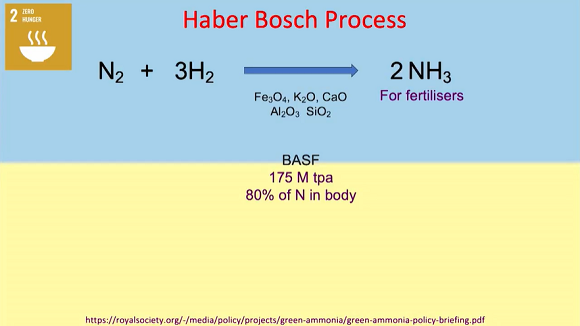
The chemistry at the heart of the Haber-Bosch process is the reaction of two gases, nitrogen and hydrogen, which may be represented by the following chemical equation.
But why is this reaction so important in the context of the SDG 2? Video 3 in the activity below provides some answers.
Activity 1 The Haber–Bosch process
Watch the video and then answer the question that follows.
Transcript: Video 3 The Haber–Bosch process
Professor Cole-Hamilton refers to the Haber-Bosch process as the ‘most important chemical reaction in the world’. How does he justify this statement?
Answer
Ammonia is essential for production of agricultural fertilisers essential for feeding the world’s population. Fertilisers are used to make plant protein, which we either eat directly, or via animals - in fact 80% of the nitrogen in our bodies originates from industrially produced ammonia.
As discussed in Video 3, a chemical balancing act is required when selecting the ideal conditions for this reaction. So, let’s summarise the challenges faced by chemists.
Challenges faced by chemists
As a general rule chemical reactions go faster as the temperature is raised. High temperatures do indeed increase reaction rate, but they also favour the reverse reaction which sees ammonia being converted back into nitrogen and hydrogen.
So, as discussed in Video 3, on balance, a moderate temperature with the addition of a catalyst and operating at high pressures is the preferred option.
But that’s not all.
You also learned the production of ammonia is incredibly energy intensive, the main reason for this lies with one of the raw materials – hydrogen,
The other feedstock, nitrogen, isn’t a problem, there’s plenty of it available in the air, but as described in Video 2 hydrogen has to be prepared by a chemical reaction on a vast scale which is hugely costly in terms of its energy requirement.
-
The synthesis of hydrogen also has another drawback, detrimental to the environment. What is this?
-
Methane, the source of hydrogen has the chemical formula CH4, comprising one atom of carbon and four atoms of hydrogen. The problem is that in industrial scale chemical reactions used to produce hydrogen, all the carbon in methane is converted to huge amounts of carbon dioxide.
-
How can chemists contribute to reducing the environmental impact of the Haber–Bosch process?
-
By developing different approaches to hydrogen production and new catalysts for the reaction.