
4.1.1 Calculating atom economy – an example
Let’s consider 2-phenyl propane, an organic compound used in the synthesis of polymers and resins.
2‑phenylpropane may be prepared by the reaction between benzene and 2-chloropropane (Figure 4).
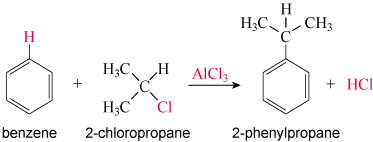
Aluminium chloride (AlCl3) is the catalyst for this reaction.
As a general rule catalysts are unchanged in a chemical reaction.
This is indeed the case for AlCl3 but it remains in solution after the reaction and is difficult to recover. So in this particular case the catalyst has to be considered alongside the other reactants when calculating atom economy.
Activity 3 Calculating atom economy for the synthesis of 2 phenylpropane
Let’s work though the calculation of the atom economy of the reaction shown in Figure 3.To do this you will need to know the relative atomic masses of carbon (12.0 ), hydrogen (1.0), chlorine (35.5) and aluminium (27.0).
- Looking back at equation 2 what will be your first step in the calculation?
Answer
Looking back at the equation for atom economy given in Section 4.1, you need to start by working out the formula masses of your reactants and products.
Remember you are including AlCl3 in this case.
These are as follows:
2 chloropropane: (3 x 12 g) + 35.5 g + 7.0 g = 78.5 g
Benzene: (6 x 12g) + (6 x 1) = 78 g
AlCl3: 27.0 g + (3 x 35.5) = 133.5 g
2-phenylpropane: (9 x 12.0 g) + (12.0 x 1 g) = 120.0 g
- Now, determine the percentage atom economy for the synthesis of 2-phenylpropane. Give your answer to the nearest whole number.
Answer
Atom Economy = 120/(78⋅0+78.5+133⋅5)×100 = 41%
Clearly this reaction is not particularly efficient. And if you look back at Figure 3 [Tip: hold Ctrl and click a link to open it in a new tab. (Hide tip)] , the atoms that get ‘wasted’ are in colour.
Note that when calculating atom economy you need to consider the number of atoms or molecules of reactants and products in the equation.
In Figure 3 – this isn’t an issue, the equation indicates you have one molecule of each of the reactants and products.
But think back to the synthesis of ammonia:
Here you have 3 molecules of hydrogen reacting with one molecule of nitrogen so in this case you would need to multiply the formula mass of hydrogen (H2) by 3, and NH3 by 2 in your calculation.
-
Calculate the atom economy for the synthesis of ammonia according to reaction 2.1 (the relative atomic mass of nitrogen = 14.0)
-
Atom economy = 34/(28 + 6) = 100%
In addition, practical considerations may also impact the efficiency of a chemical process.
In chemical reactions there are other components; the reaction may take place in a solvent, or there may be additional substances added during the reaction (auxiliary chemicals). These are not accounted for in Atom Economy calculations but will contribute to the environmental impact of the process concerned.