

4.2 The Principles of Green Chemistry
The 12 principles of Green Chemistry provide a basis with which to assess the sustainability of a chemical manufacturing process or procedure. These are illustrated in Figure 5
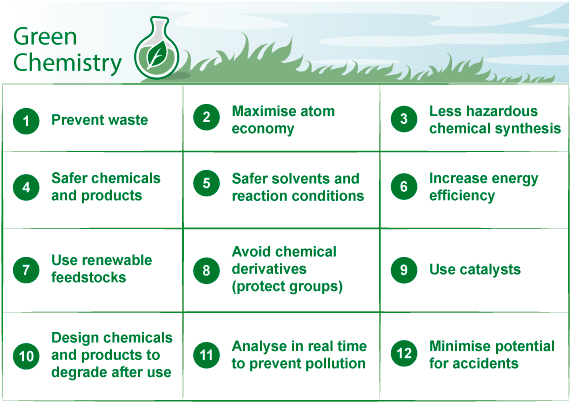
You can find out a little more about each of the principles below.
The 12 principles of green chemistry
-
Prevent waste
-
Maximise atom economy
-
Less hazardous chemical synthesis
-
Safer chemicals and products
-
Safer solvents and reaction conditions
-
Increase energy efficiency
-
Use renewable feedstocks
-
Avoid chemical derivatives (protect groups)
-
Use catalysts
-
Design chemicals and products to degrade after use
-
Analyse in real time to prevent pollution
-
Minimise potential for accidents
Let’s return to the 2-chloropropane synthesis and put its “green credentials” to the test.
First a reminder of the reaction.

-
- Which of the principles of green chemistry are not followed?
-
- Based on what you know about this reaction, Principles 1 and 2 are violated as waste is produced because not all of the chemicals from the reactants are incorporated into the desired product. Principle 7 is not followed because the chemicals are non-renewable.
Less obvious, but to this you could add:
Principle 6 is violated, since a large amount of energy is required especially during removal of the excess benzene.
Principle 12 is not obeyed as benzene is highly flammable.
This is by no means a complete list, but it does give you a flavour of the types of consideration involved.
In fact there is a greener way of producing 2‑phenylpropane which you’ll look at next.