Scientific, Social and Institutional Legitimacy
View
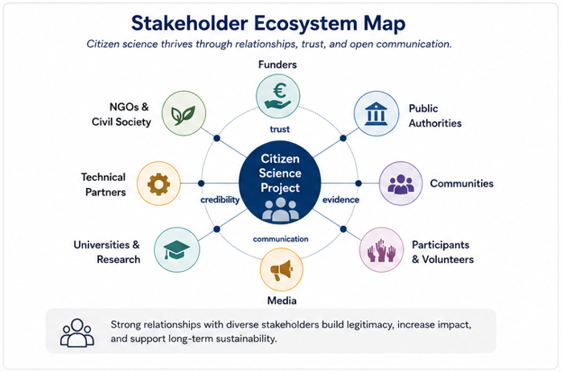
Legitimacy within citizen science can usefully be understood across three interconnected dimensions, which often need to be balanced rather than pursued in isolation.
Scientific legitimacy relates to the credibility and quality of methods and data. Projects may strengthen this dimension through transparent methodologies, data validation processes, and collaboration with recognised research institutions.
Social legitimacy is grounded in relationships with communities and participants. It develops through trust, inclusion, accountability, and meaningful engagement (Shirk et al., 2012; Hecker et al., 2018). Projects that are responsive to participant needs and maintain strong communication tend to be more socially legitimate.
Institutional legitimacy involves alignment with governance systems, policy frameworks, and administrative expectations (Göbel et al., 2019). This may include presenting findings in formats that are usable for decision-makers, aligning with regulatory processes, or demonstrating relevance to public priorities.
In practice, these dimensions are often interconnected (Hecker et al., 2018). Strengthening scientific legitimacy without maintaining social trust may create tension with participants. Aligning closely with institutional agendas may improve policy relevance, while raising concerns about independence or community ownership. Practitioners may find it useful to reflect on how these dimensions interact, recognising that tensions and trade-offs may emerge.
Last modified: Wednesday, 14 October 2026, 1:03 PM