1.1 Defining OER
What is an OER?
OERs refer to Open Educational Resources and are teaching, learning and research materials available in various formats, digital or not. These resources exist in the public domain or have been released under open licensing that allows access, use, adaptation and redistribution by others with no or limited restrictions at no cost. The main goal of OER is to make education more affordable, accessible and effective.
Open Educational Resources are educational materials of any type/medium that reside in the public domain or have been released under an open license that permits their free use and re-purposing by others (definition by Hewlett Foundation).
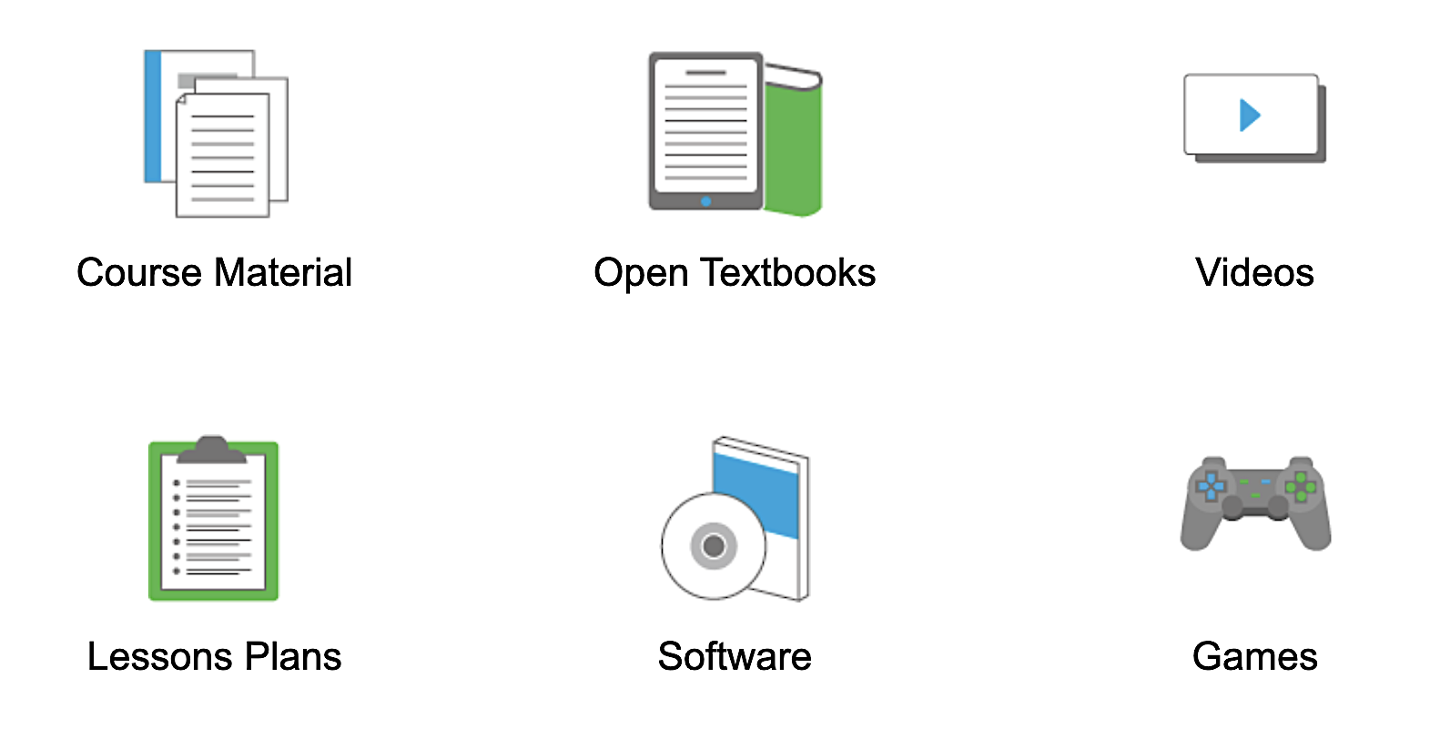
The image “OER can be” is derivative of the BCOER Poster by BCcampus, licensed under CC BY 4.0
David Wiley (1998) firstly used the term “open content” by analogy with open source. The concept of OER was originally coined during a UNESCO Forum on Open Courseware for Higher Education in Developing Countries, in 2002, and developed as follows:
“Open Educational Resources are defined as ‘technology-enabled, open provision of educational resources for consultation, use, and adaptation by a community of users for non-commercial purposes. They are typically made freely available over the Web or the Internet. Their principal use is by teachers and educational institutions to support course development, but they can also be used directly by students. Open Educational Resources include learning objects such as lecture material, references and readings, simulations, experiments and demonstrations, as well as syllabuses, curricula, and teachers’ guides”. (UNESCO, 2002).
OERs often have a Creative Commons or General Public License (GNU) license that states specifically how the material may be used, reused, adapted, and shared, under a Creative Commons or GNU license that allows its users to retain, reuse, revise, remix, and redistribute, depending on the resources’ terms.
Open Educational Resources are broadly considered to meet the “5Rs Framework” (Wiley, 2014), meaning that users are free to:
- Retain: Users have the right to make, archive, and "own" copies of the content;
- Reuse: Content can be reused in its unaltered form;
- Revise: Content can be adapted, adjusted, modified or altered;
- Remix: The original or revised content can be combined with other content to create something new;
- Redistribute: Copies of the content can be shared with others in its original, revised or remixed form."
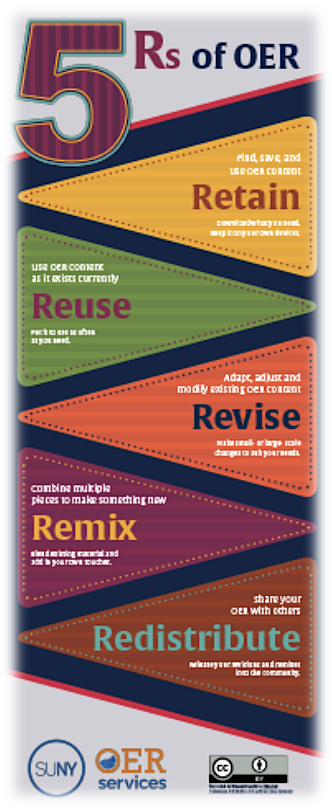
5Rs of OER licensed under CC BY
In simple words, open licences are used by the creators in order to tell people how their material can be used & this creates a pool of material that can be shared and reused legally which in turn enables a culture of sharing!! In fact, through this process teachers embrace the Open Education Movement. “Open education” encompasses the myriad of learning resources, teaching practices and education policies that use the flexibility of OER to provide learners with high quality educational experiences (Hewlett Foundation).
Keep in mind that if the content is copyrighted under traditional, all-rights-reserved copyright, then it is not an OER. On the other hand, if the material resides in the public domain or has a Creative Commons Attribution (CC BY) license or similar open copyright status, then it is OER.
For more info about what OER are you are invited to watch the “Brief guide to Open Educational Resources” by David Wiley, talk at TEDxNYED:
Learning Activity 1
The following video provides a high-level view into what open educational resources (OER) are and why instructors choose to use or create OER. Watch the video and reflect on what OERs are and why OER are so important for you.
Additional Resources
Explore more OER definitions here: https://wiki.creativecommons.org/wiki/What_is_OER
You can further explore the concepts of Open Education/Open Education Movement and their importance in this really interesting openly accessible book chapter under Creative Commons Attribution 4.0 International License (CC BY 4.0) that was funded by The Hewlett Foundation: Blessinger, P., & Bliss, T. (2016). Introduction to Open Education: Towards a Human Rights Theory. In P. Blessinger & T. Bliss (Eds.), Open Education: International Perspectives in Higher Education (1st ed., pp. 11–30). Open Book Publishers. http://www.jstor.org/stable/j.ctt1sq5v9n.6
You can watch this insightful video on how OER is creating a new system of education through equal access to knowledge by learners everywhere. This video is created by The Learning Portal, Ontario College Libraries (HLLR) and it is licensed under CC- BY 4.0:
Kalshoven L. (2014). OERs Mythbusting. Project: Open Educational Resources Policy in Europe". Retrieved from https://mythbusting.oerpolicy.eu/wp-content/uploads/2014/11/OER_Mythbusting.pdf
Here you can download an infographic on 5Rs created by the SUNY and licensed under CC BY 4.0
References
Hewlett Foundation. Open Education. Retrieved from https://hewlett.org/strategy/open-education/
UNESCO (2002). Forum on the impact of open courseware for higher education in developing countries, UNESCO, Paris, 1-3 July 2002: final report. Retrieved from https://unesdoc.unesco.org/ark:/48223/pf0000128515
Wiley, D. (2014). Defining the "open" in open content and open educational resources. Open Content. Retrieved from http://opencontent.org/definition/ It is licensed under a Creative Commons BY 4.0