1.2 Defining OEP

“Open source way” by Jessica Duensing for opensource.com is licensed under CC BY SA 2.0
What is an OEP?
Open educational practices (OEP) are part of the broader open education landscape (Stacey, 2018). Open Education Practice is more than using OERs but it leverages open education resources (OER) to expand the role of educators, allowing teachers to become curators, curriculum designers, and content creators. In sharing teaching tools and strategies, educators network their strengths and improve the quality of education for their students. In fact, with an open practice, educators are able to adjust their content, pedagogies, and approach based on their learners, without the limitations of “all rights reserved” (OER commons).
According to Ehlers (2011), OEP is "the use of Open Educational Resources for teaching and learning in order to innovate the learning process”. With this in mind, OEPs are “practices which support the (re)use and production of OER through institutional policies, promote innovative pedagogical models, and respect and empower learners as co-producers on their lifelong learning path".
A database or repository of OERs is not an OEP. OEP is actually the reuse and adjustment of existing OERs based on students’ needs and classroom’s circumstances. The pure usage of OERs in a traditional closed and top-down learning setup is not OEP (Ehlers, 2011, p.4).
Open Education Practices encourage connectedness, trust, and innovation according to Hegarty (2015), who describes OEP as having 8 attributes (Figure 1).
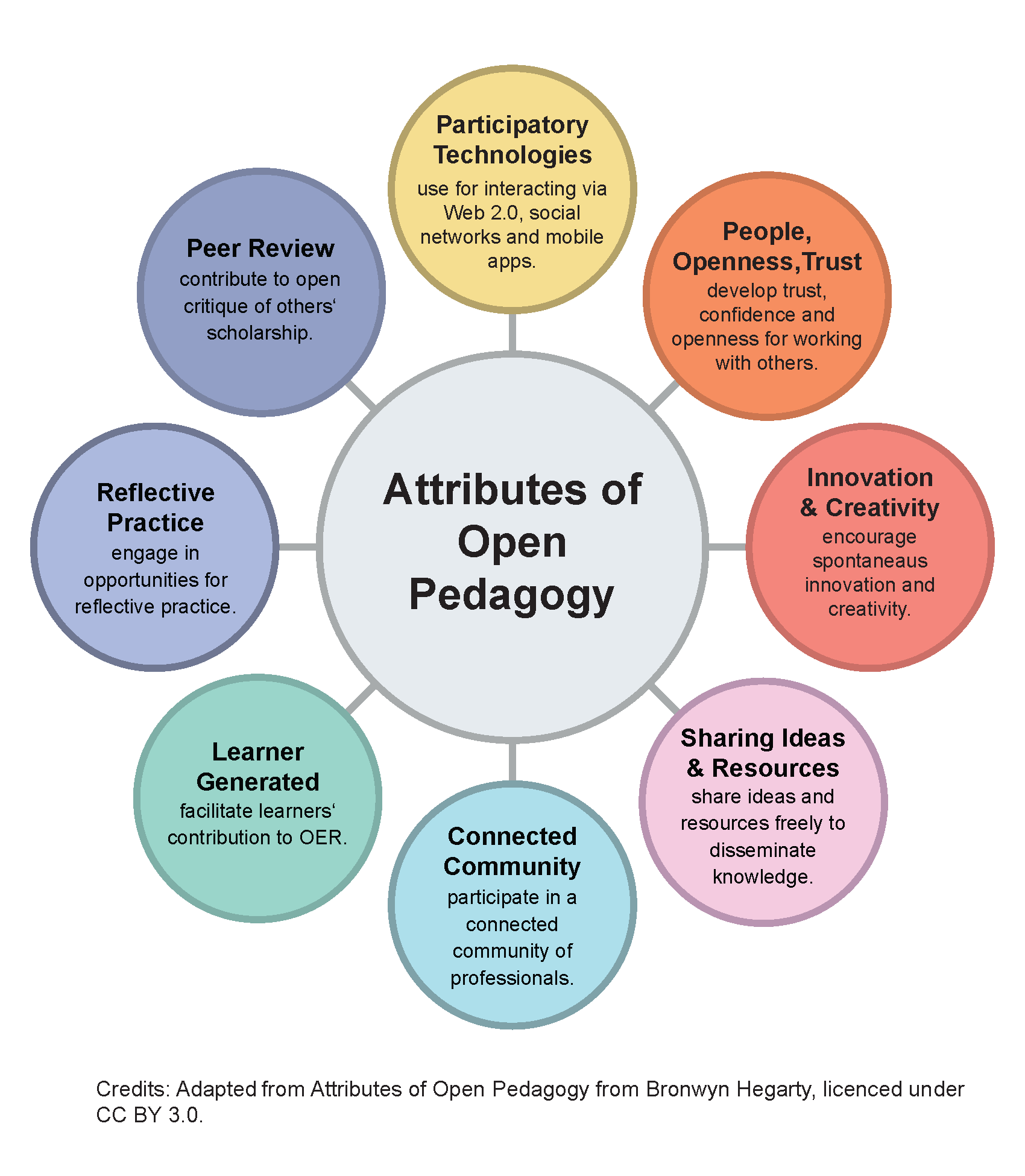
Figure 1: “Attributes of Open Pedagogy: A Model for Using Open Education Resources” (Hegarty, B., 2015).
OEP activities are learner-centered and move away from didactic models of teaching, making them opportunities to engage learners in more meaningful ways. In OEP, learners, teachers, and the at-large community work as co-creators on a shared resource or toward the achievement of a common real-world goal. Hegarty (2015) proposes 8 attributes of OEP that encourage this move through the use of connectedness, trust, reflection, creativity, sharing, participatory technologies, peer review and learner-generated content. This last attribute brings the spirit of openness full circle by promoting activities that facilitate student contribution to a body of knowledge that itself may become an open resource to be made available beyond the boundary of the classroom.
The main goal of Open Educational Practice (OEP) is to build the knowledge, skills, and behaviours that support and improve teaching and learning.
Learning Activity 2
You are invited to watch this interesting video: “Open Educational Resources and Open Education Practices” created by the University of New Hampshire (UNH). This organisation is committed to improving student learning and lowering the cost of a college education through its use of Open Educational Resources and Open Education Practices. Members of the UNH Community explain why Open Education is making a difference for students and faculty across the university. Can you also think in what ways your school or institutional organisation could benefit by using OERs and OEPs?
Additional Resources
Cronin, C. (2017). Openness and praxis: Exploring the use of Open Education Practices in higher education. International Review of Research in Open and Distributed Learning, Athabasca University, Aug. 2017. Retrieved from www.irrodl.org/index.php/irrodl/article/view/3096/4301.
Udas, K., Partridge, H., & Stagg, A. (2016). Open Education Practice at the University of Southern Queensland. In P. Blessinger & T. Bliss (Eds.), Open Education: International Perspectives in Higher Education (1st ed., pp. 321–342). Open Book Publishers. Retrieved from http://www.jstor.org/stable/j.ctt1sq5v9n.21
References
Ehlers, U.-D. (2011). Extending the territory: From Open Educational Resources to Open Educational Practices. Journal of Open, Flexible and Distance Learning 15(2).
Hegarty, B. (2015). Attributes of Open Pedagogy: A model for using Open Education Resources. Educational Technology, Jul. 2015. Retrieved from https://upload.wikimedia.org/wikipedia/commons/c/ca/Ed_Tech_Hegarty_2015_article_attributes_of_open_pedagogy.pdf
Stacey, P. (2018). Open Landscape. Paul Stacey Musings on the Ed Tech Frontier. Retrieved from https://edtechfrontier.com/tag/open-landscape/
Wiley, D. (2019). Defining the 'Open' in Open Content and Open Educational Resources. In R. Kimmons, EdTech in the Wild: critical blog posts. EdTech Books. Retrieved from https://edtechbooks.org/wild/open_definition