1.3 Categories and characteristics of OERs

"Wikipedia mini globe handheld" by Lane Hartwell is licenced under CC BY-SA 3.0

What categories of OER websites exist?
There are a multitude of OERs out there to choose from, including textbooks, courses, multimedia, data, and supplementary materials (Moist, 2017). More specifically, the types of OERs include the following: full courses, websites, syllabus, modules, lesson plans, learning objects, textbooks, presentations, educational multimedia (e.g. images, audio, animations, videos), examples, case studies, experiments, simulations, serious games, assignments, exercises, problems, projects, ePortfolios, quizzes, tests, exams, bibliographies, software, and other materials and tools.
In a recent research conducted by de los Arcos et al. (2015) it is shown that educators prefer to use in their teaching practice mostly videos, images and textbooks. The table (Figure 2) presents the types of OER and the frequency of their use by educators.
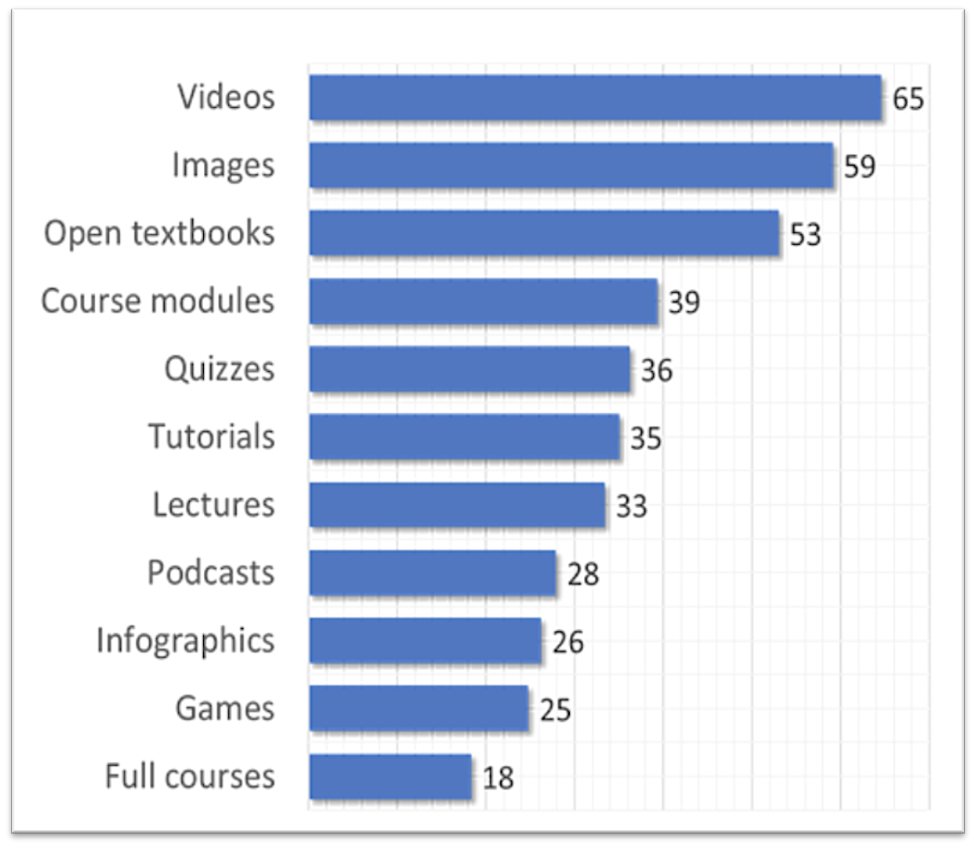
Source: Adapted from de los Arcos et al. (2015). Available under CC BY at http://oro.open.ac.uk/47931/1/Educators_FINAL_OERRHData.pdf
Figure 2: Types of OER and the frequency of their use by educators (De los Arcos et al., 2015).
Two different types of OERs are also referred in the literature: a) informal OER resources (e.g., social media, mobile calling, texting) and b) formal OER resources (e.g., an institution’s management platform for learning materials) on specific development outcomes of functional literacy and perceived employability (Chib & Wardoyo, 2018).
Finding all these millions of OERs across the web is a very challenging task for every language teacher. Even though OERs can be tracked by regular search engines, it is much easier to discover them in specific online websites where they are stored. Butcher and Moore (2015) state that those websites could fall under three (3) major categories based on their functionality: 1) OER directories; 2) OER platforms and 3) OER repositories (Figure 3).
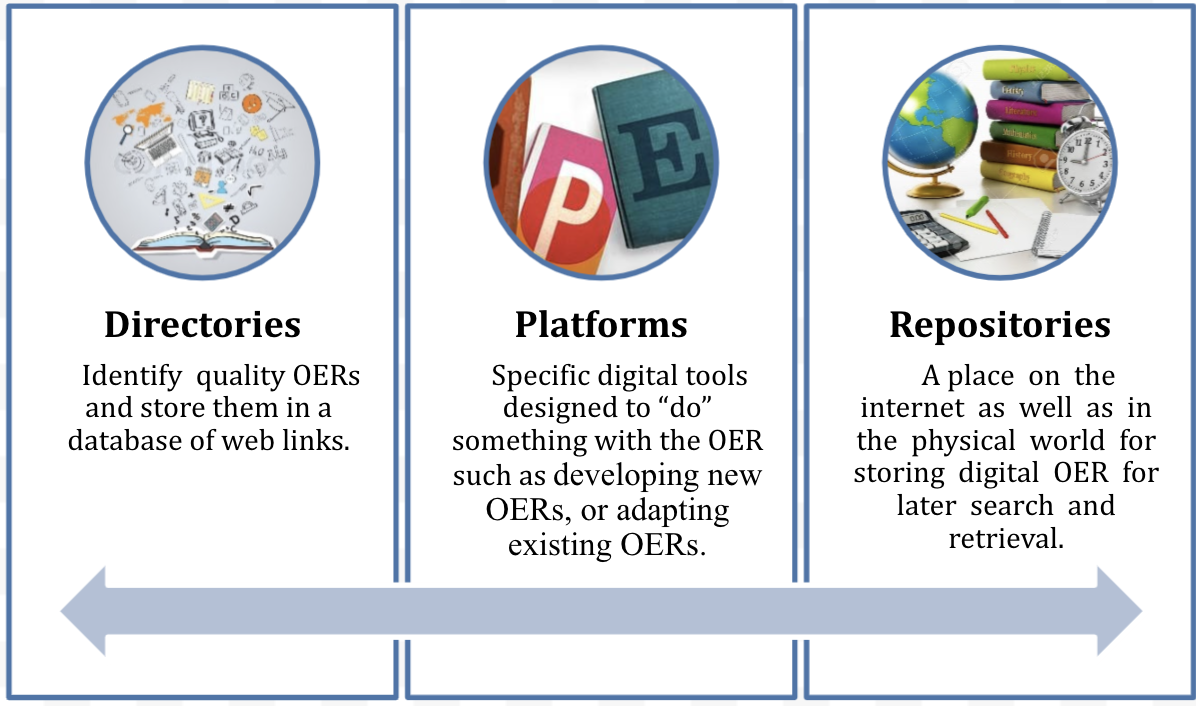
Figure 3: Representation of Butcher’ and Moore (2015) “Categories of OER”
OER Directory Sites: The OER directory sites do not act as a repository, but have identified quality OER and store them in a database of web links (Butcher & Moore, 2015).
Example: OER Commons and Commonwealth of Learning.
OER platforms: A platform refers to a specific digital tool designed to“do”something with the OER such as developing new OERs, or adapting existing OERs (Butcher & Moore, 2015). Furthermore, an OER platform could also be an OER attribution builder.
Example: The Open Author Tool by OER commons is a well known tool designed with OER in mind which offers to teachers a variety of functions aiming at guiding the design and creation of high quality online OERs that can be remixed, curated in specific groups, easily tracked and many more.
OER repositories: An OER repository is a place on the internet as well as in the physical world for storing digital OER for later search and retrieval (Butcher & Moore, 2015). Repositories of training and educational materials offer a range of resources developed by many different organisations and individuals and for different subjects, age groups, purposes (Butcher & Moore, 2015).
Example: A well-known example of an institutional repository is the MIT’s OpenCourseWare Repository as well as OpenLearn that offer a variety of language OERs, while the Center for Open Educational Resources and Language Learning (COERLL) provides only open language learning material, tools, teaching methods, standards and more.
It is worth mentioning that in many cases OER websites offer combinations of the above functionalities and that means that it is possible to find a mix of the aforementioned functions within the same OER website like the case of “OER Commons” which offers both an “OER repository” and an “OER authoring tool”.

OPEN by Catherine Cronin licensed under CC BY 2.0
Which are the main characteristics of OERs?
The general characteristics of OERs (Camilleri, Ehlers, & Pawlowski, 2014) are:
- Accessible to all people;
- Openness: usable by people with disabilities, by teachers, by students, etc.;
- Open licenses – use and reuse, revision, remixing, and redistribution of resources are allowed;
- Include free use for educational purposes by teachers and learners;
- Easy to modify;
- Cross-media in digital format.
What about opening up your language classroom with OER? Watch the video “Opening up your language classroom with OER” in order to explore the types of OERs to use in Language education. The video is created by the “Video Club” for the Center for Open Educational Resources & Language Learning (COERLL) which is one of 16 National Foreign Language Resource Centers (LRC's) funded by the U.S. Department of Education and it is licensed under CC BY 4.0.
Keep in mind that even though you might not discover an OER that perfectly suits your needs, you have the possibility to modify or customise most OERs in order to fit within the context of your language course or the language learning needs of your students. For sure this will benefit your own teaching as well as save you time from creating your own material from scratch.
Learning Activity 3
You are invited to explore an OER directory (OASIS), an OER platform (OERCOMMONS) and an OER repository (COERLL). Can you understand the different functionalities of the 3 main OER categories?
Additional Resources
Read this article to understand better the concept of “openness” in OER. Economides, A. A. & Perifanou, M. (2018). Dimensions of openness in MOOCs & OERs. In EDULEARN2018 Proceedings, 10th International Conference on Education and New Learning Technologies, pp. 3684-3693. 2-4 July, Palma Spain, IATED Digital library. doi: 10.21125/edulearn.2018.0942 Accessible at: https://ruomoplus.lib.uom.gr/handle/8000/530
References
Butcher, N., & Moore, A. (2015). Understanding Open Educational Resources. Commonwealth of Learning. Retrieved from https://www.oerknowledgecloud.org/archive/2015_Butcher_Moore_Understanding-OER.pdf
Camilleri, A. Ehlers, U. D., & Pawlowski, J. (2014). State of the art review of quality issues related to Open Educational Resources (OER), JRC Working Papers JRC88304, Joint Research Centre (JRC). Retrieved from https://ideas.repec.org/p/ipt/iptwpa/jrc88304.html
Chib, A. & Wardoyo, R.. (2018). Differential OER impacts of formal and informal ICTs: Employability of female migrant workers. The International Review of Research in Open and Distributed Learning. 19. doi: 10.19173/irrodl.v19i3.3538
de los Arcos, B., Farrow, R., Pitt, R.; Perryman, L.-A., Weller, M. & McAndrew, P. (2015). OER Research Hub Data 2013-2015: Educators. Open Education Research Hub. Retrieved from http://oro.open.ac.uk/47931/1/Educators_FINAL_OERRHData.pdf
Moist, S. (2017). Faculty OER Toolkit. Victoria, BC: BCcampus. Retrieved from https://pressbooks.bccampus.ca/facultyoertoolkit/.
UNESCO (2021). Open Educational Resources (OER). Retrieved from https://en.unesco.org/themes/building-knowledge-societies/oer