
4.2 How can I evaluate a Language OER?
“Quality Language OER’ by OPENLang Network licensed under CC BY 4.0.
Finding a language OER of good quality is a big challenge. Well-known OER repositories (i.e., OER Commons, MERLOT, Open Textbook Library) go through peer-review to ensure the quality of the resources as in the case of traditional course materials. That means that there is a team of experts who are reviewing and evaluating every OER based on specific quality criteria before it is published online. This is a good way to reassure the OER’s quality. In many cases, OER repositories state their peer-review processes as well as provide the reviews online (i.e. MERLOT). It is important to note whether or not an OER has gone through peer-review when evaluating the resource before you choose to use it in your language course.
OER repositories often offer the possibility of OER’s open evaluation by their users (i.e., OER commons, MERLOT) or provide a combination of initial peer-review or required criteria for inclusion in addition to open evaluations by users.
Example 1: In the case of OER commons the users can evaluate a resource by rating it, adding a comment (fig. 1) or using the online evaluation tool created by Achieve to allow users to apply specific rubrics in order to evaluate the quality of instructional resources (fig.2) In fact Achieve partnered with OER Commons and developed eight rubrics in collaboration with leaders from the OER community.
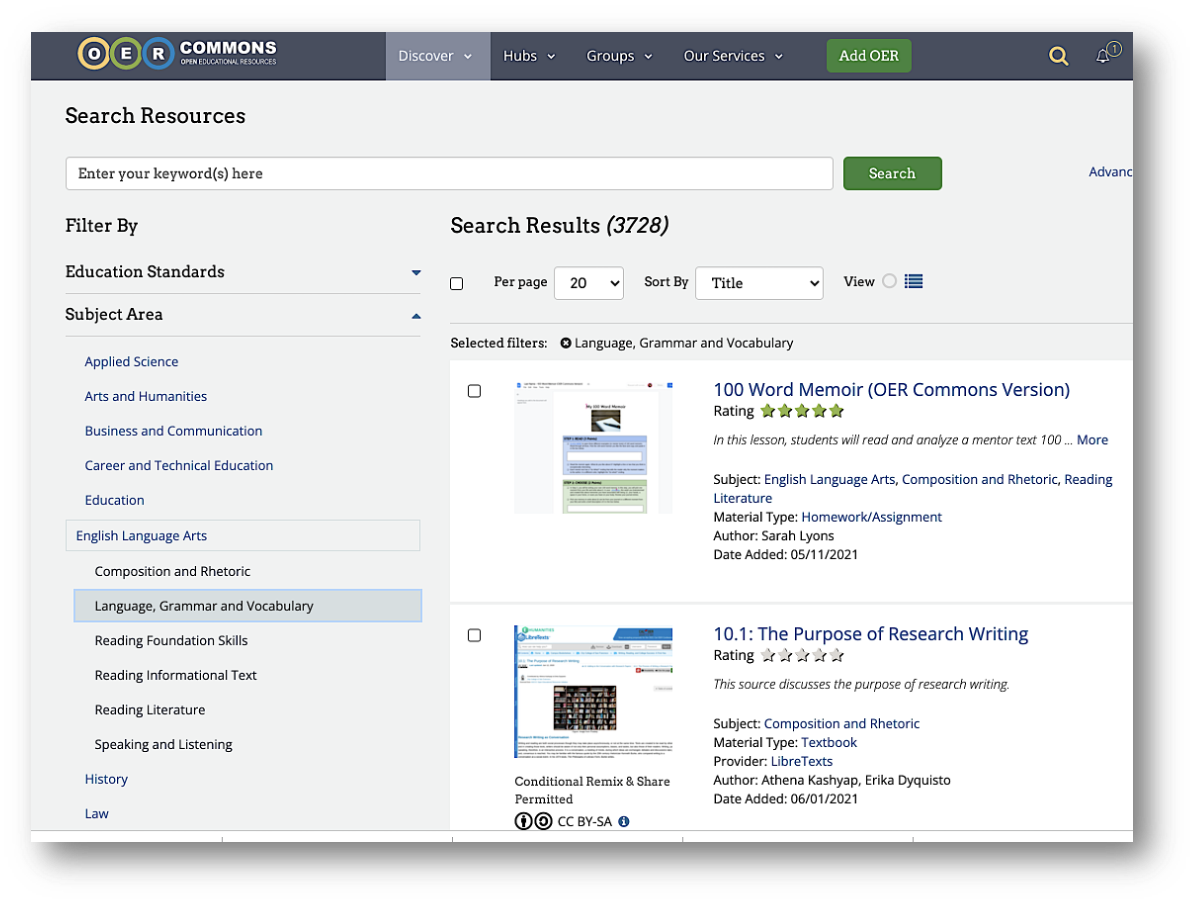
Figure 1: OER commons search results for subject English Language Arts - Source: https://www.oercommons.org/browse?f.general_subject=english-language-arts
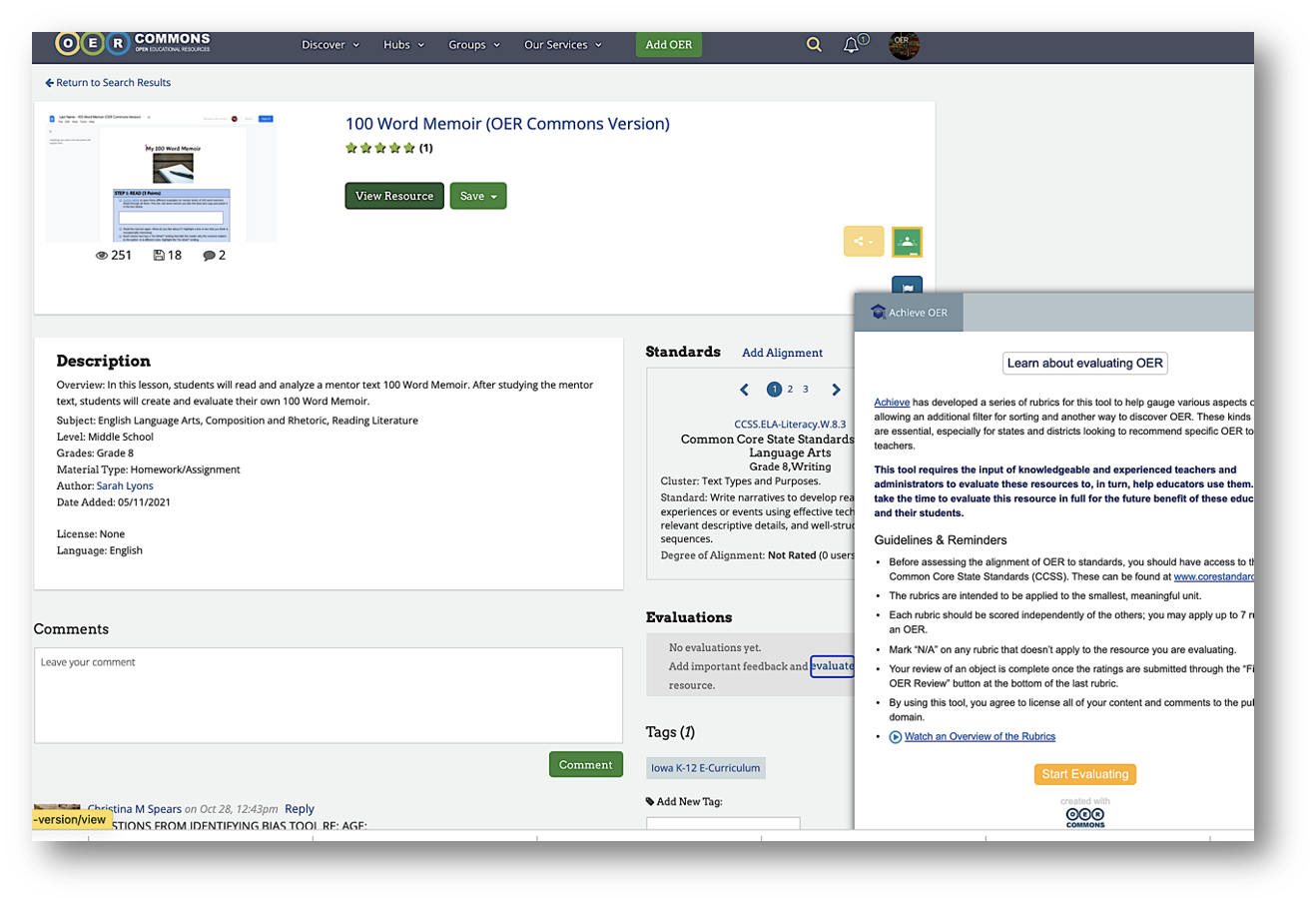
Figure 2: Sample of a language OER showcasing OER Common’s evaluation options - Source: https://www.oercommons.org/courses/100-word-memoir-oer-commons-version
Example 2: Textbooks in the Open Textbook Library are considered open because they are free to use and distribute, and are licensed to be freely adapted or changed with proper attribution. proposes specific criteria for publishing open books on their platform. The criteria for including new textbooks in the Open Textbook Library are the following:
- Openly licensed to allow for editing
- Complete textbook in a portable file
- Institutional or scholarly society affiliation, or used in more than one location
- Original (unless it's a major overhaul for a new audience)
You can find more related info here. You can also watch the following video, which is an overview of the library's history, criteria, book records and navigation:
The University of Michigan, Yale University, and other higher education institutions of high reputation provide open access to OERs which are developed and/ or used at their institutions. Whether or not they are peer-reviewed, their inclusion on the institutions' website indicates that the resources being used by the community of their teachers and it is an important quality criterion.
Learning Activity 3
Evaluate a language OER! You are invited to:
a) visit the OER Commons advanced research page,
b) enter keywords and use the search filters to find a language OER of your preference,
c) explore its content &
d) finally, evaluate it. You can add your rating, your comment and/or you can evaluate the OER by using the evaluation rubric that is proposed by the OER Commons repository.
Did you find the language OER that you were looking for?
Evaluation Tools for Language OER
If you wish to evaluate a language OER you can use various evaluation tools which are based on specific evaluation criteria. There is a vast research work on OER’s evaluation as well as a variety of rubrics and evaluation OER tools proposed or adopted by different OER repositories (i.e., Achieve rubric adopted by OER commons as it was aforementioned).
However, there are a few “quality assurance” models (i.e., Krajcso, 2016, etc.) proposed to language educators and learners for the selection of language OERs or for using specific language OER databases (i.e., the COERLL QA Model, the ECML QA Model, the ORTOLANG QA model, MERLOT QA Model, “KLASCEMENT QA Model, etc.).
The “OPENLang OER Evaluation Checklist”
In this module you will explore and test the “OPENLang OER Evaluation Checklist” which has been created in the context of the “OPENLang Network project” in order to address the needs of language teachers who wish to control the quality of language OERs that they plan to use in different ways. These resources may be shared with a wider audience or a specific language teachers’ community or they may be used with their students in their teaching practice. The creation of this tool was based on the “OPENLang Quality Framework for Language OERs” (Perifanou & Economides, 2020).
Based on this framework, it has been created the “OPENLang OERs Evaluation Tool” which has the form of a rubric and aims to enable language teachers to evaluate the language OERs that they want to use, create or share with other language teachers in the OPENLang Network community or in other OER databases or communities. Language educators that use this rubric can give a score from 0 (zero) to 3 (three) to each of the evaluation criteria that are grouped in six (6) evaluation dimensions (content, pedagogy, design, usability, openness and technology).
The “OPENLang OER Evaluation Checklist” is a complimentary evaluation tool that has the format of a simple checkbox and can be used by language educators, designers, librarians and learners who wish to do a complete & efficient quality control of any language OER they want to use. This evaluation tool can be used also as a guide by those who wish to create their own language OERs.
How to use the “OPENLang OER Evaluation Checklist”: You can fill out your scores in the rubric shown in Table 1; score 0 (=strongly disagree), 1 (=somewhat disagree), 2 (=somewhat agree), or 3 (=strongly agree), to each statement presented in the following categories:
| OPENLang OER Evaluation Checklist | |
|---|---|
| 1. CONTENT | SCORE |
| The Lang OER fits the educational purpose (e.g. target language, students’ proficiency level); | |
| The Lang OER is credible (Certified, accurate, correct, objective, good reputation of author and organization); | |
| The Lang OER is current, updated and updatable/reusable; | |
| The Lang OER is authentic, useful & practical, (Applicable, experiential, pragmatic); | |
| The Lang OER is interactive; | |
| The Lang OER is adaptive, varied & flexible; | |
| The Lang OER is clear/comprehensive/coherent; | |
| The Lang OER’s quantity is appropriate/sufficient; | |
| The Lang OER is interlinked with other resources. | |
| 2. PEDAGOGY | SCORE |
| The Lang OER’s Applied Pedagogy aligns with appropriate language learning theories, approaches & instructional strategies (e.g., inquiry-based language learning, problem-based language learning, project-based language learning, authentic & situated language learning, game-based language learning; flexible language learning; learner-centred language learning; autonomous & self-regulated language learning; personalised & adaptive language learning; collaborative language learning); | |
| The Lang OER helps the language learner to practice one or most of the basic language skills (i.e., speaking, writing, reading and listening) and/or to understand the use of the language (grammar and vocabulary); | |
| The Lang OER supports one or more different types of interaction (autonomous, peer-to-peer, group, group/peer-to-peer to class, group/peer-to-peer to outsiders); | |
| The Lang OER proposes one or more types of assessment (peer review, self-assessment, teacher-assessment); | |
| The Lang OER offers information about the mode of learning (i.e., blended, fully online, face-to-face). | |
| 3. DESIGN | SCORE |
| The Lang OER’s design has nice aesthetics; | |
| The Lang OER’s design has appropriate & consistent format; | |
| The Lang OER’s design uses the appropriate Multimedia (i.e., video & audio of high quality), Augmented, Virtual, Immersive &/or Mixed Reality. | |
| 4. USABILITY | SCORE |
| The Lang OER is easy to access/accessible; | |
| The Lang OER is easy to save, download, and install; | |
| The Lang OER is easy to use it; | |
| The Lang OER is easy to extend it; | |
| The Lang OER is easy to interact with it; | |
| The Lang OER is easy to navigate (i.e., predictability, interface help features); | |
| The Lang OER is inclusive and non-discriminating. | |
| 5. OPENNESS | SCORE |
| The Lang OER is open to find (Seek, locate, discover); | |
| The Lang OER is open to access (view, watch, read, listen, hear); | |
| The Lang OER is open to store (Save, retain, download, copy, duplicate, print); | |
| The Lang OER is open to use (Control, manage, select); | |
| The Lang OER is open to create (Design, develop, produce, construct, modify, alter, change, adapt, revise, translate, mix, integrate, combine); | |
| The Lang OER is open to Interact (Communicate); | |
| The Lang OER is open to Collaborate (Cooperate, Co-Create); | |
| The Lang OER is open to Evaluate (Assess, review, critique, rank); | |
| The Lang OER is open to Share (Distribute, teach, publish, display, show); | |
| The Lang OER is open to abandon (free to quit, drop out, leave, depart) without any penalties, charges, fines, obligations, punishments etc.; | |
| The Lang OER is at open at cost restrictions (allows anyone to participate at no cost); | |
| The Lang OER is an open place (allows anyone to participate from anywhere); | |
| The Lang OER is open to time restrictions (allows anyone to participate anytime). | |
| 6. TECHNOLOGY | SCORE |
| The Lang OER is interoperable & compatible; | |
| The Lang OER is compliant to Standards; | |
| The Lang OER is self-sufficient (No need for extra technology); | |
| The Lang OER offers security, safety & privacy; | |
| The Lang OER offers mobile design (Responsive - Adaptive); | |
| The Lang OER offers a good platform with reliable Interaction speed; | |
| The Lang OER is interconnected with other OERs; | |
| The Lang OER is co-existent (smoothly integrated) with other SW & HW; | |
| The Lang OER offers tech support; | |
| The Lang OER offers metadata; | |
| The Lang OER offers Tools for editing, co-creating, peer reviewing, interacting, communicating & collaborating, etc.; | |
| The Lang OER offers customization services; | |
| The Lang OER offers assessment, badges, &/or automated certifications. | |
Table 1: “OPENLang OER Evaluation Checklist” (Perifanou & Economides, 2020)
Learning Activity 4
Try out the “OPENLang OER Evaluation Checklist”: You are invited to visit the MERLOT OER repository (Figure 3). After you search and find a language OER of your choice, evaluate it using the “OPENLang OER Evaluation Checklist”. Reflect how this evaluation process could help you find a quality language OER.
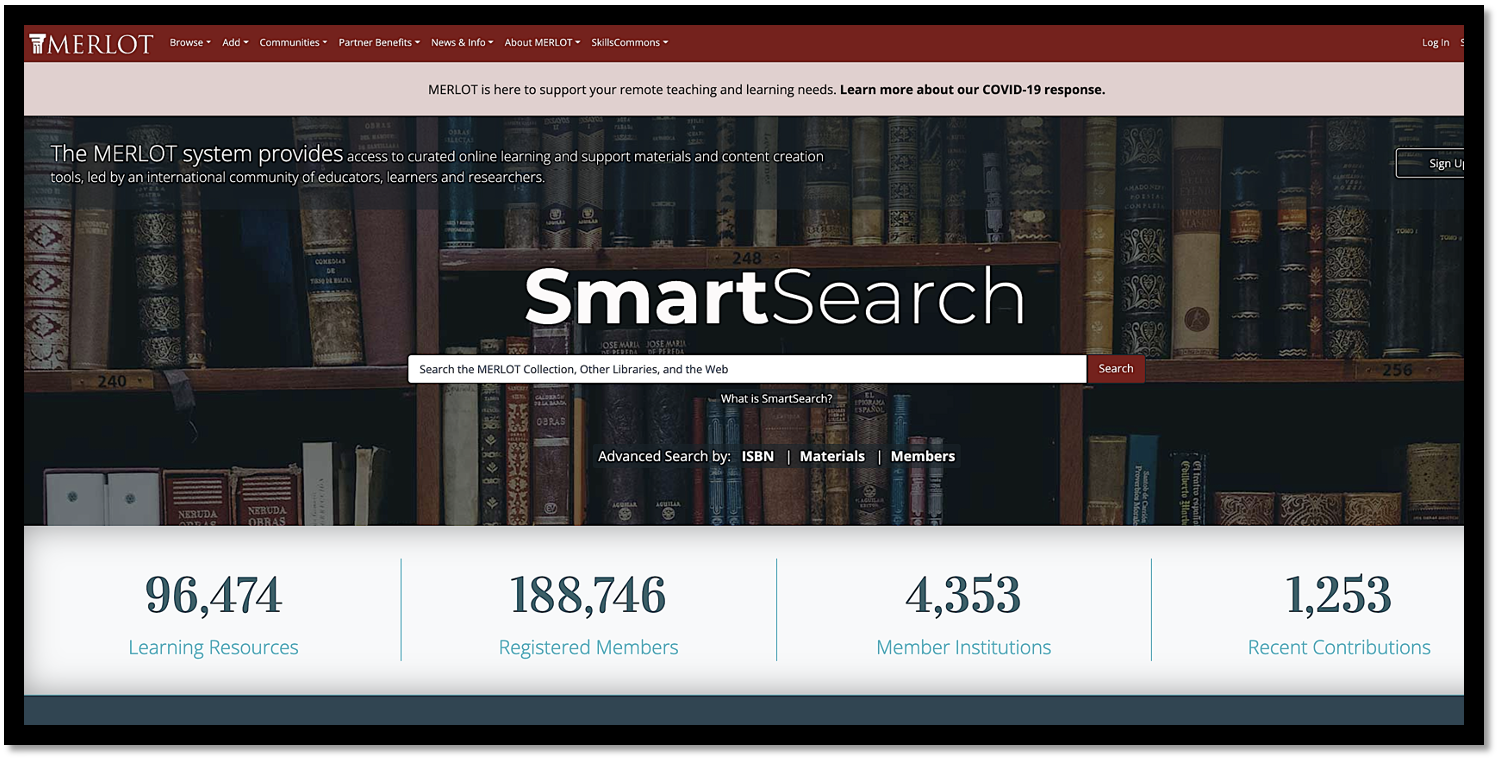
Figure 3: MERLOT OER repository - Source: https://www.merlot.org/merlot/