3.2 Language OER Repositories
“Searching for OERs” by OPENLang Network licenced under CC BY 4.0.
There are many OER repositories in relation to language education but also repositories that include a rich variety of OERs in several subjects including “language”. A list of useful language OERs repositories that could be used in language learning is presented in Table 1.
| OER Repositories | Description |
|---|---|
|
Center for Open Educational Resources & Language Learning (COERLL) |
COERLL’s main objective is to enhance teaching and learning of foreign languages by creating resources (materials and best practices) that yield financial gains and can be used in a variety of settings. COERLL's work spans through the areas of applied linguistics research, teaching materials, language assessment teacher development, less commonly taught languages, K-12 initiatives. |
| This is the Language Resource Centers’ (LRCs): A language US national network of resources to promote and improve the teaching and learning of foreign languages. Language teachers can use filters (language, author, skills, levels, audience) to find curriculum materials and professional development opportunities. | |
|
The LanguageBox is a repository where students and teachers of languages can publish and share their learning materials, resources and links on the web. You can use the resources directly, or create new activities to put your own twist on things. The LanguageBox was initially funded by JISC and designed, built and run by the Faroes project team (2008-2010) at the University of Southampton and the University of Portsmouth. It is currently managed by the LLAS Centre for Languages, Linguistics and Area Studies, at the University of Southampton. The Language Box is a new way of storing, managing and publishing Language teaching resources on the web. Users can share handouts, exercises, podcasts, videos and more. |
|
| The CEELBAS Language Repository is curated by UCL, an internationally renowned repository to support language training for social sciences and humanities research in Central and Eastern Europe and Russia. | |
|
In the OER Commons digital library anyone can search, browse, and evaluate thousands of resources: full university courses, adaptations of existing OERs, textbooks, K-12 Lesson plans, worksheets, activities, audio, video and more. The material is catalogued and organised and there are also offered collections on specific topics as well as OER Commons Groups/Hubs. Over 1,768 OERs concern language learning and 3,500 are created especially for English language learning/teaching. |
|
| IRIS database by University of York, UK targets second languages, foreign language learning, multilingualism, language education, language use and processing and has a repository of instruments, materials, stimuli, and data coding and analysis tools used for research. The library is freely accessible, it allows the download of existing resources, and uploading of contributions. You can log in via your Google account. You don't have to login to use IRIS, but without logging in you won't be able to edit your submissions at a later date. | |
| MERLOT repository includes more than 3000 language learning materials. All the collections are of peer reviewed online learning materials, catalogued by registered members and a set of faculty development support services. All Merlot resources are Creative Commons licensed and include exercises, associated comments that can improve the teaching experience. | |
| OpenLearn is a free learning platform facilitated by The Open University, and with a focus on Higher Education learning. The aim is to support students in their academic, career and personal growth, with openly available content for teaching and learning, including an OER selection for Languages. | |
| GALILEO Open Learning Materials brings together open educational resources throughout the University System of Georgia, including open textbooks and ancillary materials. Most works hosted in GALILEO Open Learning Materials have a Creative Commons license, allowing the reuse, redistribution, remix, and revision of these materials. | |
| Openly Available Sources Integrated Search (OASIS) is a search tool that aims to make the discovery of open content easier. OASIS currently searches open content from 114 different sources and contains 440,250 records. OASIS is being developed at SUNY Geneseo's Milne Library. | |
| LibreTexts libraries are supported by the Department of Education Open Textbook Pilot Project. LIbre Texts Project is the result of DOE $5 million Open Textbooks Project award in 2018, with a team of faculty from a variety of institutions led by University of California-Davis. | |
| The Open Textbook Library is a comprehensive referatory that points to open textbooks by a variety of authors and publishers with a big variety in language books. Authors and publishers give you permission to use an open textbook by giving it an open license. Open Textbook Library reviews are submitted by faculty working at institutions and consortia that are members of the Open Education Network (OEN). There is the possibility to author your own open textbook if your institution is a member of the OEN. | |
| The TED-ED section “Playing With Language” is dedicated to language learning. The platform gives the option to browse through video animations, talks and video-based lessons to kindle students' curiosity. It also offers the possibility to create your TED-Ed lesson. It is easy: you can find a video, add questions, discussion prompts, and additional resources and then you can share your lesson with your students and track their progress. | |
| Offers online language courses for free, allowing the participants to obtain a valid certification they can purchase. | |
| Brings together high-quality open educational resources from leading colleges and universities. Includes open access textbooks, course materials, lesson plans, multimedia, and more. |
Table 1. A collection of Language OER Repositories and other OER Repositories that offer language OERs.
It is worth mentioning that there are also “Media Repositories” that offer openly licensed images, audio, video, and text that language teachers can use as authentic resources to use in their teaching practice. You can explore the proposed useful repositories in Table 2.
|
Description |
Content |
Website |
|
Digital resources of Europe’s museums, libraries, archives and audio-visual collections including paintings, drawings, maps, photos and pictures of museum objects. Not all the works are openly licensed so be sure to check for usage rights. |
Images |
|
|
Online photo album with over 80 million CC licensed images. CC licensed material can be accessed via the main site or through a dedicated portal. |
Images, video |
|
|
A moderated photo community with over 3000 CC licensed photos in various categories. |
Images |
|
|
Australian themed images hosted by the National Library of Australia. Some images are CC licensed. |
Images |
|
|
Free of copyrights under CC0. |
Images |
|
|
Over 2.4 million+ high quality stock images, videos and music. |
Images, videos and music |
|
|
CC sound remix tool and archive. All the music on ccMixter can be remixed. |
Music |
Table 2. Media Repositories.
Remember that there are several OER repositories where any educator can search for open media resources (i.e., images, video, audio) across many repositories.
Example 1: “Open Washington - Open Educational Resource Network” (fig.1) is s an open educational resources (OER) network dedicated to providing easy pathways for faculty to learn, find, use and apply OER in any instructional setting. This OER network is developed for the Washington State Community and Technical College (WA CTC) faculty.
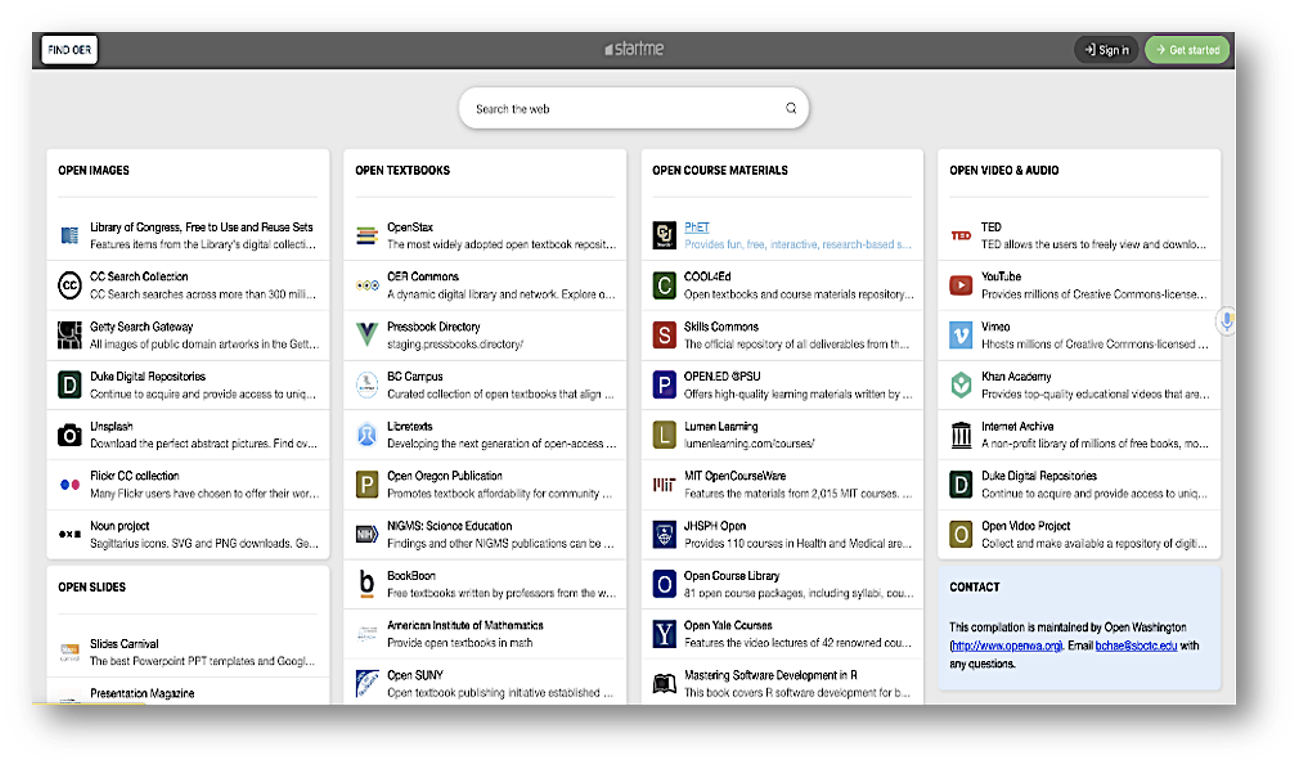
Figure 1. Searching in Open Washington - Open Educational Resource Network Source: https://www.openwa.org/discover
Example 2: “Wikimedia Commons”: is a media file repository making available public domain and freely licensed educational media content (images, sound and video clips) to everyone, in their own language. The repository is created and maintained by volunteers: https://commons.wikimedia.org/wiki/Main_Page
Learning Activity 2
Finding videos and images that are licensed to reuse in your language classroom isn't always easy. Watch the following video which will help you explore easier ways to search for openly licensed videos and images in specific repositories. Next, visit vimeo.com/creativecommons and find a video for your language course using the right keywords and choosing the “Attribution License” option. This is the most accommodating of licenses offered as you only need to attribute the creator of the OER.
Additional Resources
Watch this tutorial on how to use the OER Commons: Advanced Search service: