5.3 Sharing your OER for language learning
"Share Language OER" by OPENLang Network is licensed under CC BY 4.0
Where can I share language OERs?
According to Butcher (2015), someone could share OERs in the following places (Figure 5):
- Institutional repositories: Many organisations (namely universities) create their own collections and make them available online as OER or Opencourseware (OCW).
- Open repositories: While encouraging contributions from multiple locations, OER creators are asked to register in the database, as well as to provide information that will allow the resource to be cataloged and tagged, so that it can be found more easily. A review team will assess the material’s quality prior to adding it to the collection (e.g., MERLOT and OPENLang Network repositories).
- Building online: Some websites allow OER development in their platforms, providing also automated aids for Creative Commons licensing and adding the resource to the database. Connexions 2, for instance, fosters the cooperation between teams on their site. WikiEducator 1 also encourages educators to create teaching materials collaboratively online.
- Social networks: There are many Creative Commons platforms. For example, Flickr enables users to publish photographic materials with Creative Commons licenses, whereas YouTube does the same, for digital videos. Sharing your OER via Twitter and Facebook will instantly expand the reach and visibility of your materials to potential users.
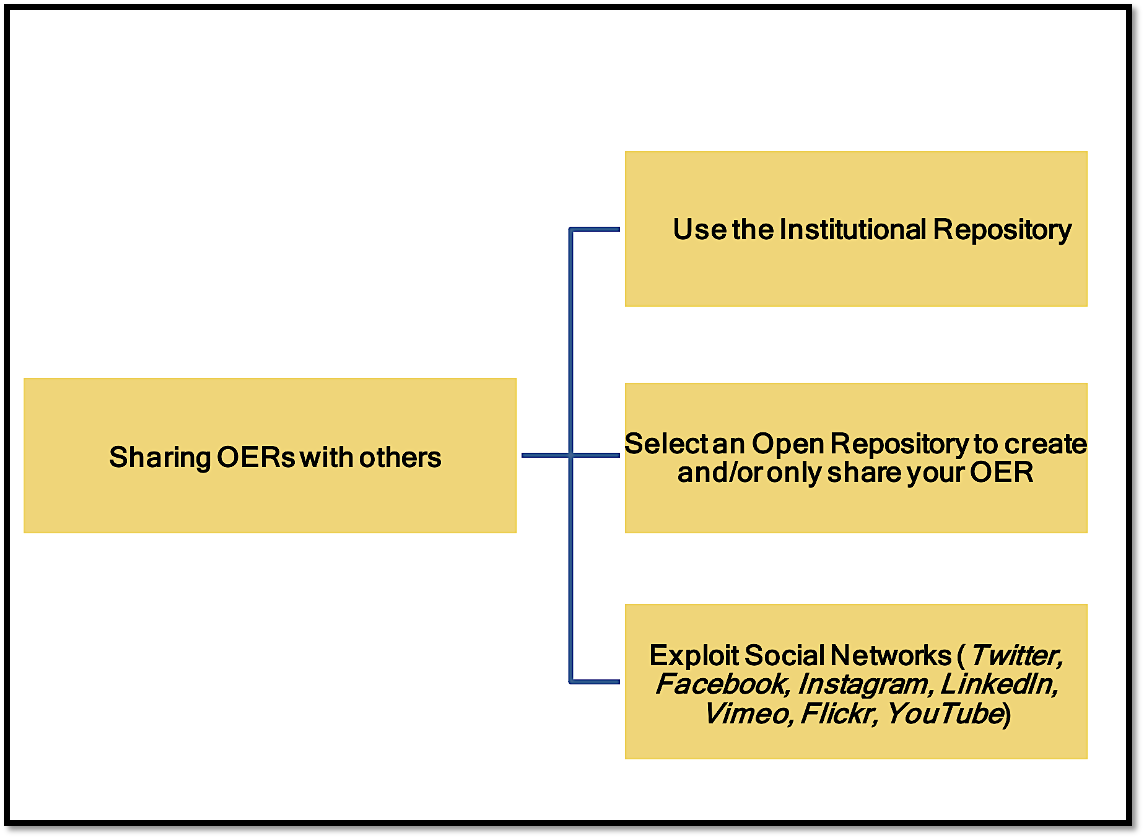
Figure 5. How to share OERs with others. Representation inspired by Butcher (2015).
Learning Activity 4
You are invited to upload your own language OER on the SlideShare cloud platform. It allows you to upload Powerpoint presentations, which you can then embed in any blog, web page, or online course and you can choose a Creative Commons license.
The basic five (5) steps that a language teacher should follow if he/she wants to remix language OERs with his/her own resources, and then share them, are:
- Use Creative Commons to find openly licensed content to remix with your materials.
- Choose the right License that allows derivatives.
- Assign a license to your new language OER.
- Share your language OER on the right platform and disseminate it to your language teachers’ professional communities.
- Don’t forget to demonstrate best practices in the attribution of authorship, for both the authors of the OER and for your own creations respecting the CC licenses.
Additional Resources
Find out more about the rationale and outcomes of OER remix in this article: ‘An OER online course remixing experience’ (Mallison, B.J & Krull, G. E.) OpenPraxis, 2015, 7 (3).
Figure 6. ‘Remixing is tasty’ by Gideon Burton, CC BY SA 2.0
Explore this interesting module on how to create and share language OERs of the OER guide created by the OpenLearn by the Open University of the UK.
Check also the Rebus Guide to Publishing Open Textbooks (So Far) by Apurva Ashok and Zoe Wake Hyde. This is a living repository of collective knowledge, written to equip all those who want to publish open textbooks with the resources they need. This Guide is a book-in-progress and will evolve and grow over time. Join the project discussion and help shape its development! The Rebus Guide to Publishing Open Textbooks (So Far) is licensed under a Creative Commons Attribution 4.0 International License, except where otherwise noted.
A very interesting book to explorer is the Authoring Open Textbooks by Melissa Falldin and Karen Lauritsen. This guide is for faculty authors, librarians, project managers and others who are involved in the production of open textbooks in higher education and K-12. Content includes a checklist for getting started, publishing program case studies, textbook organisation and elements, writing resources and an overview of useful tools. Authoring Open Textbooks is licensed under a Creative Commons Attribution 4.0 International License, except where otherwise noted.
References
Butcher, N. (2015). A basic guide to open educational resources (OER). Commonwealth of Learning, Vancouver and UNESCO. Retrieved from http://oasis.col.org/handle/11599/36
Learning Activity 5
3rd Week Discussion Forum Activity - Creating and sharing a Language OER: One more study week has been completed! You are advised to post in the Discussion Forum and interact with members of our OER learning community!
This task has two parts: In the first part you are kindly invited to start a discussion on the tools or platforms that you use or would like to use in order to create and share your language OER.
In the second part, you are invited to suggest and share a language OER that you have created or you have discovered on the internet.
Don’t forget to give feedback to the other members of our community!