2.2b – Calculating energy in the gravitational store
View
The energy in the gravitational store can be calculated using the equation
The SI unit of energy is the joule (abbreviated as ). The SI units for the other variables are mass in , gravitational field strength in ,
and height in .
Example gravitational store question
A patient in a wheelchair with a mass of goes up in a lift by . What is the increase in the gravitational store of the patient/wheelchair?
This is using a gravitational field strength on Earth of .
Now, if you were paying careful attention, you will have noticed that this is exactly the same amount of work done by the lift on lifting the person up in the previous question (link). This is not a coincidence – in fact, these two examples are
intrinsically linked.
The equation for a gravitational store can be worked out by calculating the amount of work done in lifting an object up.
The distance moved against gravity is the height gained. The force due to gravity is the weight, which is given by the equation:
So, we have:
If an object is dropping, the work is done by the gravitational field on the object moving.
If an object is being lifted up, then the work is being done
against the gravitational field by whatever is lifting the object.
Extra info – changing gravitational field strengths
An example that is sometimes asked is how the gravitational store of energy changes on different planets. Lifting a large mass on the Moon is significantly easier than on Earth (once you’ve overcome the problems in getting there and the lack
of oxygen and pressure).
Actually, even on Earth the gravitational field strength can change slightly as you increase in altitude, but the changes are so small that it is generally ignored. In fact, if you climb to the top of Everest, the gravitational field strength is still
99.6% of that at sea level.

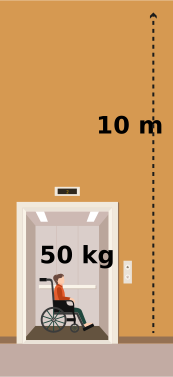 A patient in a wheelchair with a mass of goes up in a lift by . What is the increase in the gravitational store of the patient/wheelchair?