
3 – Introduction: heating up
 Allow about 10 mins
This section can be studied at home or school. In total it should take up to 1 hour.
Course requirements
As part of the blended course, this topic is designed to be studied after first doing the face-to-face session Ener2 – Thermal energy and temperature.
If you missed this face-to-face session, you could catch up on some of the missed ideas by watching the following videos from the IOP domains series:
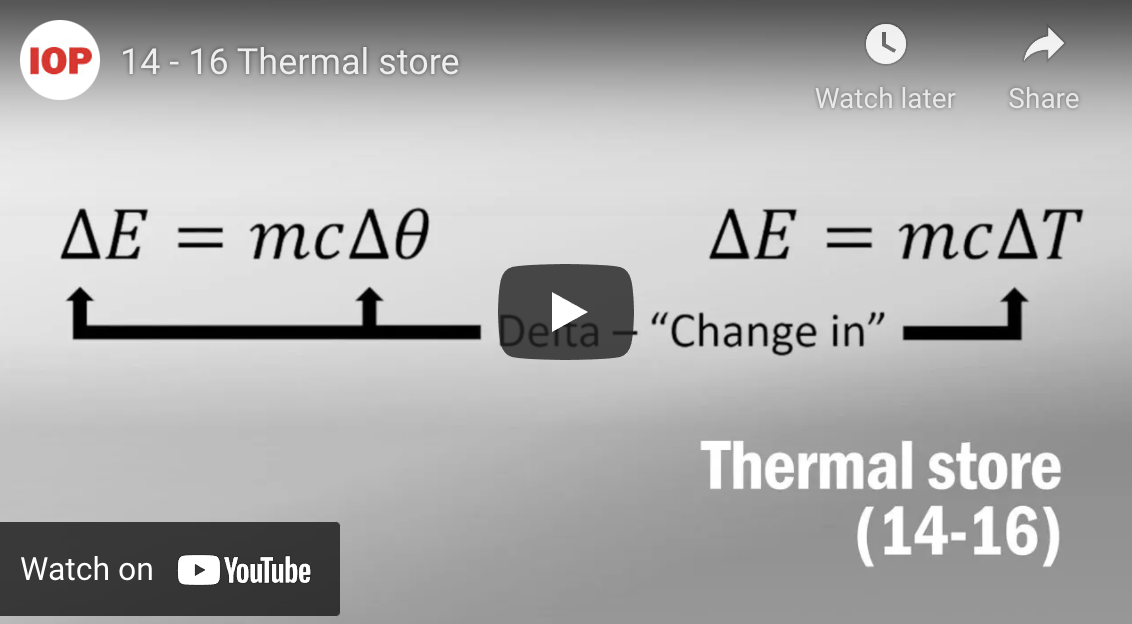
Thermal store - part of the IOP Domains CPD programme
Overview
For many people (i.e., students and teachers) the words ‘heat’ and ‘temperature’ are sometimes synonymous. Unfortunately, they encapsulate two different, albeit related, ideas. Temperature is usually more well defined in people’s mind – it is something that is measured in degrees Celsius, and something that is at a higher temperature is more likely to burn you. On the other hand, heat can mean many different things
- ‘Heat it up on the stove,’ can be used for the process of putting a pan on a hot stove.
- ‘Rubbing them together heats them up,’ can mean the temperature changing in your hands,
- ‘When switched off, the fridge loses heat,’ describes the energy stored thermally decreasing of the fridge transferring to the air around it.
- ‘Close the door! Don’t let the heat out,’ confuses the warm air in your house with the energy store that the air has.
In your home life*, you’ll probably be happy to use all the above phrases. But as good physicists we do not like that ambiguity. Because we do not want to confuse our students, when we are talking about a quantity of energy, we will call it the thermal store of energy. We will try to reserve the word heat for the process where thermal energy is transferred by heating.
 One of the most important aspects is to describe the relationship between the thermal store of energy and the temperature of an object. Rather than do this by defining the terms, in the face-to-face session you should have discussed some Gedankenexperiments
(thought experiments) that try to pluck apart these two concepts – to focus on the differences between them. A simple example, is to answer the questions:
One of the most important aspects is to describe the relationship between the thermal store of energy and the temperature of an object. Rather than do this by defining the terms, in the face-to-face session you should have discussed some Gedankenexperiments
(thought experiments) that try to pluck apart these two concepts – to focus on the differences between them. A simple example, is to answer the questions:
“Which takes more energy to heat** up: a bathful of water, or a cup of freshly made tea?”
The bath, because of its size, requires a lot more energy to heat** it up. It will therefore cost more, will take more time, and will have a bigger environmental impact – all real-world considerations that students should be easily able to relate to.
“Which would you rather stick your finger in: a bathful of water, or a cup of freshly made tea?
The cup of tea is made with water at ; a comfortable bath is only just above your body temperature, . Although it will have cooled rapidly as it heats** up the mug, it is still not a good idea to put your finger in it!
Much of work with students, and the experiments we do, are described by a heating curve (or a cooling curve) – looking at how increasing the thermal store of energy corresponds to either an increase in the temperature, or to a change between states. We will explore heating curves in a range of different ways:
- how the arrangement of the particles changes during the different phases;
- which part of the graphs can be used to calculate specific heat capacity and specific latent heat;
- which experiments a class can do to explore the different parts of a heating/cooling curve.
We will also look at some data taken from the classical required practical of specific heat capacity. We will use that data as an example to discuss why we use graphs.
* Science teachers are allowed to have home lives! At home you can use the word ‘heat’ to mean anything you want, and only other science teachers will judge you. If you would like to know a less ambiguous way of saying these sentences, here are some suggestions. More information about the language is contained in 2.5 – Thermal store language.
- ‘Heat** it up on the stove.’
- ‘Rubbing your hands together increases their temperature.’
- ‘When switched off, the fridge’s thermal store of energy decreases.’
- ‘Close the door! Don’t let the hot air out’.
** In all these examples we are using the word heat as a verb, describing a process.
Progression
Key terminology
Heat (verb): the process by which an object is warmed.
Heat (noun): deprecated, see thermal store of energy.
You can increase an object’s thermal store of energy by heating it.
Temperature is a measure of hotness or coldness. Usually expressed in degrees Celsius or kelvin. When two objects at different temperatures are placed next to one another, the hotter object will try to heat up a cooler object – until an equilibrium is reached.
Absolute temperature is measured on a scale that starts at absolute zero, such as the Kelvin scale.
We use the term particles as a catch all term that includes atoms, ions and molecules.
At KS3 and KS4 we consider there are three different phases or states of matter (solid, liquid and gas). There are other interesting states that are considered elsewhere, such as plasma (which is an ionised gas that can conduct https://www.britannica.com/science/plasma-state-of-matter) and Bose-Einstein condensates (predicted in 1942 and only created for the first time in 1995, see more here).
- In a solid the particles are in fixed locations, but they vibrate. They are tightly packed together.
- In a liquid the particles are free to move, but are still touching each other. A liquid is less ordered than a similar solid. They will fill a container from the bottom up.
- In a gas the particles are free to move around, and are much more spread out. They move quickly, and randomly collide with each other and the container walls.
A phase change or state change occurs when a substance changes from one state to another.
- Melting is a state change from solid to liquid.
- Boiling is the state change from liquid to gas.
- Condensing is the state change from gas to liquid.
- Solidfying is the state change from liquid to solid (called freezing when the substance is water).
- Sublimation is the state change from a solid directly to a gas without passing through the liquid state. Solid carbon dioxide is an example substance that at standard temperatures and pressures will sublime, rather than melt (it is used in some types of fog machines).
- Evaporation is also a state change from liquid to gas, but rather than being caused by heating, it is caused by the particles having random speeds spread over a distribution. There will be a small number of particles at any one point that are near the surface and are also moving fast enough that they can escape. Evaporation is therefore a slow process. As it takes away the fastest particles, evaporation will cool a liquid. Increasing a liquid’s temperature will increase the rate of evaporation.
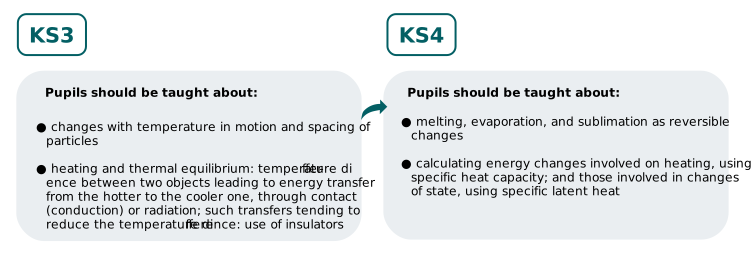
These state changes are all reversible physical changes, where the original form of matter can be restored.
The internal energy, kinetic energy and potential energy of gases are considered in more detail in 3.1E – Internal Energy.
The specific heat capacity of an object is the amount of energy that is needed to increase one unit of mass by one degree of temperature. In GCSE physics we normally measure specific heat capacity in .
The specific latent heat of vapourisation is the amount of energy that is needed to turn one unit of mass from liquid to gas. In GCSE physics we normally measure specific latent in .
The specific latent heat of fusion is the amount of energy that is needed to turn one unit of mass from solid to liquid. In GCSE physics we normally measure specific latent in .
Activities
| Task title | Approximate study time (mins) | Outcomes |
|
10 |
Understanding of this topic's content and place in the curriculum. |
|
|
15 |
What do the different parts of a cooling/heating curve represent in terms of particle movement; melting, sublimation and evaporation; specific heat capacity and latent heat? |
|
|
15 |
How can we use part of a heating curve to find the Specific Heat Capacity for a substance from experimental data |
|
|
20 |
A look at some conceptual questions to do with heating and cooling objects. |
|
|
10 |
Consider the implications of the different language choices you make to describe thermal stores and temperature. |
|
|
10 |
Test your understanding of heating/cooling. |