
1.1 Introduction
Study time: Approx. 1.5 hours

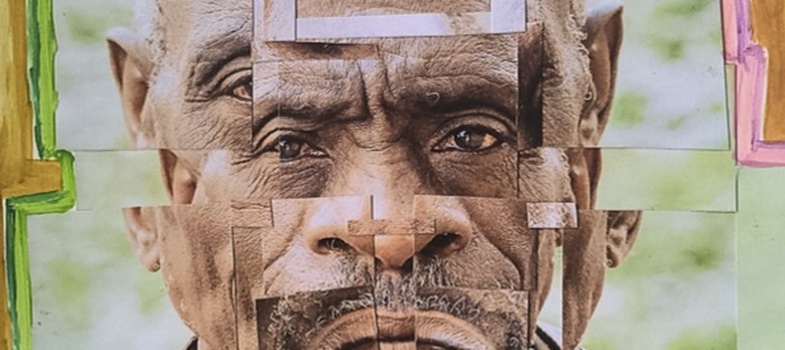
Image: This collage artifact was created through the DEPA Fluid Borders project. The associated story is called 'They Want To Be Seen’ and is authored by a UK researcher on the DEPA project. Behind the narrative of ethics procedures, it is about listening when people's experiences challenge our assumptions about what inclusion, respect and participation should look like. EDIA comes to life in the everyday decisions researchers make when established expectations meet the realities, needs and aspirations of the people involved.
This image is just one entry in the PEERs Gallery. If you would like to begin exploring before you delve into the course, you can read the full story behind it before continuing. You will find the exhibit in the Situated Ethics room. As you do, think about how the story illustrates one of the core themes of this course: EDIA comes to life through the everyday decisions researchers make in practice.
1.1 Introduction
“By valuing all, we recognise that a diversity of ideas, opinions, knowledge and people enrich our work and enlarges our knowledge economy.” (UKRI, 2026).
Welcome to Unit 1 of the course.
The statement above, taken from UK Research and Innovation's guidance on inclusive research and innovation, reflects the growing importance of EDIA in social science research. Whether you are developing research ideas, writing funding applications, collecting data, or working with communities and partners, EDIA has the potential to influence many aspects of research practice.
This unit introduces the ideas, debates and expectations that have contributed to the growing prominence of EDIA within the research landscape and invites you to consider what they might mean for your own research.
You will explore how EDIA has become a feature across the research landscape and examine key policies, principles and frameworks that shape research practice, why they matter, and how they influence the way research is designed, conducted and evaluated. Understanding these frameworks is important because they shape contemporary research. However, EDIA can sometimes feel abstract or aspirational rather than something that informs everyday research decisions. This raises an important challenge for social science researchers: how do broad principles of equality, diversity, inclusion and accessibility translate into the choices you make throughout your own research practice?
The second part of the unit introduces you to the CERI Framework and reposition EDIA as an everyday research practice rather than a set of abstract principles or requirements. The framework provides you with a lens for recognising, examining and reflecting on EDIA across the research lifecycle, which you will revisit throughout the course as you consider different aspects of your own research practice.
How this unit contributes to the course learning objectives
In this unit, you will begin to explore why EDIA are important in contemporary social science research, why it is beneficial to think of EDIA as more than compliance, and how EDIA can influence different stages of the research lifecycle (Learning Outcomes 1 and 2). You will also be introduced to the CERI Framework, which you will use throughout the course to analyse how EDIA shapes research processes, decisions and outcomes, including questions of inclusion, exclusion and power (Learning Outcomes 3 and 4).
As you work through this unit, consider not only what EDIA means in principle, but how it shapes the decisions researchers make in practice. The following section explores why EDIA has become a central feature of the contemporary research landscape.