
Learning Through the PEERs Gallery
The PEERs Gallery (Partnering for Equitable Research) was developed through the Building Equitable African Partnerships (BEAP) project, funded by the Arts and Humanities Research Council (AHRC). It is an interactive virtual exhibition and immersive learning space that brings together stories and reflections from social scientists and research partners working across a wide range of disciplines, countries and research contexts.
The gallery contains more than 100 stories drawn from over 25 research projects spanning 20 countries. Together, these stories provide insight into the realities of conducting research in different settings, highlighting the decisions, dilemmas, challenges and opportunities that researchers encounter when seeking to embed equity, diversity, inclusion and accessibility (EDIA) in practice.
Information about the individual projects represented in the gallery can be found in the course acknowledgements and within the gallery itself. The central corridor introduces the gallery, explains how it was developed and provides further information about the contributing projects and partners.
Why the PEERs Gallery matters in this course
The PEERs Gallery is more than an accompanying resource; it is the primary learning resource for this course. Rather than learning about EDIA through abstract principles alone, you will engage with the experiences of people involved in research, told in their own words, as they navigate real-world challenges, decisions and dilemmas. These stories provide a starting point for examining how similar issues arise within your own research context.
The gallery brings together perspectives from researchers and academics at different career stages, research collaborators and partners, research participants, and members of research support staff. Together, they offer insight into the many ways that EDIA can shape research relationships, processes and outcomes.
Throughout the course, you will return to these stories to explore how EDIA operates in practice. Rather than offering simple solutions, they illustrate the complexities, trade-offs and judgements involved in conducting research and working with others in fair and meaningful ways.
Each story follows a common structure:
- Project context – the research challenge and the inequality or barrier being addressed.
- Action – the steps taken to respond to that challenge.
- Resolution – the outcomes that emerged and whether fairer or more inclusive approaches were achieved.
- Reflection – the lessons, questions or insights contributors invite you to consider in relation to your own work.
The structure of the Gallery
The PEERs Gallery examines equity and inclusion through the lens of research partnerships. It explores how relationships, institutional systems and everyday research practices can influence whose voices are heard, who participates, whose knowledge is valued and who ultimately benefits from research.
Although partnership equity provides the organising framework for the gallery, the exhibits also serve as real-world examples of many of the concepts explored throughout this course. Through stories drawn from lived research experiences, they illustrate how issues of power, participation, inclusion, knowledge, relationships and benefit are encountered and navigated in practice.
PEERs is not intended to tell you how to do inclusion 'correctly'. Instead, it offers a rich collection of experiences and case studies that encourage reflection on the realities of research practice. Throughout the course, the gallery stories provide opportunities to explore course concepts through the experiences of others and consider how they relate to your own work.
How the gallery is organised
The gallery is designed as a virtual exhibition space. Each time you enter, you will begin in the central corridor, which provides background information about the gallery, its contributors and the projects featured within it. You can also find details of the contributing projects in the course acknowledgements.
Connected to the central corridor are eight themed rooms, each exploring a different aspect of equitable research practice. Six rooms focus on themes relating to research partnerships and institutional systems:
Image: Six coloured tiles represent the six partnership and institutional dimensions of equity identified through the Building Equitable African Partnerships (BEAP) project. Each tile leads to its own room of exhibits within the Gallery, where you will find an introduction to the dimension, examples of how it can influence research partnerships, and stories from researchers and partners that bring these ideas to life through real-world experiences.
Two additional rooms focus on community and participant engagement:
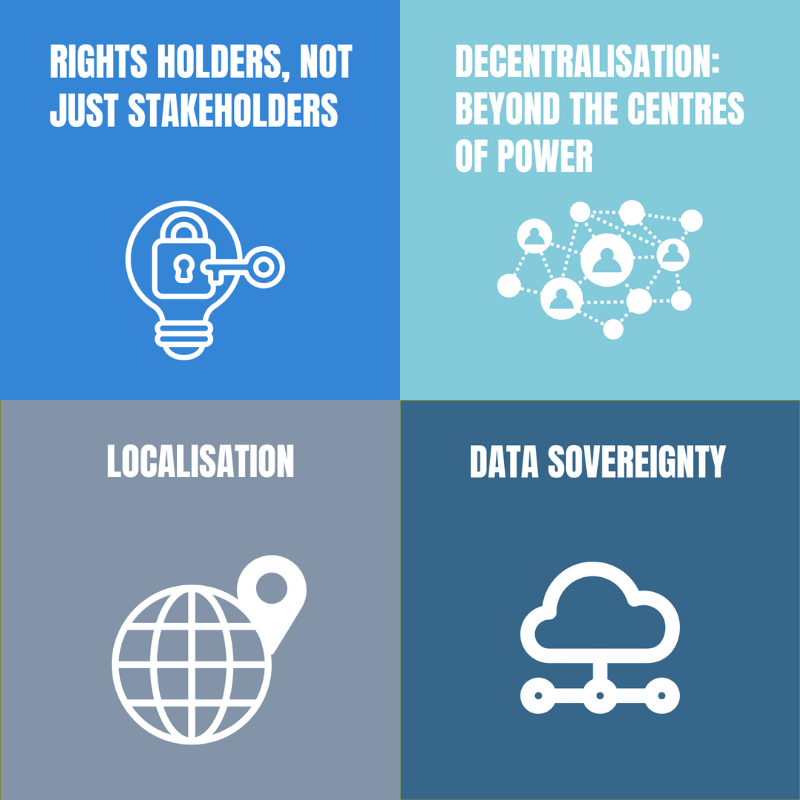
Image: Four coloured times representing the four aspects of equitable research with communities and participants. They are paired across two rooms - Localisation and Rights Holders, Not Stakeholders, and Data Sovereignty with Decentralisation: Beyond the Centres of Power. You will, similarly, find explanations of each in the rooms.
Together, these themes provide different entry points for exploring equity, diversity, inclusion and accessibility in research. As you move through the course, you will visit different rooms and exhibits to examine how these themes emerge in real research projects and contexts.
Next: Navigating the Gallery