

1.4.1 Percentages and parts per million (ppm)
This section explains percentages and percentage change, as well as parts per million (ppm).
Percentages and percentage change
Percentages (%) indicate proportions and show the number of parts out of 100. For example, 30% is 30 out of 100 and 65.2% is 65.2 out of 100.
To find out the percentage of something, first convert the figures into a fraction and then multiply by 100%. For example, if 42 people in a group of 70 vote for a political party, the percentage voting for that party is 42 divided by 70 multiplied by 100%, or
If you already have a fraction and want to change it to a percentage, you multiply by 100%. So three-quarters expressed as a percentage is
Similarly, to change a decimal to a percentage, you multiply by 100%. For example, the decimal number 0.25 expressed as a percentage is 0.25 × 100% = 25%.
To change a percentage to a fraction, or to a decimal, the percentage is divided by 100. So for example, 30% expressed as a fraction is 30100, or 0.30 as a decimal; and 65.2% is 65.2100 or 0.652.
In order to find a percentage of a quantity, first convert the percentage to a fraction, or decimal number, and then multiply this by the quantity. For example, to find 20% of 350 people the calculation is:
Percentage changes
Repeated measurement of a quantity makes it possible to assess change over time. Change between two given dates is often expressed as percentage change in which the change in the measurement between the later and earlier dates is expressed as a percentage of the earlier measurement. This can be written as follows:
You may also come across percentage changes described as percentage increases or decreases.
Calculation of percentage change is best done in stages. For example, if you wish to calculate the percentage increase of atmospheric CO2 levels from 1995 to 2023, which were 360 parts per million (ppm) in 1995 rising to 420 ppm in 2023, then:
- The change is (420 – 360) ppm = 60 ppm.
- As a fraction of the earlier (or original) value, this is 60 ppm360 ppm = 0.1666.
- As a percentage change, this becomes 0.1666 × 100% = 17% (rounded appropriately – you will learn more about rounding later). This is a positive value, so it indicates a percentage increase.
Note that to calculate a percentage change, you always divide by the original (earlier) value regardless of it being numerically larger or smaller than the later one. If it is larger than the later value, then this would be a percentage decrease, which is sometimes written using a minus sign before the number e.g. –11%.
You can also use percentage change the other way round. Suppose you plan to reduce carbon emissions of 350 kg by 20%. What would the new value of emissions be?
There are two ways of tackling this question. Either:
- A 20% reduction leaves 80% of 350 kg of emissions to remain.
- 80% of 350 kg is 80100 × 350 kg = 280 kg as the new reduced value.
Or
- 20% of 350 kg is 20100 × 350 = 70 kg.
- Subtract 70 from the original 350 to give the new reduced value of 280 kg.
Parts per million
Parts per million (ppm) is an alternative to percentages that can be useful for very small proportions. As the name implies, ppm represent the number of parts out of a million (1 000 000) instead of 100. For even smaller proportions, parts per billion (ppb) may be used.
Like percentages, ppm can be converted into a fraction or a decimal. For example, an atmospheric CO2 level of 400 ppm can be written as 400/1 000 000. This can also be expressed as a decimal as 0.0004.
Activity 2 Calculating percentages
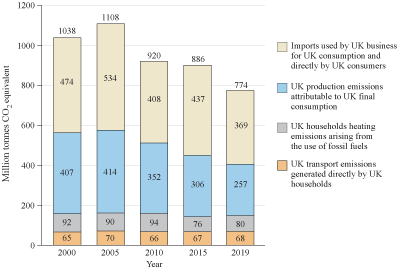
Use Figure 4 to answer the following the questions.
- a.What percentage of the total UK carbon footprint of 774 million tonnes CO2e in 2019 is represented by household heating emissions?
Answer
From Figure 4, household heating emissions were 80 million tonnes (Mt) CO2e in 2019. Therefore household heating with fossil fuels as a percentage of the UK total footprint is given by
which is 10% to the nearest whole number.
- b.What is the percentage change in the total UK carbon footprint between 2000 and 2019? Indicate the direction of change; that is, has the footprint increased or decreased?
Answer
The change in emissions between 2000 and 2019 was 774 Mt CO2e – 1038 Mt CO2e = -264 Mt CO2e Therefore, the percentage change in the UK footprint between 2000 and 2019 was
= -25.43352%
= -25% (to the nearest whole number)
The minus sign indicates that it was a decrease.
- c.If the UK managed to reduce its 2019 carbon footprint of 774 Mt CO2e by 68% by 2030, what would be the resulting footprint?
Answer
A reduction of 68% means that 32% of the 2019 footprint remains in 2035 (since 100% − 68% = 32%). The 2035 footprint can therefore be calculated as follows:
which is 248 Mt CO2e to the nearest whole number.