
Welcome
What if your research is unintentionally excluding the very people it aims to understand or benefit?
EDIA (Equality, Diversity, Inclusion and Accessibility) is increasingly recognised as an important part of high-quality research. Yet many researchers encounter EDIA through policies, funding requirements and institutional expectations, with less guidance on how it can be applied in everyday research practice.
Designed for social scientists, this course moves beyond compliance to explore how EDIA can strengthen research quality, relevance and impact. Through practical examples, activities and reflection, you will examine how EDIA influences the way research is developed, conducted, experienced and used.
Using the CERI Framework, the course explores four interconnected dimensions of research practice: Credibility and Competitiveness, Excellence, Relationships and Impact. Across these areas, you will consider how research decisions influence participation, representation, knowledge production, collaboration and the distribution of research benefits.
Drawing on the PEERs Gallery, a virtual exhibition space containing more than 100 stories and reflections from social scientists, the course highlights the challenges, dilemmas and opportunities researchers encounter when embedding EDIA in practice.
Rather than presenting EDIA as a checklist, the course explores it as an ongoing process of reflection, responsiveness and adaptation. It encourages you to recognise how everyday research decisions create opportunities to embed EDIA throughout the research lifecycle and strengthen research practice.
You can track your progress through the course by creating an OpenLearn Create account. If you review all course content, complete the pre- and post-questionnaires and successfully complete an end of course quiz, you will be awarded a digital badge and statement of participation. Each unit also includes a short formative quiz to consolidate your learning.
The Research Capability Hub (RCH)
 This course was produced as part of the Research Capability Hub (RCH), a UK-wide initiative designed to build research capability in the social sciences and to coordinate and simplify access to high-quality training and capacity building resources. This work is funded by the UKRI Economic and Social Research Council (ESRC) and led by The Open University (UK) under grant agreement UKRI2874.
About the Course
EDIA in Research Practice was created by Dr Craig Walker and Dr Saraswati Dawadi as part of the Research Capability Hub. The course is licensed on a Creative Commons Attribution 4.0 International license, unless otherwise stated. Read the Acknowledgements statement.
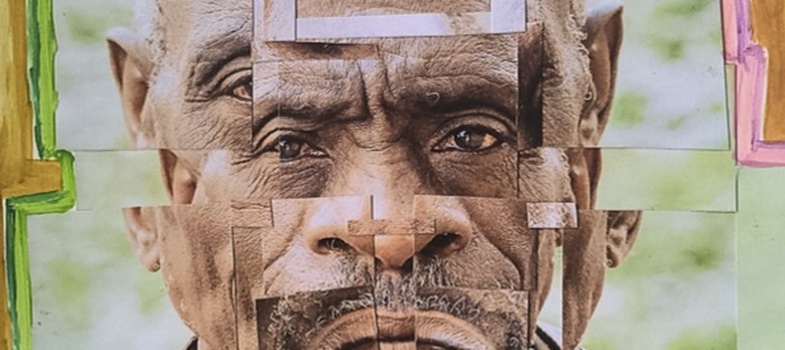
The course image is a collage created by a participant in Fluid Borders. The project brought together researchers, artists and people affected by flooding around Lake Tanganyika to explore how floods and borders shape everyday life and education for peace, using decolonial feminist and arts-based approaches. Fluid Borders was part of the Decolonising Education for Peace in Africa (DEPA) project.